

This post contains affiliate links. We may earn a commission if you click on them and make a purchase. It’s at no extra cost to you and helps us run this site. Thanks for your support!
Geometric sans serifs have dominated the design landscape for decades. Most of them share one problem: they are cold. Their precision keeps readers at arm’s length. The Equity Sans font family by Font Catalogue breaks that pattern entirely. It brings genuine warmth, circular geometry, and real structural depth to a category that usually feels clinical. Designers working across wellness, beauty, lifestyle, and editorial spaces are adopting it with good reason. It solves a problem most typefaces cannot — being modern and emotionally accessible at the same time.
What Makes the Equity Sans Font Family Different From Other Geometric Sans-Serif Typefaces?
The answer starts with the circle. Pure circular forms define every letterform in the Equity Sans font family. That foundation alone is not unusual for geometric typefaces. But what Equity Sans does next sets it apart. Most geometric sans serifs sharpen their endpoints. That sharpness creates tension — it reads as precise, but also cold. Equity Sans softens its terminals instead. Rounded endpoints extend the circular logic outward. Every character carries a sense of ease and openness. The result is neither rigid nor loose. It lands somewhere far more interesting than either extreme.
The Circle as a Design Philosophy
There is a growing school of thought in contemporary typography. Call it Soft Geometry — where designers use mathematical foundations without sacrificing human warmth. The typeface embodies this approach more completely than almost any other recent release. Its open counters and generous curves create what this article defines as Geometric Accessibility: the ability of a typeface to communicate structural confidence while remaining emotionally approachable. This is not softness for its own sake. Moreover, it is a deliberate typographic choice with real functional implications for brand communication. A typeface that balances both qualities becomes a powerful tool — not just a stylistic preference.
Rounded Terminals and the Concept of Open Rhythm
Open rhythm is another defining characteristic of the typeface. The spacing between letters breathes. It does not crowd itself. Brands working in wellness, personal care, and lifestyle benefit most from this quality. Type that crowds itself creates subtle anxiety in readers. Type that breathes creates ease and trust. The Equity Sans font family chooses ease without sacrificing legibility. Furthermore, that balance is genuinely rare in geometric typefaces. It takes careful type design to preserve structural discipline while achieving genuine openness — and Equity Sans achieves it.
Who Should Use the Equity Sans Font Family?
The Equity Sans font family is not trying to serve every use case. That clarity of purpose is one of its greatest strengths. It suits brands operating in the warm, the soft, and the human — but with structure and credibility behind them. Think beauty packaging. Think wellness apps, maternal care products, skincare, organic food brands, and contemporary editorial design. Any brand communicating care, wellbeing, or accessible quality will find the typeface a natural fit.

Beauty and Wellness Branding With Equity Sans
Beauty typography has long relied on two modes. Either the high-fashion coldness of sharp-contrast serifs, or the friendly-but-forgettable warmth of naively rounded sans-serifs. The typeface offers a genuine third path. It reads as premium without feeling exclusive. It feels caring without feeling childish. For brands communicating quality alongside accessibility — an increasingly common brief in beauty and wellness — the Equity Sans font family delivers exactly the right typographic register. It is modern, clean, and warm all at once.
Lifestyle and Editorial Design Applications
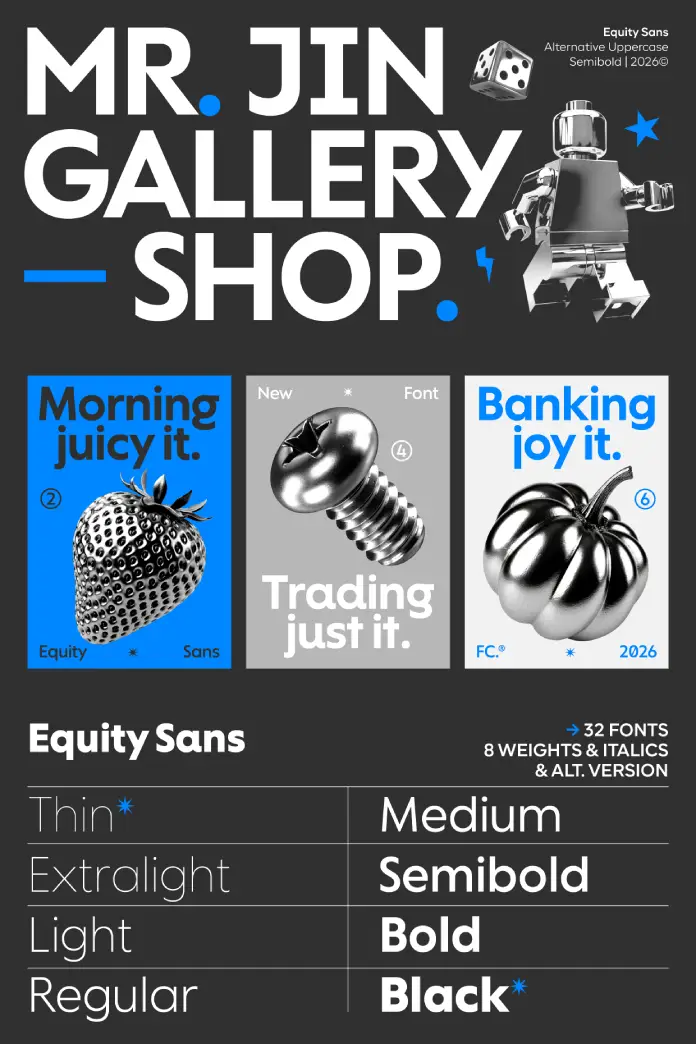
Editorial designers working in lifestyle publications face a specific challenge. They need type that functions across headlines, subheadings, body copy, and captions — and stays coherent throughout. The Equity Sans font family handles this range exceptionally well. Its eight weights create real flexibility across all those contexts. Its eight corresponding italic cuts extend that range further. Additionally, the overall character of the typeface stays consistent across the full weight range. That consistency is harder to achieve than it sounds, and it matters enormously in multi-context editorial systems.
The Equity Sans Font Family Weight Structure: A System Built for Complexity
Most typeface families offer four to six weights. The Equity Sans font family offers eight. Furthermore, it pairs each weight with a dedicated italic cut. That means sixteen cuts in total — a serious, professional type system. Brand designers building comprehensive visual identity systems will recognize what that depth provides. A logo, a landing page, an editorial spread, a packaging label — each demands a different weight and optical scale. The typeface accommodates all of them without requiring a secondary typeface.
What Sixteen Cuts Mean for Brand Identity Systems
Consistency is the real luxury in branding. When a brand stays within a single typeface family across all touchpoints, its visual language becomes more cohesive and more recognizable. The Equity Sans font family makes single-typeface brand systems genuinely viable — even for complex, multi-channel brands. Design teams spend less time managing font conflicts and more time building strong visual narratives. That is an underappreciated operational advantage that a rich type system like this one provides.
From Light to Black: The Full Equity Sans Weight Range
The lightest weights of the Equity Sans font family carry an almost editorial delicacy. They suit luxury skincare body text, minimalist app interfaces, and refined caption work. The heaviest weights, by contrast, carry real visual presence. Importantly, they do so without sacrificing the typeface’s inherent warmth. This is where the circle-based foundation does its most important structural work. Heavy geometric typefaces often lose their character at large sizes — they become simply loud. The typeface stays characterful under pressure. It gains presence without losing itself.
Equity Sans and the Rise of Warm Geometry in Brand Typography
Typography trends rarely appear from nowhere. The rise of warm, approachable geometric typefaces reflects something broader happening in design culture. After a decade of ultra-minimal, cold-corporate aesthetics — maximum whitespace, hairline serifs, brutal precision — brands are recalibrating. They want to feel human. They want to build emotional trust, not just visual credibility. The Equity Sans font family arrives at exactly the right moment for exactly that conversation.
Defining “Warm Geometry” as an Emerging Typographic Category
Warm Geometry — a term this article introduces — describes typefaces built on mathematical, circular foundations that deliberately incorporate humanist warmth into their detailing. Rounded terminals, open apertures, and generous spacing are its defining attributes. The Equity Sans font family is arguably the clearest current example of this category. Unlike purely humanist typefaces, Warm Geometry retains structural discipline. Unlike cold geometric typefaces, it prioritizes approachability. It occupies a genuinely new middle space — and that space is exactly where contemporary brand typography is moving.
The Cultural Context Behind Soft Design Aesthetics
Consumer culture is shifting toward care, authenticity, and wellness. Brand language is as follows. Typography — often the first language a brand speaks — is adapting accordingly. The growth of wellness categories, maternal care, clean beauty, and mindful consumption has created genuine demand for typefaces that communicate through warmth rather than assertion. Accordingly, designers who recognize this shift early will make better typeface decisions for the brands they build. The typeface is a direct response to that cultural moment.
How to Use the Equity Sans Font Family Effectively in Design
Understanding a typeface is one thing. Using it well is another. The Equity Sans font family rewards careful application. Every weight and cut has a natural home in a well-built design system. The following considerations help designers apply it with intention rather than instinct.
Pairing Equity Sans With Complementary Typefaces
The Equity Sans font family works best when paired with typefaces that respect its warmth. High-contrast serifs with sharp bracketing create visual tension rather than balance. Instead, consider pairing Equity Sans with low-contrast serifs or refined humanist typefaces in contexts requiring a secondary typographic voice — long-form editorial body copy, for instance. The primary Equity Sans weight does the architectural work. Any secondary typeface adds textural variety without competing with the warm geometry that defines Equity Sans.
Applying the Equity Sans Font Family to Brand Identity
For logos and primary wordmarks, the medium or semibold weight of the Equity Sans font family delivers the best combination of presence and openness. Lighter weights carry insufficient visual weight at small application sizes. Heavier weights can feel more assertive than the typeface’s natural character suggests. The sweet spot sits in the middle, where the circular geometry and rounded terminals read most clearly. For subheadings and supporting labels, the book and regular weights extend the system with ease and coherence.
Equity Sans in Digital Environments
Digital typography demands legibility at variable sizes and across device resolutions. The typeface performs well under those conditions. Its open counters and generous apertures maintain readability at small sizes. Its rounded terminals remain clear rather than blurring at lower resolutions. For app interfaces, digital packaging mockups, and landing pages, the Equity Sans font family is technically as well as aesthetically well-suited. It does not just look right — it functions correctly in the demanding digital contexts modern brands require.
The Equity Sans Font Family and the Future of Brand Typography
Typography is a brand decision. The typeface a brand chooses shapes how audiences perceive it before they read a single word. The Equity Sans font family makes a clear argument: geometric precision and human warmth are not opposites. Furthermore, it demonstrates that a typeface can carry serious structural depth — sixteen cuts, circle-based geometry, a full weight range — without sacrificing emotional accessibility. That combination is exactly where forward-thinking brand typography is heading.
A Prediction: Warm Geometry Will Define Brand Typography This Decade
Over the next ten years, Warm Geometry typefaces — those built on mathematical circular foundations but softened through rounded detailing and open rhythm — will become the dominant typographic category across wellness, beauty, lifestyle, and consumer technology sectors. The Equity Sans font family is not the last of its kind. It is an early signal of a larger shift. Designers who understand this shift now will make better, more durable typographic decisions for the brands they develop.
Equity Sans as a Reference Typeface for a New Category
Reference typefaces are those that define what a category can be. The Equity Sans font family is positioning itself as the reference typeface for Warm Geometry. Its eight weights, circular foundation, rounded terminals, and coherent character across the full range make it one of the most complete realizations of this emerging typographic approach available today. When designers discuss soft geometric sans-serif fonts in ten years, the typeface will be part of that conversation — not as a trend, but as a standard.
Frequently Asked Questions About the Equity Sans Font Family
What is the Equity Sans font family?
The Equity Sans font family is a geometric sans-serif typeface by Font Catalogue. It is built on pure circular forms, features rounded terminals, open counters, and generous letter spacing. It includes eight weights and eight italic cuts, making it a comprehensive type system for brand and editorial design.
Who makes the Equity Sans font family?
The typeface is designed and distributed by Font Catalogue.
What is the Equity Sans font family best used for?
It excels in beauty, wellness, lifestyle, and consumer brand design. It also performs strongly in editorial layouts, app interfaces, packaging design, and branding contexts that call for modern warmth and approachability.
How many weights does the family include?
The family includes eight weights and eight corresponding italic cuts, totaling sixteen typeface cuts — a comprehensive type system for complex brand applications.
Is the typeface suitable for digital use?
Yes. The open counters, rounded terminals, and generous apertures of the Equity Sans font family ensure strong legibility across digital environments, including app interfaces, websites, and digital advertising at variable sizes.
What makes the Equity Sans font family different from other geometric sans-serifs?
Most geometric sans-serif typefaces prioritize cold precision through sharp terminals. The Equity Sans font family applies circular geometry while incorporating rounded detailing and open spacing — creating what this article defines as Geometric Accessibility: structural confidence with emotional warmth.
What typefaces pair well with the Equity Sans font family?
Low-contrast serifs and humanist typefaces complement the typeface most effectively. High-contrast serifs with sharp bracketing create visual tension rather than typographic balance.
Is the Equity Sans font family a good choice for logo design?
Yes. The medium and semibold weights of the Equity Sans font family deliver the clearest combination of visual presence and openness for logo and wordmark applications, where legibility and character both matter at varied scales.
What is Warm Geometry in typography?
Warm Geometry is a term introduced in this article to describe typefaces built on mathematical, circular foundations that incorporate humanist warmth through rounded terminals, open apertures, and generous spacing. The Equity Sans font family is the clearest current example of this emerging typographic category.
What is Geometric Accessibility in type design?
Geometric Accessibility is a term introduced in this article to describe a typeface’s ability to communicate structural confidence while remaining emotionally approachable. The Equity Sans font family achieves this through its circular base forms, rounded terminals, and open rhythmic spacing.
Where can designers access the Equity Sans font family?
The complete family is available through MyFonts.
Feel free to find other trending typefaces in the Fonts section here at WE AND THE COLOR.