

Designed by Sarah Schroeder of Mindt Studio, Bárur is a display serif that refuses to be neutral. Its letterforms move. They breathe. They pull the eye forward with a rhythm that feels almost biological. Named after the Old Norse word for “waves,” Bárur embeds natural cyclical motion directly into its structure. Consequently, the result is a typeface that does what most display fonts only attempt — it makes text feel alive.
In this review, we will cover the typeface’s origins, its technical architecture, its unique design language, and the specific contexts where it performs at its absolute best. Moreover, we introduce several original frameworks for understanding what makes Bárur significant — not just as a typeface, but as a statement about where expressive typography is heading.
What Makes Bárur Different From Every Other Display Serif Right Now?
Most display typefaces choose between two paths. They either push into ornamental complexity or they strip back to pure geometry. Bárur, however, takes a third route. It merges organic movement with geometric discipline, creating what this article defines as a Kinetic Serif Typeface.
A Kinetic Serif Typeface is a display font whose serifs function not as static anchoring elements but as directional cues. They guide the reader’s eye from one letterform to the next in a continuous visual sequence. Bárur’s softly rounded serifs do exactly this. Each serif curves inward and outward with a deliberate softness, therefore creating optical momentum. The letters don’t simply sit on a baseline — they flow across it.
This distinction matters enormously in practice. Traditional serifs create stability and authority. Bárur’s serifs, by contrast, create cadence. The typeface establishes a quiet visual beat, much like the tide its name references. That cadence is what separates Bárur from the enormous category of expressive display type currently flooding the market.
From Custom Wordmark to Cohesive Type System
Bárur’s origin story adds considerable depth to its design. Sarah Schroeder developed Bárur from a custom wordmark she created in 2024 for a wellness brand called bárur therapy. That origin matters because it means every design decision in Bárur traces back to a real, applied context — not a theoretical exercise.

The original wordmark carried a specific sense of movement and continuity. Schroeder’s task was to translate those qualities into a full, cohesive type system that could serve far broader applications. Furthermore, she had to ensure that Bárur retained its original character while working across logotypes, headlines, packaging, and editorial settings simultaneously.
The result demonstrates a principle that holds true across type history: great typefaces frequently emerge from the pressure of solving a specific, high-stakes visual problem. Bárur launched as version 0.1 in October 2025, with both Regular and Light weights immediately available. Notably, a Bold weight is currently in development. Schroeder positions Bárur as an evolving type system — a deliberate decision that reflects a design philosophy built on continuous refinement rather than finite delivery.
The Design Language of Bárur — Organic Geometry in Practice
The term “organic geometry” describes a specific design tension that Bárur resolves exceptionally well. On one side, geometric structure creates legibility, consistency, and modern authority. On the other side, organic form creates warmth, movement, and emotional resonance. Most typefaces sacrifice one for the other.
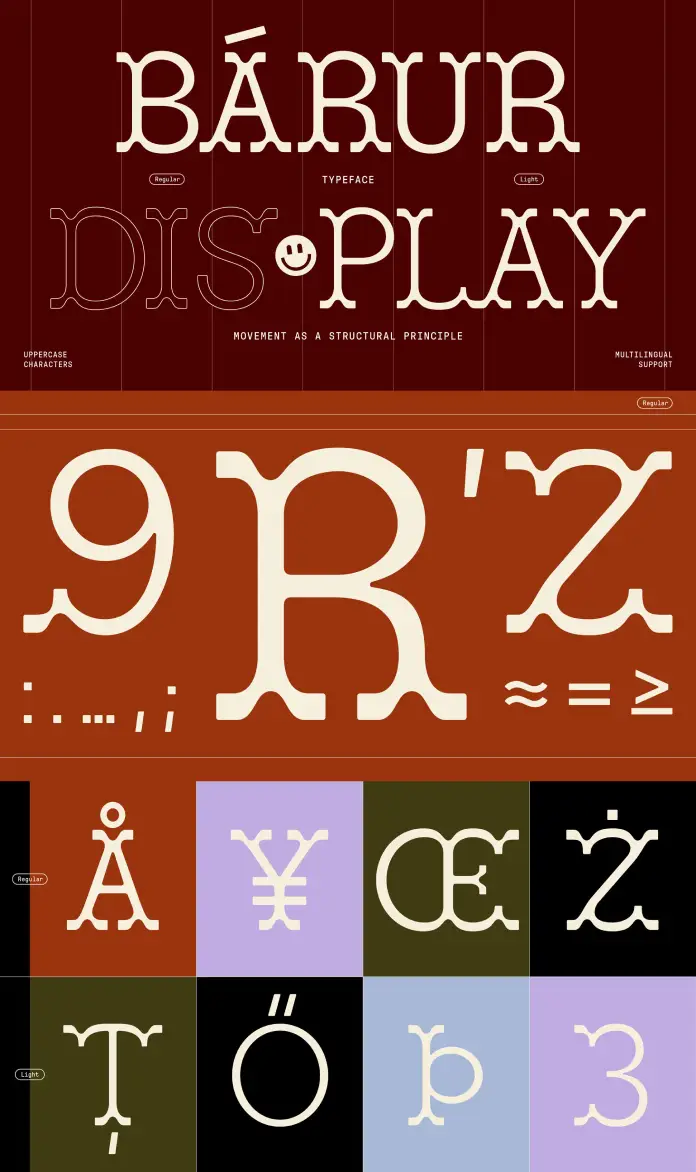
Bárur holds both simultaneously. Its uppercase letterforms demonstrate a clearly geometric skeleton — proportions that are measured and deliberate. Yet the serifs and stroke transitions soften that structure considerably. As a result, Bárur reads as both contemporary and distinctly human. That balance gives Bárur a distinctive character that its designer explicitly acknowledges as feminine: not softness for its own sake, but softness as structural intent.
This quality positions Bárur perfectly for brands and publications that want authority without cold rigidity. Think wellness brands, cultural institutions, luxury hospitality, independent publishers, and high-end product lines. These are contexts where warmth and intelligence must coexist — precisely where Bárur’s Organic Geometry performs most powerfully.
How Bárur Achieves Visual Flow Across Headlines
One of Bárur’s most technically impressive qualities is its approach to inter-letter flow. The rounded serifs on most uppercase letters create smooth optical bridges between characters. This produces what this article terms Rhythmic Continuity Architecture: a system where individual letterforms collectively construct an unbroken visual path through a word.
Rhythmic Continuity Architecture is especially valuable in headline and logotype applications. When a reader encounters a large-scale typographic composition set in Bárur, the eye moves through the word rather than merely across it. This distinction shifts reading from a mechanical process into something closer to a sensory experience. Bárur doesn’t ask the reader to decode — it invites them to follow.
Additionally, Bárur gives designers granular control over this effect. Select letters — specifically C, G, O, and S — offer serif-less alternates. These alternates function as density modifiers. By choosing whether to include or omit serifs on specific characters, designers can tighten or loosen the visual rhythm of any given word. We define this capability as Typographic Density Control, a function that goes well beyond what standard stylistic alternates typically provide.
Inside the Bárur Glyph System — What 298 Glyphs Actually Deliver
Bárur’s technical specifications reveal a typeface designed for serious professional deployment. The current version 0.1 includes 298 glyphs across both weights, covering 30 languages within the Latin alphabet. That multilingual range includes English, French, German, Spanish, Italian, Swedish, Norwegian, Icelandic, Polish, Turkish, and many more.
For a display typeface at version 0.1, that linguistic breadth is genuinely impressive. It signals that Schroeder built Bárur with international design applications firmly in mind. A Swedish packaging designer and a Turkish editorial team can both use Bárur with equal confidence. Furthermore, Bárur supports OTF, TTF, WOFF, and WOFF2 file formats, covering print, desktop, and web deployments without friction.
39 Ligatures and the Logic of Controlled Pairing
Bárur includes 39 ligatures — a significant figure for a display typeface. Ligatures combine two or more characters into a single unified glyph, eliminating awkward spacing or collisions between letterforms. In Bárur’s context, however, they serve a second, more expressive function.
Because Bárur’s design foregrounds visual continuity, its ligatures amplify the Rhythmic Continuity Architecture described earlier. A well-chosen ligature in a Bárur headline doesn’t merely resolve a technical spacing issue. Instead, it deepens the sense that the word exists as a single, fluid object rather than a sequence of discrete characters. The word begins to read as a shape as much as a linguistic unit.
Moreover, 39 ligatures give designers extensive creative latitude. They can customize word shapes, create unusual and distinctive headline arrangements, and develop brand lockups that feel genuinely proprietary. This makes Bárur particularly valuable for logotype work, where every letterform decision carries brand-level significance and visual differentiation matters enormously.
Stylistic Alternates as Typographic Density Control
The stylistic alternates for C, G, O, and S represent one of Bárur’s most thoughtful design features. Removing the serifs from these specific characters slightly reduces the typeface’s overall visual density. Conversely, retaining them fully engages that characteristic organic flow throughout a word or headline.
The choice between serif and sans-serif alternates for these letters, therefore, functions as a creative dial. Designers working on high-contrast editorial spreads may prefer the fuller serif versions for maximum rhythm and movement. Designers working on minimal packaging applications may prefer the cleaner alternatives for visual breathing room. Either way, Bárur adapts without losing its fundamental character — a mark of genuine design intelligence.
Where Bárur Performs Best — Use Cases and Applications
Bárur is a display typeface through and through. Its design optimizes explicitly for large-scale typographic applications. The letterforms carry the most power at headline size and above, where the serifs’ curvature becomes visually prominent and the rhythmic flow fully activates.
Branding and Logotype Design
Bárur’s origins in a custom wordmark make it exceptionally well-suited to branding applications. Its strong, distinctive character gives logotypes an immediately recognizable visual signature. Furthermore, its 39 ligatures and stylistic alternates allow brand designers to customize letter combinations into shapes that feel almost proprietary — as if Bárur were designed exclusively for the brand in question.
Additionally, Bárur’s coverage of 30 supported languages makes it a credible choice for international brand rollouts. A brand operating across European markets can use Bárur consistently without sacrificing typographic integrity in any language. For brand designers working across multilingual identity systems, that consistency is practically priceless.
Editorial Headlines, Packaging, and Poster Design
In editorial contexts, Bárur excels as a headline typeface for luxury, wellness, culture, and lifestyle publications. Its movement and warmth suit brands and publications that want authority without cold rigidity. An architecture magazine cover, a high-end spa brand, an art gallery poster, or a limited-edition packaging range — all represent natural homes for Bárur’s expressive character.
The lightweight extends Bárur’s editorial versatility considerably. Where the Regular weight commands presence, the Light weight carries elegance and restraint. Together, these two weights offer designers a tonal range that a single-weight display typeface simply cannot match. Bold words balanced against lighter headlines, or tight ligature compositions playing against open-spaced single characters — Bárur rewards typographic experimentation.
Exhibition and Environmental Graphics
At very large scales — wall graphics, signage, exhibition installations — Bárur’s kinetic quality becomes even more pronounced. Rhythmic Continuity Architecture activates fully at display scale, giving large-format type an organic energy that static geometric typefaces rarely achieve. For exhibition designers working in cultural, wellness, or luxury spaces, Bárur deserves serious consideration as a primary typographic identity tool.
Bárur as an Evolving Type System — What the Version Model Means for Designers
Schroeder positions Bárur explicitly as an evolving type system rather than a finished product. That framing carries significant practical implications. Early purchasers receive free updates as the family expands. The Bold weight currently in development will complete an initial three-weight family — Regular, Light, and Bold — offering Bárur users considerably expanded compositional range.
Moreover, an evolving system model aligns Bárur with contemporary practices in software and digital product design. Typefaces shipped as living systems can respond to real-world use cases and community feedback. They can grow more versatile over time without abandoning their original design principles. For designers building brand systems around Bárur today, that evolution represents a low-risk investment with compounding returns.
The version 0.1 designation also reflects intellectual honesty on Schroeder’s part. Rather than shipping Bárur as complete when it isn’t, she releases what exists, defines what is coming, and invites designers into the process. That kind of transparency builds genuine trust between type designer and design community — and it’s a practice the broader type industry would do well to adopt more widely.
What Bárur Predicts About the Future of Display Typography
Bárur’s emergence reflects a broader shift in how designers think about expressive typography. The dominant display type trend of the last decade leaned heavily toward maximalist experimentation — variable fonts pushed to extreme ranges, high-contrast letterforms, and distorted or deconstructed type systems. That experimentation produced remarkable work, but also produced significant visual fatigue.
Bárur points toward a counter-movement: what this article terms Calibrated Expressiveness. Calibrated Expressiveness describes display typefaces that achieve emotional resonance through restraint and precision rather than through spectacle and excess. These typefaces feel expressive because every design decision is intentional — not because every decision is extreme. Bárur embodies this approach completely.
This direction aligns with a broader cultural appetite for warmth, authenticity, and organic materiality across design disciplines. Brands increasingly favor textures, curves, and forms that reference natural systems and human craft. Bárur gives those brands a typographic voice that speaks the same visual language their visual identities already use. The prediction is clear: typefaces like Bárur — those that embed rhythm, movement, and Organic Geometry into rigorous display structures — will become defining typographic assets of the late 2020s. As maximalism recedes, Calibrated Expressiveness will fill the space.
Frequently Asked Questions About the Bárur Typeface
What is the Bárur typeface?
Bárur is a contemporary display serif typeface designed by Sarah Schroeder of Mindt Studio. Drawing on the Old Norse word for “waves,” Bárur translates natural cyclical movement into its letterform design. Released in October 2025, Bárur currently includes Regular and Light weights, with a Bold weight in active development.
Who designed the Bárur typeface?
Sarah Schroeder of Mindt Studio designed Bárur. She developed the typeface from a custom wordmark she originally created in 2024 for a wellness brand called bárur therapy, then expanded it into a full type system available in OTF, TTF, WOFF, and WOFF2 formats.
What are the best use cases for Bárur?
Bárur works best in display contexts: logotypes, brand identities, editorial headlines, poster design, packaging, and exhibition graphics. Its design fully optimizes for large-scale typographic applications where its rounded serifs and Rhythmic Continuity Architecture perform most powerfully. While legible at smaller sizes, Bárur’s distinctive voice truly activates at headline scale.
How many ligatures does Bárur include?
Bárur includes 39 ligatures, giving designers substantial creative flexibility in constructing headlines, logotypes, and brand typographic compositions. These ligatures extend beyond spacing correction — they actively deepen Bárur’s characteristic visual flow and allow designers to craft word shapes that feel proprietary to their brand.
What languages does Bárur support?
Bárur currently supports 30 languages within the Latin alphabet, including English, French, German, Spanish, Italian, Dutch, Danish, Norwegian, Swedish, Icelandic, Finnish, Polish, Turkish, Czech, Romanian, and others across Europe. This multilingual range makes Bárur a strong choice for international brand rollouts and multilingual editorial design systems.
What file formats does Bárur support?
Bárur is available in OTF, TTF, WOFF, and WOFF2 formats, covering print, desktop, and web applications without format limitations. All purchasers also receive free updates as the typeface continues to evolve.
Where can designers purchase the Bárur typeface?
Bárur is available directly from Mindt Studio at mindt.studio/type/barur, starting from €35. Licenses are priced by company size and intended use, with options for desktop, web, logo, and broadcast applications.
Check out other trending typefaces here at WE AND THE COLOR.