
This post contains affiliate links. We may earn a commission if you click on them and make a purchase. It’s at no extra cost to you and helps us run this site. Thanks for your support!
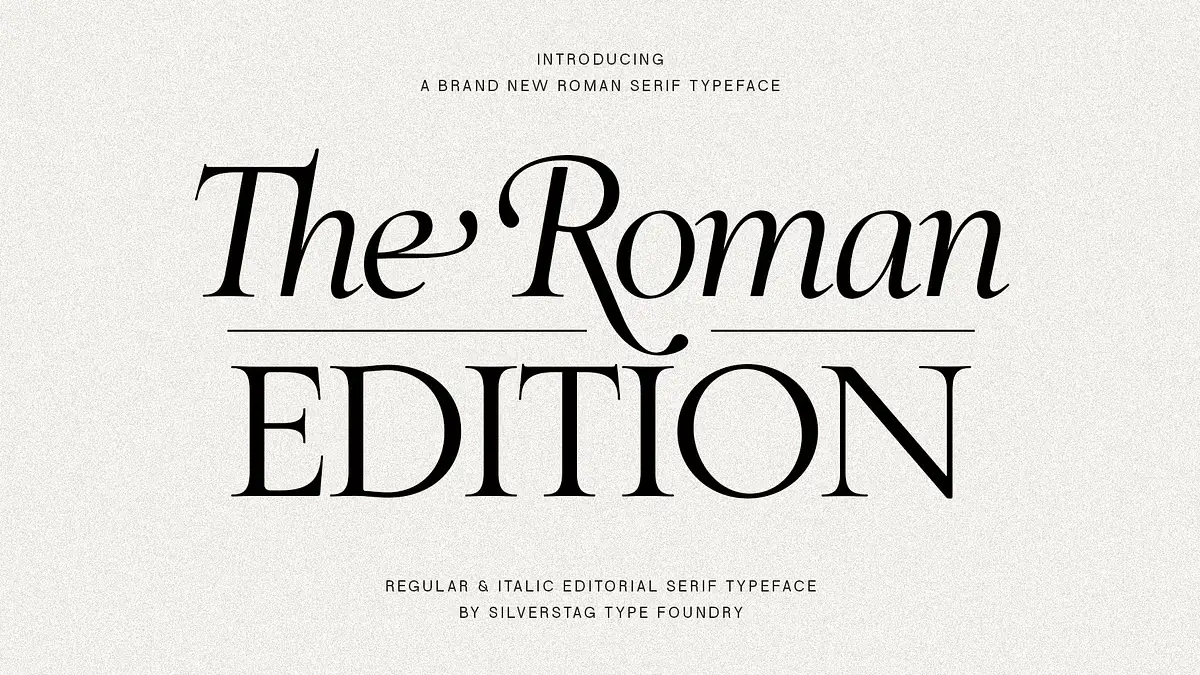
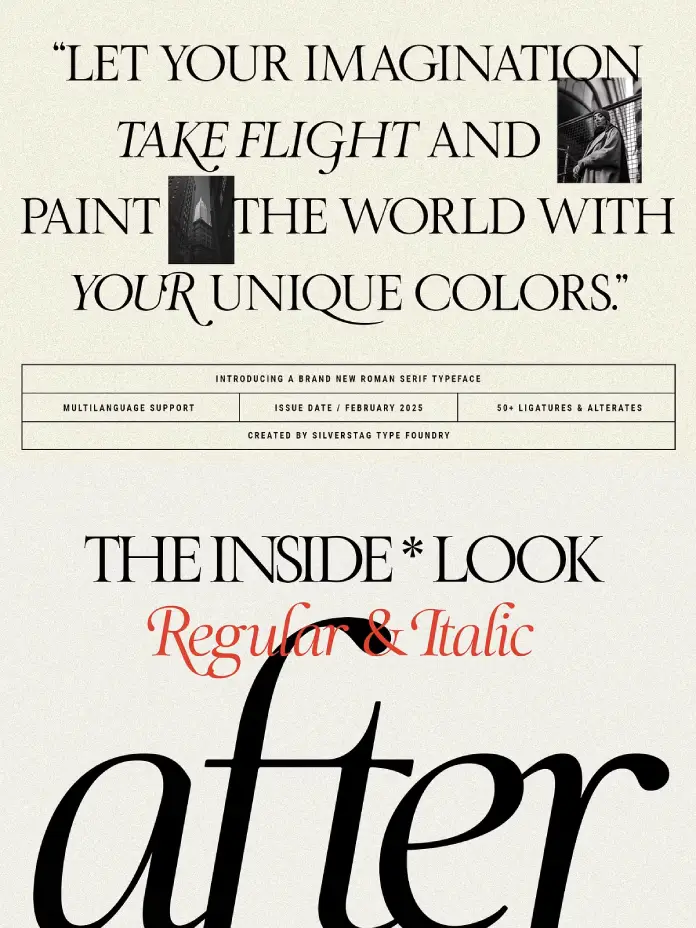
Serif fonts come and go. Most follow a predictable formula — clean proportions, safe optical spacing, and just enough historical reference to feel trustworthy. Then something like The Roman Edition typeface appears, and you realize how low that bar actually was. Designed and published by SilverStag Type Foundry (SLTF), this typeface pulls from the deep grammar of classical Roman letterforms and reinterprets them with a precision that makes most contemporaries look underdeveloped.
The timing matters. Right now, branding studios, editorial art directors, and luxury packaging designers are actively pulling away from minimalism for its own sake. There’s a renewed appetite for heritage — for typefaces that carry cultural memory. The Roman Edition answers that appetite directly. It doesn’t just look expensive. It looks earned.
You can purchase the typeface for a very low budget from:
So let’s talk about what this typeface actually does, why it works, and which projects it genuinely serves.
What Makes The Roman Edition Different From Every Other Classic Serif Typeface?
That question has a specific answer, and it starts with what type designers call optical authority — the degree to which a typeface commands the space it occupies without overstepping it. Many serif fonts claim classical roots but deliver something watered-down, a kind of typographic nostalgia with no actual depth.

The Roman Edition operates differently. Every character — from the cap serifs to the terminal strokes of the lowercase — reflects decisions that required historical literacy. The proportions reference the monumental inscriptions of ancient Rome, but the spacing and weight distribution belong firmly to the present. That combination is genuinely rare.
Furthermore, the italic companion isn’t an afterthought. It features graceful swashes, ornate flourishes, and calligraphic endings that function as a separate design artifact. Most serif families treat the italic as a slanted correction. Here, it’s a full personality shift — the kind of contrast that gives editorial layouts their rhythm.
Consequently, what you’re working with isn’t one typeface. It’s a system — a regular-to-italic axis with enough character tension to support complex, layered design work.
You can purchase the typeface for a very low budget from:
The Temporal Serif Stack: A Framework for Understanding The Roman Edition
To understand exactly how The Roman Edition achieves its authority, consider a concept I call the Temporal Serif Stack — the layered historical registers that a single typeface can carry simultaneously.
At the first layer sits the structural reference: the proportions and stroke logic of inscribed Roman capitals, the same letterforms that have informed Western typography for over two thousand years. Most serif fonts touch this layer. Few go deeper.
At the second layer is the editorial register — the conventions shaped by centuries of print publishing, from Renaissance type specimens to twentieth-century magazine design. This layer determines how a typeface feels at text sizes, whether it breathes or crowds, whether reading it feels natural or effortful.
At the third layer is what designers call the luxury register — the visual codes of exclusivity, restraint, and cultural capital. This layer is about context as much as form. Not every serif earns it.
Critically, The Roman Edition activates all three layers at once. That’s not a small achievement. It means the font works equally well as a headline on a magazine cover, a logotype for a jewelry brand, and body copy inside a premium catalog. The Temporal Serif Stack gives it range without dilution.
Over 50 Ligatures and the Logic of Calligraphic Residue
The Roman Edition ships with over 50 ligatures and alternate characters. That number alone signals serious typographic intent. But the more interesting question is: why do ligatures matter, and what do they actually do for design?
Here’s my answer: ligatures preserve what I call Calligraphic Residue — the visible trace of the handwritten origins of letterforms. When two characters connect naturally through a ligature, they communicate that a human being made these marks. That residue is subtle. Most readers won’t consciously notice it. But they feel it, especially in premium contexts where authenticity is part of the product message.
For luxury branding specifically, Calligraphic Residue is a strategic asset. It tells the eye that this text was crafted, not generated. That perception has real value at a time when so much visual communication feels automated.
Additionally, the alternates in The Roman Edition give designers a meaningful degree of customization. Swapping characters can shift the mood of a headline from stately to warm, from institutional to intimate. That flexibility, built directly into the font, reduces the need to manipulate letterforms externally — which is how type quality erodes.
Where The Roman Edition Performs Best
Editorial and Publishing Design
Editorial design lives and dies by the typeface choices made in the first hour of a layout. The Roman Edition earns its place in that initial shortlist through what I’d call its Editorial Gravity — the visual weight and authority a typeface carries in a publishing context.
Magazine headlines set in The Roman Edition command the page without requiring a large point size. The proportions do the work. Meanwhile, the italic style handles pull quotes and captions with a grace that cheaper alternatives simply can’t replicate. For long-form layouts — feature articles, book interiors, literary reviews — the Regular weight holds up across extended reading without visual fatigue.
Moreover, the typeface scales predictably. At display sizes, the fine serifs and detailed terminals catch the eye. At text sizes, the optical balance holds. That consistency is essential for editorial work, where hierarchy depends on scale relationships being clear and trustworthy.
Luxury Branding and Identity Systems
Luxury branding asks more of a typeface than almost any other application. The font needs to carry the entire weight of a brand promise across every touchpoint — packaging, advertising, digital, and environmental. The Roman Edition handles that responsibility.
Think about the specific creative categories where this typeface belongs: fashion houses, fine jewelry, haute perfumery, premium wine and spirits, heritage watchmakers. These industries share a visual language built on restraint, precision, and legible cultural authority. The Roman Edition speaks that language natively.
Specifically, the Regular weight works as a wordmark or logotype base without modification. The letterfit is even, the optical weight distribution is consistent, and the serif detail reads beautifully at small embossing or engraving sizes. That last point matters more than most designers initially consider — many serif fonts lose critical detail when reproduced on physical materials.
Luxury Packaging, Stationery, and Invitations
Wedding invitations, bespoke stationery, wine labels, cosmetic packaging — these are applications where typography functions as physical craft. The paper stock, the printing method, and the typeface create a single sensory experience. The Roman Edition elevates every element in that system.
The italic weight is particularly well-suited here. Those calligraphic endings and ornate flourishes transform wedding invitation copy from legible to genuinely beautiful. Furthermore, the over-50-ligature library means that long names, location lines, and date formats can all be set with natural-looking letter connections rather than awkward gaps.
Web and Digital Applications
High-end digital design is currently experiencing a renaissance of editorial typography. Header-heavy website layouts, long-form digital publishing platforms, and premium e-commerce experiences are all embracing serif typefaces with historical depth. The Roman Edition fits naturally into this shift.
Additionally, the multi-language support — covering over 90 languages — makes it genuinely useful for global brands. That’s not a trivial feature. Finding a luxury serif font with serious historical credentials that also supports extended Latin, Central European, and other character sets is harder than it sounds.
The Prestige Legibility Index: Balancing Beauty and Function
There’s an honest tension in decorative serif design. The more ornate a typeface becomes, the more it risks sacrificing readability for visual impact. I call this tension the Prestige Legibility Index — the ratio of decorative complexity to functional clarity within a typeface system.
Most fonts fall toward one extreme or the other. Either they’re so decorative that they work only as display type, or they’re so restrained that they carry no visual personality. The Roman Edition sits at a genuinely productive middle point on that index.
The Regular style is clean enough to work in body copy applications while retaining enough personality to function as a display face. The Italic tips further toward the decorative end without losing legibility at reasonable sizes. That range means a single font license covers more design scenarios than most alternatives.
Consequently, for studios and individual designers managing font libraries, The Roman Edition offers genuine economy of means — one typeface family that competes with specialized alternatives across several distinct use cases.
The Roman Edition Versus the Competition: An Honest Assessment
It’s worth being direct here. The luxury serif category is competitive. Cormorant Garamond, Playfair Display, and EB Garamond are widely used alternatives, and they each have real strengths. So, where does The Roman Edition actually differentiate?
The answer comes down to three things. First, the italic — it’s more expressive and calligraphically detailed than most web-licensed competitors. Second, the ligature library — 50-plus ligatures is a professional-grade asset, not a checkbox feature. Third, the optical balance at larger sizes — the Regular weight holds its proportional integrity at display scales better than most alternatives at a comparable price point.
Moreover, the multi-language coverage separates it from boutique serif releases that focus purely on Western European character sets. For international brand work, that matters.
Where comparable freely available options might edge ahead: raw variety of weights. The Roman Edition offers two styles — Regular and Italic — which work well for focused applications but may feel limiting for complex editorial hierarchies requiring multiple weight grades. That’s an honest limitation worth noting.
Even so, for the specific applications this typeface targets — luxury branding, premium editorial, bespoke stationery — the two-style system is not a weakness. It’s focus.
Why Historical Typeface Design Still Matters in 2026 and Beyond
Here’s a prediction: over the next five years, the visual language of premium branding will swing further toward historical reference and away from geometric minimalism. We’re already seeing early signals — in fashion, in hospitality, in luxury consumer goods. The brands gaining the most cultural traction right now are the ones that communicate craft, heritage, and longevity.
Typefaces like The Roman Edition sit at the center of that shift. They provide a direct visual connection to centuries of Western letterform tradition — the kind of connection that geometric sans-serifs and display novelty fonts simply cannot manufacture.
Furthermore, as AI-generated visual content becomes ubiquitous, the premium for genuine craft signals will increase. A typeface with real historical depth and deliberate calligraphic character will become a more valuable differentiator, not a less valuable one. That’s the bet SilverStag Type Foundry made with this design. Based on the result, it was the right one.
The Archive-to-Image Pipeline — the process by which historical typographic archives inform contemporary digital font design — is becoming a recognized methodology in serious type foundry work. The Roman Edition exemplifies that pipeline at a high level of execution.
Who Should Use The Roman Edition?
The honest target audience for this typeface is specific. You’re a good candidate if you design for clients who operate in premium categories. Furthermore, you’re a strong candidate if your editorial work demands typefaces that read as culturally informed rather than merely stylish. And you’re the ideal user if you’re building a luxury serif font collection and need a workhorse that covers branding, editorial, and packaging without compromise.
Conversely, if you primarily design UI/UX systems, technical documentation, or high-volume body text for non-premium contexts, other options will serve you better. The Roman Edition is a specialized instrument. Use it where specialization is rewarded.
For independent designers and small studios, this typeface also offers something underrated: a credibility signal. Clients in the luxury and heritage space recognize typographic quality. Showing up to a brand presentation with The Roman Edition in your proposals communicates that you understand the visual register you’re working in.
The Roman Edition in Practice: A Short Typographic Case Study
Imagine a new perfume house launching a debut fragrance. The brand strategy targets culturally literate consumers aged 28–45. The aesthetic references early 20th-century Parisian luxury. The product sits at a premium price point.
The type system needs to carry: a wordmark, packaging copy, press materials, and a landing page. The designer runs The Roman Edition Regular as the wordmark base and primary headline face. The Italic handles the fragrance name, ingredient descriptions, and editorial subheadings across all materials.
The result is visual coherence across channels — print, digital, physical packaging — anchored by a single typeface system that communicates exactly the right cultural register. The brand feels considered. The typeface’s Calligraphic Residue adds warmth to what could otherwise feel cold and institutional.
That scenario isn’t hypothetical. It’s the exact kind of project The Roman Edition was designed to serve. And it delivers.
SilverStag Type Foundry: The Design Philosophy Behind the Typeface
SilverStag Type Foundry’s approach to typeface design reflects a clear philosophy: classical formal traditions deserve rigorous contemporary execution, not mere nostalgic reproduction. The Roman Edition embodies that position.
Every curve, serif terminal, and optical spacing decision in this typeface reflects decisions made by someone who understood both the historical sources and the contemporary production context. That combination — historical literacy plus technical precision — produces typefaces that age well. They don’t depend on trend cycles for their relevance.
You can purchase the typeface for a very low budget from:
SilverStag’s decision to include over 90 languages in the character set also reflects a foundry-level commitment to global applicability. That’s not a casual addition. Extended character support requires additional design work, testing, and spacing decisions for every added script variant. It signals that this typeface was built to function professionally, not just to photograph well in specimen spreads.
Frequently Asked Questions About The Roman Edition
What is The Roman Edition?
The Roman Edition is a serif typeface designed and published by SilverStag Type Foundry (SLTF). It draws from classical Roman letterform traditions and offers two styles — Regular and Italic — along with over 50 ligatures and alternates, and multi-language support for over 90 languages.
What design applications is The Roman Edition best suited for?
The Roman Edition performs best in luxury branding, high-end editorial design, premium packaging, wedding invitations, bespoke stationery, book cover design, and sophisticated digital publishing. It also works effectively as a logotype or wordmark base for premium brands.
Does The Roman Edition work for body text or only as a display typeface?
Both. The Regular style holds its optical balance and legibility at text sizes, making it suitable for magazine body copy and long-form editorial layouts. The Italic is more expressive and better suited to display applications, captions, and editorial highlights.
How many ligatures does The Roman Edition include?
The Roman Edition includes over 50 ligatures and alternate characters. These are designed to create natural letter connections, add visual sophistication, and reduce awkward spacing in headline and display settings.
What languages does The Roman Edition support?
The typeface supports over 90 languages, covering a broad range of Latin-based scripts. This makes it suitable for international luxury branding projects and multilingual editorial publications.
How does The Roman Edition compare to free serif alternatives like Cormorant Garamond?
The Roman Edition differentiates primarily through its expressive Italic style, extensive ligature library, and optical performance at larger display sizes. Free alternatives offer more weight variety but typically deliver less calligraphic detail in the italic and smaller alternate character sets.
Who publishes The Roman Edition?
SilverStag Type Foundry (SLTF) designed and published The Roman Edition. The foundry focuses on classical-reference serif typefaces built for professional editorial and luxury design applications.
Is The Roman Edition appropriate for digital and web use?
Yes. The Roman Edition works well in web and digital contexts, including website headlines, social media graphics, and digital editorial platforms. Its optical balance and historical character translate effectively across screen environments.
What makes The Roman Edition a good choice for luxury branding?
The Roman Edition carries what type professionals call Editorial Gravity — the visual authority and cultural weight that luxury brands require across all their touchpoints. Its historical reference, calligraphic detail, and optical precision make it a natural fit for fashion, fine jewelry, fragrance, and premium consumer goods branding.
Where can designers purchase The Roman Edition?
The Roman Edition is available through SilverStag Type Foundry’s official channels. Check the foundry’s current distribution platforms for licensing options and pricing.
Check out WE AND THE COLOR’s popular Fonts section to find other professional typefaces for different creative needs.