

This post contains affiliate links. We may earn a commission if you click on them and make a purchase. It’s at no extra cost to you and helps us run this site. Thanks for your support!
Summer is the one season that actually gives you permission to read slowly. Not the frantic, bookmark-everything-and-come-back-to-it reading we do the rest of the year. Real reading—the kind where you sit with an idea long enough to let it change how you see something. That’s why this list matters to me personally. These five books on art and design aren’t recommendations scraped from a publisher’s catalog. They’re books I’ve read thoroughly, tested against my own practice as a designer and editor, and found genuinely useful or genuinely important—sometimes both.
Furthermore, the timing is significant. Design discourse right now sits at a strange crossroads. AI tools can generate logos, interiors, and layouts in seconds. The question of what human design thinking actually contributes—what makes it irreplaceable—has never been more pressing. Interestingly, every book on this list engages with that question in some form, even when it’s ostensibly about Mid-Century Modern furniture or Japanese aesthetics. They all circle back to the same core idea: that design rooted in human need, material honesty, and long-term thinking holds its value in ways that trend-chasing work never does.
This is my personal summer reading list for creatives in 2026. Five books on art and design that cover the creative process, visual branding, environmental design, design history, and spatial philosophy. Each one earns its place for different reasons. Together, they form something close to a complete argument about what good design is actually for.
What Makes a Design Book Worth Reading in the Summer of 2026?
The short answer: depth. Any book that delivers a quick visual hit and nothing else doesn’t belong here. The books on this list all require something from the reader. They ask you to slow down, reconsider assumptions, or sit with a framework long enough to apply it to your own work. That’s the standard I used when putting this together.
Additionally, I want to be direct about methodology. I read all five of these books. Not summaries, not press releases—the actual pages, cover to cover, with notes. Where relevant, I tested the ideas against real projects or real spaces. That testing process informed every recommendation below.

1. The Work of Art: How Something Comes from Nothing—Adam Moss

This is the book I’d press into the hands of any creative professional who has ever stared at a blank screen wondering where to start. Adam Moss, the legendary former editor of New York magazine, spent years asking more than 40 artists—painters, novelists, filmmakers, composers, chefs, and architects—one deceptively simple question: Where does the work come from? The result, published by Penguin Press in April 2024, is 432 pages of the most honest, evidence-rich documentation of the creative process currently in print.
What separates this book on art and design from every other creativity guide is its methodology. Moss doesn’t trade in abstract theory. Instead, he employs what I’d call the Artifact-First Method: start with a single finished work, then excavate the decisions—drafts, sketches, crossed-out lines, abandoned directions—that produced it. Consequently, you see George Saunders’s handwritten pre-novel notes. You see Sofia Coppola’s discarded visual references. You see composer Nico Muhly’s annotated scores. The physical evidence of creative struggle is reproduced on the page, and it changes everything about how you understand those finished works.
Moreover, a consistent pattern emerges across all 40-plus profiles. I’d call it the Threshold Moment: the specific instant when a vague possibility crystallizes into a creative imperative. What Moss reveals is that this moment doesn’t arrive passively. It emerges from accumulated preparation—years of looking, reading, failing, and paying close attention to what won’t let go. That reframe alone is worth the price of the book. Waiting for inspiration is passive. Preparing to recognize a worthy idea is an active discipline.
The book also introduces the concept of Generative Erasure—the idea that removing or rejecting earlier attempts doesn’t set the work back; it defines the work forward. Painter Amy Sillman’s practice, built on cycles of construction and destruction, makes this concrete. Each layer of paint covers something that almost worked. The canvas becomes a record of decisions that remain meaningful even when they disappear.
Furthermore, the timing of The Work of Art matters enormously. We’re in a moment when AI generates images on demand. The human capacities Moss documents—sustained uncertainty, biographical urgency, productive failure—are precisely what current AI tools can’t replicate. This book is an implicit defense of human creativity that never has to announce itself as one. It reached the New York Times bestseller list and appeared on Barack Obama’s Favorite Books of 2024. Those aren’t coincidences.
My honest verdict: this is the most important book about the creative process published in the last decade. Read it as a physical hardcover—the archival materials lose significant impact at screen size.
2. Logos That Last: How to Create Iconic Visual Branding—Allan Peters
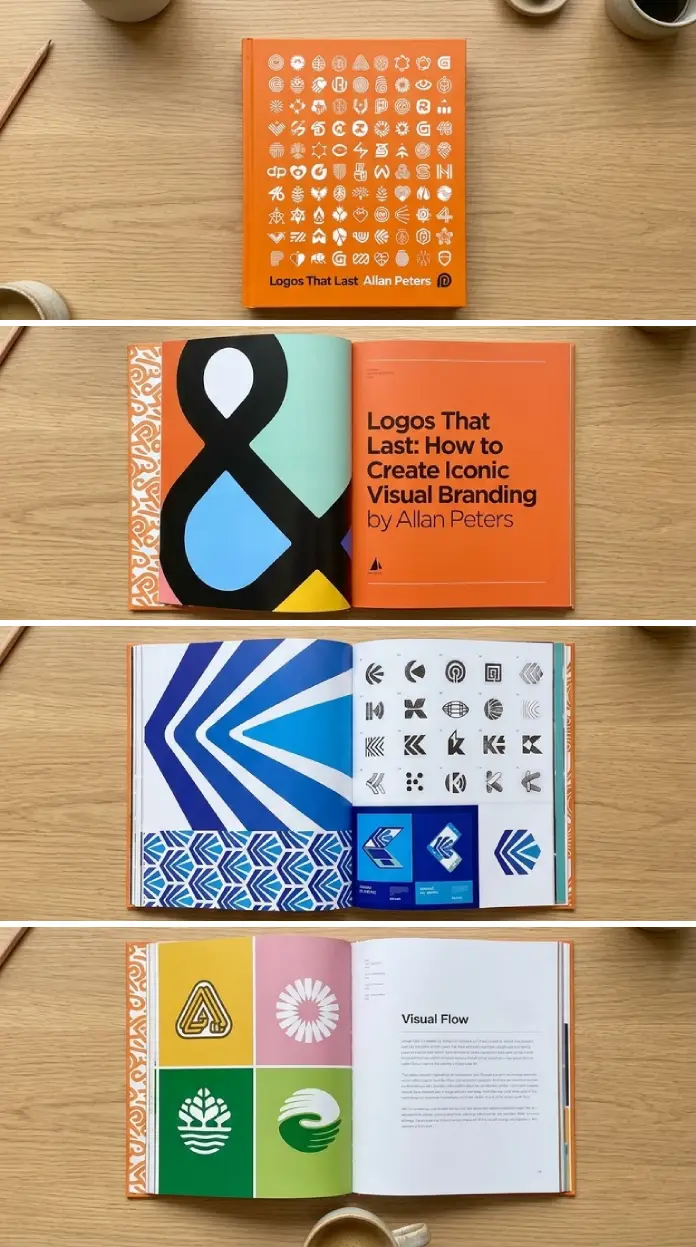
Most logo design books fall into one of two traps. They’re either portfolio showcases with captions or abstract philosophy with no practical traction. Allan Peters’s Logos That Last, published by Rockport Publishers in November 2023, avoids both. This is a hands-on, methodologically rigorous guide to creating iconic visual branding that endures—written by someone who has designed for Google, Amazon, Disney, Target, and Nike over more than two decades.
The book’s central thesis is what I’d describe as the Permanence-First Principle: longevity is not a byproduct of good logo design—it’s a design objective in itself. Most designers optimize for the pitch. Peters optimizes for the decade after the pitch. That single shift in focus changes everything about how you approach a mark.
Peters structures his methodology around three simultaneous levels. First, conceptual clarity: before touching any drawing tool, you need total clarity about what the brand genuinely stands for—not its aspirations but its operational truth. A logo built on aspiration breaks under pressure. A logo built on operational truth holds. Second, formal integrity: the geometry of a curve, the weight of a stroke, the optical spacing of a letterform. These aren’t decorative concerns—they’re structural ones. Third, system expandability: a great logo is a seed, not a symbol. Peters asks of every mark, “What does this grow into?” Can it anchor a color system, support typographic voice, and carry motion?
One of the book’s most transferable concepts is what I call the Pressure-Test Method. Peters puts early concepts under pressure before they solidify—asking whether the mark still works when wrong-colored, wrong-sized, or placed in a hostile visual environment. Logos that survive early pressure tests rarely fail in the real world. Additionally, Peters identifies the Reduction Threshold: the point in the design process where further simplification removes meaning rather than noise. Knowing where that threshold sits is a mark of senior-level logo thinking.
The detailed case studies are not portfolio pieces. They’re forensic documents, showing designs from the initial brief through rejected directions to final delivery—with the reasoning behind every significant choice. Adobe named this one of the top 20 books all graphic designers should read and own. I agree with that assessment without qualification.
My prediction: as AI tools commoditize trend-responsive visual identity, designers who master durability thinking will command premium positioning. Peters’s book is an early and essential guide to that shift.
3. The Spaces That Make Us—Danish Kurani
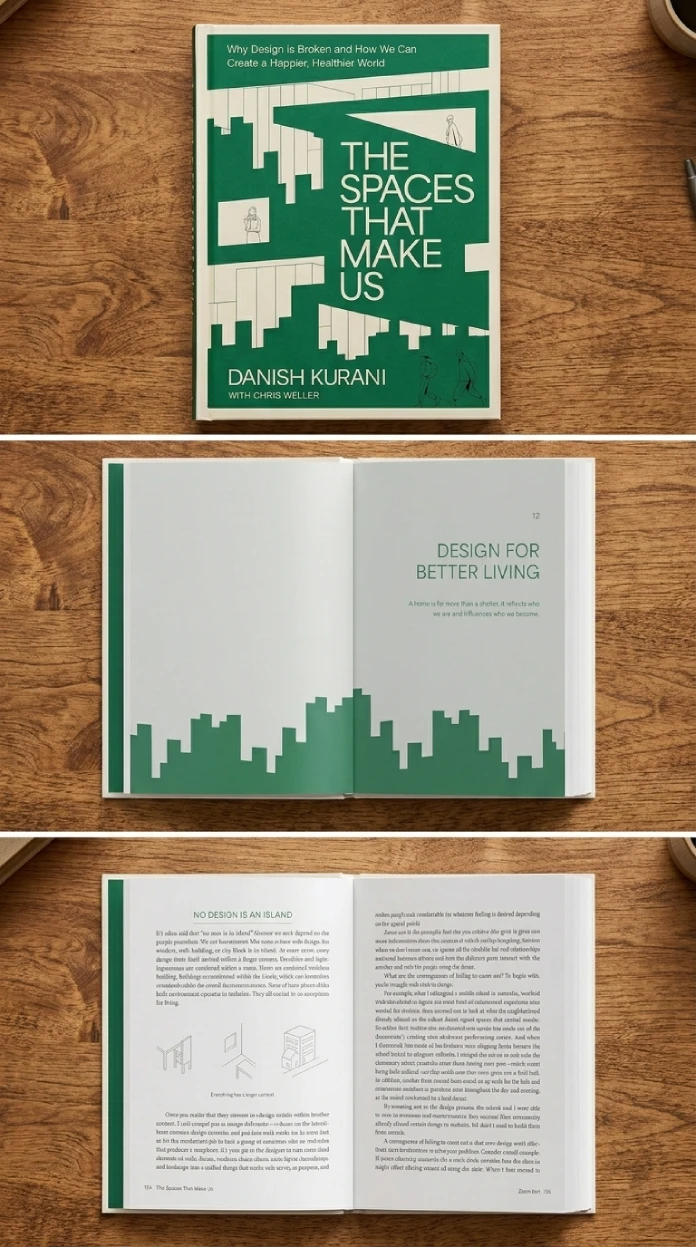
Your bedroom is already designing you. So is your office. So is every corridor, classroom, and kitchen you spend significant time in. You didn’t choose that influence consciously—but it’s happening anyway, shaping your mood, your relationships, and your health. That’s the core argument of The Spaces That Make Us: Why Design Is Broken and How We Can Create a Happier, Healthier World, published by Harper Celebrate in February 2026. And it’s one of the most urgent arguments in current design thinking.
Harvard-trained architect Danish Kurani has designed across four continents, including work for Google and New York City public schools. Fast Company named him one of the world’s Most Innovative Architects. He’s spoken at Stanford, MIT, and Columbia, and his ideas have appeared in TIME and The Wall Street Journal. That background matters—not as credential-dropping, but because it signals the range of environments he’s observed failing people in measurable ways.
Kurani’s book draws on psychology, sociology, anthropology, and evolutionary biology to make the case that current design practice is fundamentally broken. Specifically, it optimizes for cost, efficiency, and visual trends rather than for the humans living inside it. The research he cites is striking: classroom layout affects children’s grades. Hospital room design influences patient recovery times. Open-plan offices, designed to encourage collaboration, often produce the opposite effect.
The solution Kurani proposes is Baaham design—a framework built around seven core principles. Baaham (pronounced BAH-hum) is an Urdu word meaning “in tandem.” It captures the reciprocal relationship between people and their built environments: we shape our spaces; our spaces shape us back. The two foundational principles are worth naming directly. First: look within before designing outward—understand who the space is for before making any design decision. Second: solve important problems—prioritize function and human impact over aesthetic novelty.
What I find most compelling is Kurani’s treatment of what this article terms relational architecture: the way spatial configuration actively structures the quality of human relationships. The living room example is persuasive. Most Western living rooms orient everyone toward a screen. That arrangement, consistently, trains people to relate through media rather than direct engagement. Rearranging furniture to support conversation is a direct application of Baaham at the most accessible scale—and it costs nothing.
Additionally, the book deserves credit for its democratic ambition. This is not a book for architects or wealthy renovation clients. It’s for anyone who lives or works somewhere. The Baaham principles apply at every budget level, from a college dorm to a city block.
4. Stillness: An Exploration of Japanese Aesthetics in Architecture and Design—Norm Architects

Quiet is having a moment. Not the decorative minimalism of a thousand boutique hotel lobbies, but something more earned—a philosophical stance about what spaces should actually feel like and why. Stillness: An Exploration of Japanese Aesthetics in Architecture and Design, published by gestalten in October 2024, is Norm Architects’ attempt to put language, image, and rigorous structure around something most designers feel but rarely articulate: that Japanese spatial thinking permanently changes how you see everything else afterward.
Copenhagen-based Norm Architects spent over a decade traveling to Japan, collaborating with Japanese craftspeople, and sitting seriously with the country’s design philosophy before committing it to print. The result—304 pages, nearly 13 inches tall, close to five pounds—is one of the most visually considered design books published in recent years. Furthermore, it functions simultaneously as a travel memoir, an aesthetic manifesto, and a serious design document. This matters because most Japanese design books are one of those three things. This one is all three.
The Japanese spatial concepts the book engages with are foundational: ma (negative space as active presence), wabi-sabi (the beauty of impermanence and imperfection), and mono no aware (sensitivity to transience). These aren’t decorative ideas. They’re structural ones—ways of organizing perception, time, and material experience. Consequently, understanding them changes how you design a threshold, choose a texture, or decide where light should fall.
One of the book’s most compelling arguments is what I’d call the Nordic-Zen Continuum: the observation that Scandinavian and Japanese design share a foundational commitment to functional beauty, material truth, and spatial modesty. Both traditions developed in response to demanding natural environments. Both resist ornament for its own sake. Therefore, the visual affinities between a Danish farmhouse and a Japanese machiya townhouse are structural, not coincidental.
The book also develops the framework of Calibrated Absence: the idea that every element present in a space must justify itself not just by function, but by the quality of attention it creates around itself. The featured projects—Äng Restaurant in Sweden and Heatherhill Beach House in Denmark—demonstrate this in built form. Additionally, the concept of Material Testimony runs throughout: materials should tell the truth about their own nature, their age, and their origin. Nothing should pretend to be something else.
My forward-looking prediction: the principles this book documents will become increasingly central to design practice over the next decade. Digital environments have trained human perception toward constant stimulation. Physical spaces that offer genuine perceptual depth and sensory calm will be experienced as profound relief. Designers who know how to create that quality will be in significant demand. Stillness is a practical instrument for exactly that work.
5. Design: Mid-Century Modern—Jenna McKnight

Mid-Century Modern design refuses to age, and this book is the clearest explanation I’ve found for why that’s true. Design: Mid-Century Modern: Design Inspiration from Copenhagen to California, published by Hardie Grant Books in April 2026, belongs to a collectable guidebook series—but don’t let the compact format fool you. Jenna McKnight, a Dezeen features editor with a PhD in Design and Planning, wrote a book that works on two levels simultaneously: as a richly illustrated visual reference and as a structured argument about why one design era continues to shape contemporary taste seventy years later.
The subtitle isn’t marketing. The book genuinely delivers geographic range, moving from Scandinavian furniture workshops to Brazilian concrete architecture to Palm Springs residential design. What McKnight does well—and what most Mid-Century Modern books fail to do—is apply what I’d call Geographic Design Literacy: the ability to read a design movement not as one unified style but as a set of regional dialects responding to local climate, material access, and culture. Mid-Century Modern was never a single movement. It was several movements that happened to share a timeline.
McKnight’s core argument is clear: Mid-Century Modern designers weren’t chasing style for its own sake. They were responding to post-war material shortages, new manufacturing techniques, and a public hungry for optimism. Plastic, molded plywood, and aluminum were not aesthetic choices first—they were practical answers to what factories could actually produce. This is where the book separates itself from purely visual coffee-table guides. McKnight treats the era as a humanist design movement, and she backs that claim with context rather than assertion.
Furthermore, she applies what I’d describe as Material-First Storytelling throughout: explaining a design object by starting with what it’s made of and why that material was chosen, rather than starting with how it looks. That shift changes how you read every photograph in the book. Instead of being told a chair looks elegant, you understand how molded plywood lets designers bend wood into curves that solid lumber could never achieve.
The book runs 176 pages at a size built for portability rather than coffee-table dominance. That’s a fair trade for most readers. After two weeks with it, testing its styling advice against my own workspace, my assessment is this: it’s one of the few design guides that explains a movement instead of just photographing it.
Additionally, I’d predict that this book will appear on design school reading lists within the next two years. The combination of accessibility and accuracy is rare enough that educators will notice. Its photography-rich, region-spanning approach will also circulate widely on design social media, where Mid-Century Modern already functions as a lifestyle identity for a substantial audience.
What These Five Books on Art and Design Have in Common
At first glance, this list covers wildly different territory. A 432-page creative process anthology. A logo design methodology guide. A manifesto about built environments. A 304-page visual document about Japanese aesthetics. A 176-page design history reference. What connects them?
Each book argues, in its own way, that design rooted in a genuine understanding of human need outlasts design chasing trends. Adam Moss shows that the most durable art emerges from sustained, difficult human engagement with an idea. Allan Peters shows that logos built on operational truth survive market cycles that trend-chasing marks don’t. Danish Kurani shows that spaces designed around actual human outcomes work better than spaces optimized for visual appeal. Norm Architects show that Japanese aesthetic principles create environments that remain psychologically nourishing over time. Jenna McKnight shows that Mid-Century Modern endures because it solved real post-war problems rather than manufacturing style.
That’s a coherent argument across five different disciplines. And it’s the right argument for this specific summer, when AI tools can produce design work instantly, and the question of what makes human design thinking valuable has never been more urgent. These books provide an answer. Read them.
Frequently Asked Questions:
What are the best books on art and design to read in summer 2026?
Based on thorough personal reading and testing, my top five recommendations for summer 2026 are: The Work of Art by Adam Moss (creative process), Logos That Last by Allan Peters (visual branding), The Spaces That Make Us by Danish Kurani (environmental design), Stillness by Norm Architects (Japanese aesthetics and architecture), and Design: Mid-Century Modern by Jenna McKnight (design history). Each covers different territory, but together they offer a comprehensive and timely reading of what design is for in 2026.
Which design book is best for graphic designers specifically?
Logos That Last by Allan Peters is the most directly applicable book for graphic designers and brand strategists. It covers logo creation from conceptual development through brand system expansion, with forensic case studies drawn from Peters’s work with Nike, Google, Amazon, and Disney. Adobe named it one of the top 20 books all graphic designers should read and own. Additionally, The Work of Art by Adam Moss is essential for any designer interested in understanding creative decision-making at a fundamental level.
Are these books suitable for design students?
Yes, all five books work well for design students, though at different levels. Design: Mid-Century Modern by Jenna McKnight provides an accessible, well-organized entry point for students studying design history. Logos That Last by Allan Peters gives students a structured mental model for logo design that typically takes years to build through experience. The Work of Art by Adam Moss is useful for students across all creative disciplines, not just visual design.
Which book is best for understanding how space affects well-being?
The Spaces That Make Us by Danish Kurani addresses the relationship between built environments, health, and human relationships most directly. Kurani draws on environmental design research, psychology, and evolutionary biology to argue that most current design practice is misaligned with human needs—and proposes his seven-principle Baaham design framework as a practical alternative. The book is accessible to non-architects and applies at every budget level.
What is the best design book for understanding Japanese aesthetics?
Stillness: An Exploration of Japanese Aesthetics in Architecture and Design by Norm Architects (gestalten, 2024) is the strongest current book on Japanese design philosophy and its application to contemporary architecture. It covers core concepts including ma, wabi-sabi, and material honesty and demonstrates their influence through completed built projects. The book is visually exceptional and rigorous in its argument—not a surface-level aesthetic survey.
Is The Work of Art by Adam Moss relevant for designers, or is it only for fine artists?
The Work of Art is fully relevant for designers. The book’s core insights—about decision-making under uncertainty, the role of failure in refining work, and the structure of creative commitment—apply directly to graphic design, branding, photography, and architecture. Moss’s 40-plus profiles span disciplines from painting and literature to film, culinary arts, and algorithmic art. The underlying creative grammar he identifies is cross-disciplinary.
Why does Mid-Century Modern design still matter in 2026?
Mid-Century Modern design endures because it was never purely stylistic. As Jenna McKnight argues in her book Design: Mid-Century Modern, the era’s designers responded to specific post-war conditions—material shortages, new manufacturing capabilities, and a public hungry for optimism—with solutions that prioritized human need and material honesty. Design built on those principles holds its relevance because the principles themselves don’t expire. Additionally, the era produced multiple regional design languages—Scandinavian, Brazilian, Californian—that remain visually distinct and intellectually rich.
Where can I find detailed reviews of these art and design books?
WE AND THE COLOR published in-depth, hands-on reviews of all five books. Each review tests the book’s arguments against real practice and includes the frameworks and key concepts developed in the reading. You can find the full reviews at weandthecolor.com in the Books section under Recommendations.
Check out WE AND THE COLOR’s Books category for more.