
This post contains affiliate links. We may earn a commission if you click on them and make a purchase. It’s at no extra cost to you and helps us run this site. Thanks for your support!
Goodbye, Things by Fumio Sasaki makes a better argument with its photographs than with its prose. I mean that as praise and as a complaint at the same time. Black Friday is on November 27 this year, which makes a book about owning less an almost ironic read.
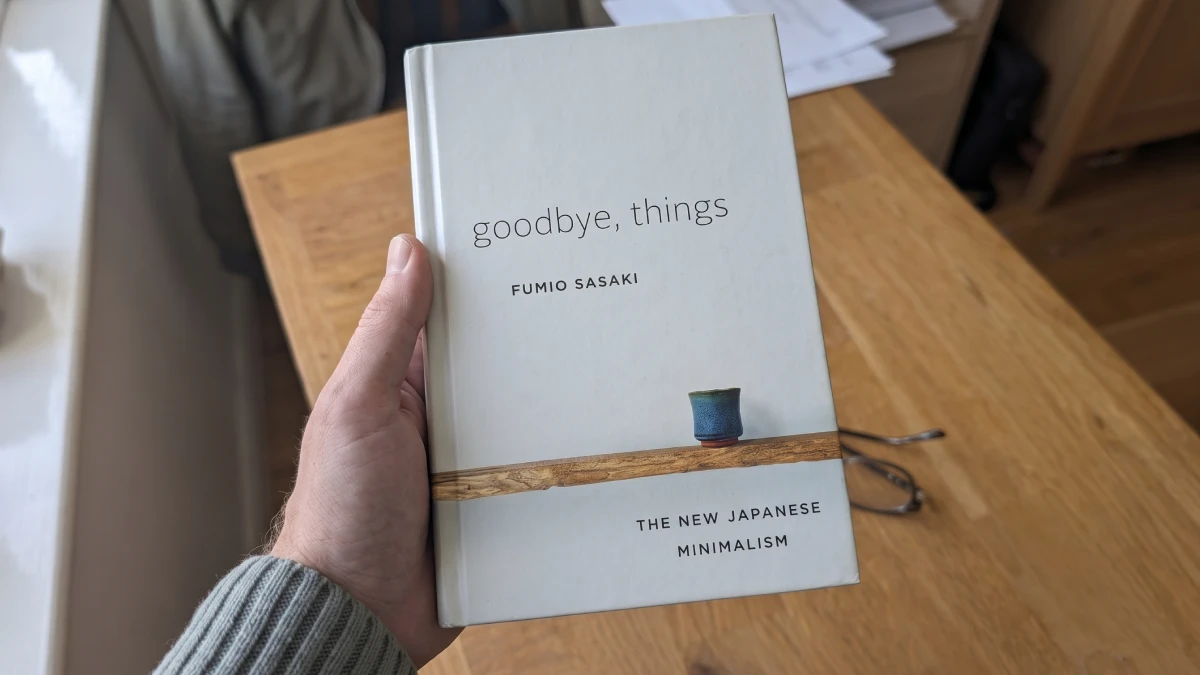
I read the hardcover, a 272-page Norton edition that measures 5.6 by 8.6 inches. Then I held the rules of Goodbye, Things up against my own shelves. Some rules survived. Others collapsed fast, and I will tell you which ones.
Do you own anything you cannot explain in one sentence?
What Is Goodbye, Things Really Asking You to Do?
Goodbye, Things is a minimalism memoir with a practical manual built into its middle. Eriko Sugita translated it into English, and W. W. Norton published that edition on April 11, 2017.
The Japanese original, Bokutachi ni, mō mono wa hitsuyō nai, appeared from Wani Books in 2015. By the time the English edition of Goodbye, Things arrived, the original had sold roughly 150,000 copies in Japan. Sasaki is a former co-editor-in-chief at Wani Books, so he knows how to hold a reader.

Here is the definition I use in this article. Minimalism means owning only what you use or love today. That definition is mine, yet it matches the life Sasaki describes in Goodbye, Things.
His life is extreme enough to quote. Sasaki lives in a 215-square-foot Tokyo apartment and owns about 150 items. A desk and a roll-up futon pad furnish it, along with one small wooden box.
Goodbye, Things runs through six parts. The 55 tips in the middle carry most of the practical weight. A shorter set of 15 follow-up tips then covers the next stage of the minimalist journey.
Why the Photos in Goodbye, Things Carry the Argument
Open the hardcover of Goodbye, Things, and the photographs come first. Sixteen pages of color images open the book, and they include before-and-after shots of Sasaki’s old apartment. The before shots look crowded, while the after shots look nearly empty.
This is a design argument, and a good one. Anyone who has built a mood board for a project knows that an image can settle a debate in one second, and Sasaki exploits that speed by placing his before-and-after photographs ahead of the first chapter, so the reader has already agreed with him when the text begins.
I would argue the remaining pages of Goodbye, Things mostly repeat what those images already told you. A tighter edit could lose a quarter of the book, and I would not miss it.
The prose is plain and repetitive, and Sugita’s translation keeps it that way. Marie Kondo asks whether an item sparks joy. Sasaki asks blunter questions. Have you used it this year? Can you talk about it with passion?
Comparison Is the Real Subject of Goodbye, Things
Sasaki describes himself as a stressed man who constantly compared himself to others. Possessions fed that habit, because every purchase offered a small claim to status. I think this is the sharpest idea in Goodbye, Things, and the tips bury it.
His fix in Goodbye, Things is subtraction. When you own fewer things, you also have fewer scoreboards to check. The closing part, on feeling happy instead of becoming happy, follows from that logic.
Designers should pay attention here, because a feed is a showroom. Every portfolio you scroll past invites a measurement. I expect the next wave of minimalism writing to apply Sasaki’s comparison thesis to social media rather than closets.
The 55 Tips in Goodbye, Things, Ranked by How Fast They Work
The tips justify buying Goodbye, Things. I ranked them by how quickly they pay off, so the order is mine and not Sasaki’s.
Tips That Work on the First Afternoon
Three tips need no courage at all.
- Start with things that are clearly junk, because momentum beats strategy.
- Discard clothes with holes, since nobody will argue with you about them.
- Throw out boxes you have not opened since you moved in.
These sound obvious, yet they solve the hardest problem in Goodbye, Things, which is starting.
Tips That Need a Second Pass
The harder tips in Goodbye, Things ask you to change a habit. The photo rule is my favorite. Sasaki photographs items he finds hard to release, and he admits he hardly ever looks at those photos again. I call this Memory Offload, an editorial label and not Sasaki’s term. The camera stores the memory, so the object no longer has to.
The year rule works the same way. If you have not used something in a year, Sasaki says to let it go. Then comes the uniform tip. His own wardrobe proves it, since he owns three shirts and four pairs of trousers, plus four pairs of socks. A uniform works like a design system for your body, because fixed components remove daily decisions.
Next comes the tip I rate highest for designers. Sasaki says to be a borrower, so you use what you need and hand it back. Pair that with the passion test, and the logic is simple. Keep what you love, and borrow the rest.
Finally, there is the habit I call Someday Debt. Spare cables and vacuum parts hang around because you might need them someday. Sasaki says he has never used a warranty. He also compares possessions to roommates who pay no rent. Someday Debt names that rent, which is the space and attention you pay today for a future that rarely arrives.
How to Use Goodbye, Things in Three Passes
I turned the tips into a routine, which I call the Three-Pass Declutter. It is another editorial label, so you will not find it in Goodbye, Things.
- The junk pass. Remove broken things and anything you forgot you owned. This takes one afternoon.
- The year pass. Pull everything you have not used in twelve months. Photograph the items that hurt to release, then release them.
- The passion pass. Pick up each remaining item and talk about it for thirty seconds. Silence means it goes.
Then stop for a week. Sasaki says you need not discard everything at once. He also asks you to focus on each item you cannot part with and to ask why. Sell or donate the rest when you can, because Sasaki favors auctions and donations over the trash.
Where Goodbye, Things Falls Short for Families and Designers
A 215-square-foot studio sets a ceiling on what you can copy from Goodbye, Things. The 150-item figure describes what one man did in one small apartment in Tokyo, so I trust it far more as a record of what is physically possible than as advice that any household with children could ever follow in daily life.
Designers hit a harder wall with Goodbye, Things. Reference books and paper samples fail the used-in-a-year test, yet they earn their space. So I apply the passion rule first and the year rule second.
The borrower tip also assumes you live near libraries and rental shops. A small town changes that math.
Yes, I still own the hardcover. Sasaki’s passion test lets me keep it, because I can talk about it for an hour.
Why Japanese Minimalism Took Off, and Where It Goes Next
Sasaki links the rise of minimalism in Japan to information overload. He also points to the 2011 Great East Japan Earthquake, which destroyed many houses. Smartphones and cloud storage added a third push, because they let people move photos and music off their shelves.
I expect digital clutter to replace closet clutter as the main subject of minimalism books by 2030. Sasaki wrote Goodbye, Things in 2015, when cloud storage looked like a cure. Today it looks more like a second storage unit.
Borrowing will also beat discarding, in my view. Tool libraries and clothing rentals have already built the market that the borrower tip describes.
The before-and-after photo will stay the format that sells minimalism online. Sasaki’s book leads with that format, and social feeds still reward it.
Goodbye, Things at a Glance
| Attribute | Details |
|---|---|
| Title | Goodbye, Things: The New Japanese Minimalism |
| Author | Fumio Sasaki, born 1979, former co-editor in chief at Wani Books, co-founder of Minimal & ism |
| Translator | Eriko Sugita |
| Japanese original | Bokutachi ni, mō mono wa hitsuyō nai (Wani Books, 2015) |
| English edition | W. W. Norton & Company, April 11, 2017, illustrated hardcover |
| Length and size | 272 pages, 5.6 x 0.9 x 8.6 inches, 16 pages of color illustrations |
| ISBN | 978-0393609035 (ISBN-10: 0393609030) |
| Structure | Six parts, including 55 discarding tips and 15 follow-up tips |
| Core method | Subtraction: discard unused items, photograph what hurts to release, borrow, wear a uniform |
| Author’s own count | About 150 items in 215 square feet |
| Best for | First-time declutterers and designers who want a visual case for owning less |
| Weak spot | Repetitive prose and a method that is hard to copy in a family home |
Who Should Read Goodbye, Things?
Buy Goodbye, Things in hardcover if you have never decluttered and want a visual push. Buy it, too, if you collect design objects and need a firm voice to question them. Skip it if you want a system for a family home, because Goodbye, Things describes one man’s apartment.
Black Friday sits just over five weeks away. Reading Goodbye, Things first costs one evening, and it may save you a few purchases.
Frequently Asked Questions About Goodbye, Things
What is Goodbye, Things about?
Goodbye, Things is Fumio Sasaki’s account of cutting his possessions to about 150 items. It mixes memoir with a practical list of 55 discarding tips and 15 follow-up tips.
Who wrote and translated Goodbye, Things?
Fumio Sasaki wrote Goodbye, Things, and Eriko Sugita translated it. Wani Books published the Japanese original in 2015, and W. W. Norton published the English edition in 2017.
How many items does Fumio Sasaki own?
Sasaki owns about 150 items in a 215-square-foot Tokyo apartment. That count includes small things such as his toothbrush and his kitchen condiments.
How many tips does Goodbye, Things contain?
Goodbye, Things contains 55 tips for discarding and 15 more tips for the next stage. That makes 70 tips in total.
How does Goodbye, Things differ from Marie Kondo’s method?
Kondo’s method centers on whether an item sparks joy. Sasaki leans on use and passion tests, such as the one-year rule, and presents minimalism as a personal experiment.
Is Goodbye, Things worth reading?
Yes, if you want a fast, visual push to start decluttering. The photo section and the 55 tips deliver the most value, while later chapters repeat earlier points.
Does Goodbye, Things work for designers and families?
Partly. Designers can keep reference material by applying the passion test first. Families cannot copy the 150-item count, but the Three-Pass Declutter scales to any household.
What are the hardcover’s specifications?
The illustrated hardcover of Goodbye, Things has 272 pages and measures 5.6 by 0.9 by 8.6 inches. Its ISBN-13 is 978-0393609035, and 16 of its pages are color illustrations.
Don’t hesitate to browse WE AND THE COLOR’s Books category for more reviews.
Subscribe to our newsletter!