


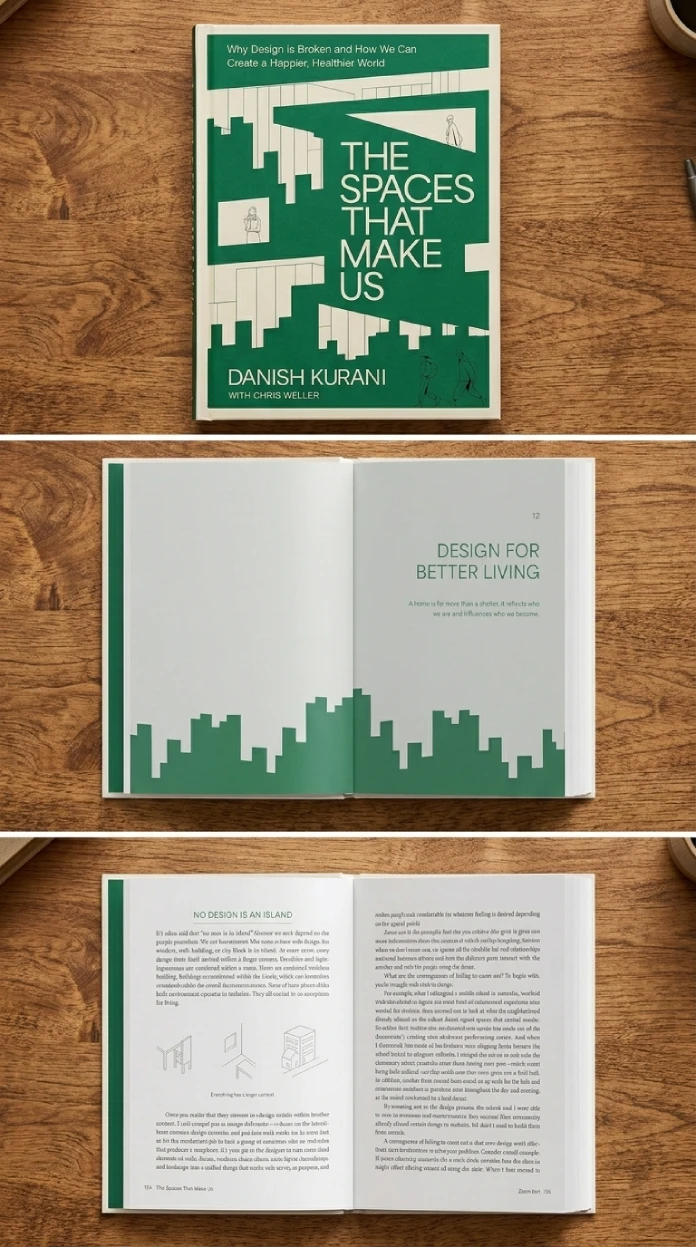
Your bedroom is already designing you. So is your office. So is every corridor, classroom, and kitchen you spend time in. You didn’t choose that influence consciously. But it’s happening anyway — shaping your mood, your relationships, your health, and even your sense of self. That’s the core argument at the heart of The Spaces That Make Us: Why Design Is Broken and How We Can Create a Happier, Healthier World, a new book by architect and designer Danish Kurani, published by Harper Celebrate in February 2026. And it’s one of the most urgent arguments in design right now.
Furthermore, it’s not just urgent — it’s personal. Most of us will spend the vast majority of our lives inside built environments. We eat in them, sleep in them, raise children in them, work in them, grieve in them, heal in them. Yet almost nobody pauses to ask: Is this space actually working for me? Does it support the kind of person I’m trying to become? Kurani does ask that question. He’s been asking it professionally for two decades across four continents.
Additionally, his book arrives at a cultural moment when people are rethinking nearly everything about how they live and work. Post-pandemic life pushed millions of people into a sudden, forced experiment with their home environments. Many discovered that their spaces weren’t designed for them at all. The Spaces That Make Us gives that vague unease a name, a framework, and — crucially — a way forward.
Why Does Design Have Such a Powerful Impact on Human Well-Being?
The answer isn’t mystical. It’s evolutionary. Human beings evolved over roughly two million years in specific types of environments. Our nervous systems, our social instincts, our physiological responses — all of them developed in direct relationship to physical space. Then, in a geological blink, we built cities, office towers, school hallways, and hospital wards that bear almost no resemblance to those ancestral environments.
Kurani draws on psychology, sociology, anthropology, and evolutionary biology to make the case that this mismatch is causing measurable harm. Moreover, the harm isn’t abstract. Classroom layout affects children’s grades and test scores. The arrangement of a living room can improve or strain a romantic relationship. The design of a hospital room influences how quickly patients recover. These aren’t soft claims — they reflect a growing body of evidence-based environmental design research.
What Kurani adds to that research is a designer’s perspective and a practitioner’s honesty. He has designed schools, homes, offices, and community centers around the world. He has watched spaces either lift people up or quietly diminish them. Consequently, he came to believe that current design practice — as an industry, a discipline, and a cultural assumption — is fundamentally broken.

The Environmental Design Problem Nobody Talks About
Most design conversation focuses on aesthetics: what looks good. A smaller conversation focuses on function: what works. Almost no mainstream design conversation focuses on what Kurani identifies as the real stakes — how space shapes human behavior, relationships, and health over time. He calls this the environmental design problem.
The problem isn’t just that buildings are ugly. It’s that they’re misaligned with human needs. They optimize for efficiency, cost, and visual trend rather than for the people living inside them. Schools are still built like factories. Hospitals still feel clinical and cold. Open-plan offices were supposed to encourage collaboration — but studies suggest they often produce the opposite effect.
Therefore, the question Kurani raises is worth sitting with: if we know that design affects behavior and well-being, why are we still designing spaces that make people worse off? His answer is part cultural, part economic, and part philosophical. And the solution he proposes — Baaham design — is one of the most coherent frameworks for human-centered architecture currently in circulation.
What Is Baaham Design? Danish Kurani’s Seven-Principle Framework Explained
Baaham (pronounced BAH-hum) is a word from Urdu, the language spoken primarily in Pakistan and across South Asia. It means “in tandem” — two interconnected things working in harmony. Kurani uses the term to describe the reciprocal relationship between people and the spaces they inhabit. We shape our spaces. Our spaces shape us back. Neither party in that relationship is passive.
This is not a new idea on its own. Winston Churchill famously said, “First we shape our buildings; thereafter, they shape us.” But Kurani takes that observation and builds a complete design methodology around it — seven core principles that together constitute what he calls Baaham design. These principles apply at every scale, from a bedroom reorganization to a neighborhood master plan.
Principle One: Look Within Before You Design Outward
The first principle of Baaham design is deceptively simple: before you design anything, understand who it’s for. Kurani insists that genuine understanding — of needs, values, habits, relationships, and aspirations — must precede any design decision. Moreover, this is not the same as a brief or a client interview. It’s a deeper act of inquiry.
In practice, this means resisting the pull toward immediate visual problem-solving. It means pausing long enough to ask what this space needs to do for the people who will live or work inside it. Only then does designing outward become meaningful.
Principle Two: Solve Important Problems
Kurani traces the word “design” to its Latin root, designare, meaning to identify a problem and contrive a solution. This etymological grounding is intentional. It reminds designers — and anyone rethinking their space — that the core purpose of design is problem-solving, not decoration.
Furthermore, the principle demands that designers prioritize the problems that actually matter. Flash over function is a failure of this principle. Style over substance is a failure of this principle. A beautiful space that doesn’t serve its occupants isn’t good design. It’s expensive furniture.
The Remaining Five Principles and Their Design Implications
While Kurani lays out all seven principles in detail throughout the book, the common thread is this: every decision should loop back to the human experience of the space. That includes sensory experience — how light, sound, temperature, and material feel to the body. It includes social experience — how the space facilitates or disrupts connection. And it includes psychological experience — how the space affects mood, identity, and sense of safety.
Taken together, the seven principles constitute what this article defines as a reciprocal design standard — a measurable benchmark for whether a space genuinely serves its occupants in return for the time they spend inside it. This is an editorial framework, not an industry term. But it reflects Kurani’s thinking with precision: design that doesn’t give back to its users has failed, regardless of its aesthetic quality.
The Spaces That Make Us: What the Book Actually Delivers
Kurani structures The Spaces That Make Us as both an intellectual argument and a practical guide. The first section traces human spatial history across two million years — a timeline that puts current design dysfunction in evolutionary context. This historical arc is one of the book’s most valuable contributions. It shows how design was once adapted to human needs and how it gradually lost that orientation as industrialization, urbanization, and economic pressure took over.
Additionally, the book is illustrated throughout. Each chapter features visual material designed to make the Baaham principles concrete and legible. This matters because design thinking can slip into abstraction quickly. Kurani anchors his ideas in images, making the book genuinely readable for non-designers as well as practitioners.
How Design Affects Physical Health: The Evidence Base
The research Kurani cites on physical health and built environments is striking. Natural light exposure affects circadian rhythm, immune function, and mood regulation. Noise pollution in schools measurably reduces children’s cognitive performance. Hospital room design — including window views, acoustic conditions, and spatial layout — influences patient recovery times and medication needs.
Moreover, this evidence base extends into housing design. Crowded, poorly ventilated homes correlate with higher rates of respiratory illness and mental health challenges. The relationship between space and health is not metaphorical. It is physiological. Kurani argues that any honest design practice must treat this relationship as a primary design constraint — not an afterthought.
How Space Shapes Relationships: The Relational Architecture Argument
One of the most compelling sections of the book concerns what this article terms relational architecture — the way spatial configuration actively structures the quality of human relationships. Kurani argues that furniture arrangement, room adjacency, sightlines, and acoustic conditions all influence whether people connect, cooperate, or withdraw from each other.
Consider the living room example Kurani raises. Most Western living rooms are arranged around a screen. That arrangement orients everyone in the same direction, toward content rather than toward each other. Conversations become secondary to viewing. Subtly, consistently, the room trains the people inside it to relate through media rather than through direct engagement.
Contrast that with arrangements designed around conversation — seating that faces inward, lighting that doesn’t create glare, acoustics that allow voices to carry clearly. The spatial difference is relatively small. The relational difference, over months and years, can be profound. This is Baaham thinking applied at the most intimate scale.
Why The Spaces That Make Us Matters Beyond Architecture
Kurani’s book is not primarily addressed to architects. It’s addressed to everyone who lives somewhere, which is everyone. That universality is a deliberate and important choice. The Baaham philosophy is designed to scale from the smallest budget to the largest. A college student rearranging a dorm room can apply it. So can a city planner redesign a public park.
Furthermore, this democratic ambition separates The Spaces That Make Us from most architectural writing, which tends to speak to practitioners, critics, or wealthy clients. Kurani’s intended reader is the ordinary person who hasn’t thought much about environmental design but suspects, dimly, that their spaces aren’t really working for them.
The Design Accountability Gap: A Framework for Evaluating Spaces
Reading Kurani’s argument, a concept emerges that deserves naming: what this article calls the design accountability gap. This refers to the distance between a designer’s intentions for a space and its actual effect on the people who use it. Most design evaluation happens at the point of completion — does it look right, and does it meet code? — rather than at the point of occupation, months or years later.
Kurani implicitly calls for closing that gap. He asks designers, clients, and space-users alike to evaluate environments based on ongoing human outcomes rather than upfront aesthetic judgments. Moreover, he provides the conceptual vocabulary to do that — through Baaham’s seven principles, each of which can serve as a diagnostic lens for an existing space as well as a generative principle for a new one.
This is the book’s most practically radical move. It doesn’t just advocate for better design in the abstract. It gives readers a framework they can use — today, in their current space — to identify what isn’t working and understand why.
Danish Kurani’s Background: Why His Credibility Matters Here
Kurani is Harvard-trained and has designed across four continents, including work for Google and New York City public schools. His ideas have been featured in The Wall Street Journal, TIME, and at the World Economic Forum. Fast Company named him one of the world’s Most Innovative Architects. He has spoken at Stanford, MIT, and Columbia.
That resume matters — not as credential-dropping, but because it signals the range of environments Kurani has worked in. He has seen design dysfunction at every scale and in every economic context. That breadth gives the Baaham philosophy its grounding. It didn’t emerge from a single cultural context or a single building type. It emerged from twenty years of watching what actually happens to people inside spaces.
The Baaham Philosophy in the Context of Current Design Discourse
The timing of The Spaces That Make Us is significant. Design discourse in 2026 is saturated with competing value systems: sustainability, technology integration, minimalism, maximalism, biophilic design, and neuroarchitecture. Each represents a real insight. But few offer a coherent, unified philosophy for how all of these concerns relate to each other — and to the people who actually have to live inside the results.
Baaham functions as what this article terms a meta-design orientation — a philosophical stance that sits above and organizes specific design decisions, rather than competing with them. Biophilic elements might serve Baaham principles beautifully. So might minimalist spatial clarity or technologically mediated acoustic control. Baaham doesn’t prescribe style. It prescribes intention — and it demands that intention be grounded in human need.
Additionally, neuroarchitecture — the emerging field connecting neuroscience and built environment research — provides growing empirical support for the intuitions behind Baaham. Researchers in this field study how spatial variables like ceiling height, curvature, color, and light affect cognitive function and emotional state. Kurani’s framework is positioned to benefit from and contribute to that research trajectory.
What Baaham Design Means for Schools and Learning Environments
Kurani’s work in school design deserves particular attention. He has described the factory model of school architecture — long corridors, identical classrooms, institutional materials — as one of the most damaging legacies of industrial-era design thinking. That model optimized for standardization and administrative efficiency. It didn’t optimize for learning, curiosity, or belonging.
Furthermore, research on learning environments supports the critique. Studies consistently find that classroom lighting, acoustics, air quality, and spatial flexibility all affect student achievement. Yet most school construction still defaults to the industrial template because it’s familiar, economical, and administratively convenient. Kurani argues that this represents a failure of design accountability — a prioritization of institutional ease over student outcomes.
The Baaham alternative for learning environments emphasizes spaces that integrate with their communities, support varied modes of engagement, and communicate through their physical form that learning is valued and learners are respected. That’s an ambitious standard. It’s also an achievable one — and the book illustrates it with examples from Kurani’s own practice.
The Spaces That Make Us: An Honest Critical Perspective
No book is without tension, and The Spaces That Make Us is worth reading critically as well as appreciatively. The Baaham framework is elegant and genuinely useful — but it rests on the assumption that good design is primarily a problem of philosophy and intention. That’s only partly true. Budget constraints, zoning regulations, developer economics, and political priorities also determine what gets built and for whom.
Kurani acknowledges this. He explicitly notes that Baaham applies at any budget level, and he includes strategies for people working with very limited resources. Moreover, the book addresses the systemic forces that make good design difficult. But it is primarily a book of ideas and principles, not a policy manual. The translation from Baaham philosophy to systemic change — in urban planning, in building codes, in developer incentives — is a project that extends beyond any single book.
That said, this is the right kind of limitation. Changing how people think about space is genuinely necessary before changing how space gets built. The Spaces That Make Us works at the level of perception and intention — and that’s exactly where it needs to work. Because ultimately, as Kurani argues, the most important design decisions are the ones made by the people who live inside the spaces.
Forward-Looking Prediction: Baaham as a Design Standard
Here is a forward-looking prediction, stated as an editorial thesis: within the next decade, the principles underlying Baaham design will become foundational to human-centered design education and practice. The convergence of neuroarchitecture research, post-pandemic spatial rethinking, and growing public awareness of environmental well-being makes this trajectory likely.
Moreover, as AI-assisted design tools become more capable, the risk of producing technically sophisticated but humanly impoverished spaces will increase. Tools optimize for what they can measure. If the only metrics are cost, area, and structural efficiency, the results will reflect that. Baaham provides a counter-metric system — one that centers human experience as the primary design output.
Consequently, books like The Spaces That Make Us perform a function that goes beyond inspiration. They establish vocabulary, frameworks, and standards that practitioners, clients, and critics can use to hold design accountable. That is a lasting contribution, regardless of how widely Kurani’s specific seven principles are adopted in their exact form.
Who Should Read The Spaces That Make Us?
The honest answer is: almost anyone who lives or works somewhere. The book is accessible enough for a general reader who has never studied architecture. It is intellectually rigorous enough for a practicing designer to find genuine provocation. It is practically oriented enough for a homeowner, manager, or school administrator to draw directly actionable ideas from it.
Furthermore, it’s the right book for anyone who has walked into a space and felt inexplicably at ease — or inexplicably oppressed — without knowing why. Kurani gives you the language to understand that feeling. He also gives you the tools to do something about it.
Additionally, for design educators, this book makes a compelling argument for expanding the scope of what design education addresses. Technical competence and aesthetic judgment are necessary but insufficient. Understanding how space affects human behavior — physiologically, psychologically, relationally — should be as central to design training as drawing or material science.
Practical Takeaways from Baaham Design for Everyday Spaces
Not every reader will undertake a full redesign. But Baaham’s thinking offers practical value even at the smallest scale. Ask yourself: what does this space need to do for the people using it? What behaviors does it currently encourage — and are those the behaviors you want? What sensory qualities does it produce — light, sound, temperature, material texture — and how do those affect how you feel?
Moreover, look at where people naturally gravitate in a space and where they avoid. Patterns of use reveal design problems that visual assessment misses. Rearranging furniture to support the conversations or activities you want — rather than the ones the room defaults to — is a direct application of Baaham’s first principles. It costs nothing. It can change a great deal.
Additionally, think about natural light. Kurani’s research-informed perspective underscores its importance repeatedly. Access to daylight isn’t a luxury — it’s a physiological need. Maximizing it in your home or workspace, even through small adjustments, reflects Baaham’s thinking in action.
Frequently Asked Questions About The Spaces That Make Us and Baaham Design
What is the main argument of The Spaces That Make Us by Danish Kurani?
The central argument is that built environments profoundly shape human health, relationships, and well-being — and that current design practice largely fails to account for this. Kurani argues that design is broken in its priorities and offers the Baaham philosophy as a coherent alternative framework for creating spaces that genuinely serve the people inside them.
What does Baaham mean in Danish Kurani’s design philosophy?
Baaham is an Urdu word meaning “in tandem.” Kurani uses it to describe the reciprocal relationship between people and their built environments — we shape our spaces, and our spaces shape us back. The Baaham design philosophy is built around seven core principles that apply this reciprocal thinking at every scale of design, from a single room to a city block.
Is The Spaces That Make Us only for professional architects and designers?
No. Kurani explicitly wrote the book for a general audience. The Baaham principles are presented in accessible language and illustrated throughout. Anyone who lives or works in a built environment — which is everyone — can apply Baaham thinking to improve their spaces, regardless of design background or budget.
What are the seven principles of Baaham design?
Kurani outlines all seven principles in detail in the book. Two foundational principles are: first, look within before designing outward — understand who the space is for and what they genuinely need before making any design decisions; and second, solve important problems — prioritize function and human impact over aesthetic trend or visual novelty. The remaining five principles extend and deepen this human-centered orientation across different dimensions of spatial experience.
How does design affect physical health, according to Danish Kurani?
Kurani draws on substantial environmental design research showing that spatial variables — including natural light, acoustic conditions, air quality, and room configuration — directly affect physiological health outcomes. Examples include the correlation between hospital room design and patient recovery times, the impact of classroom acoustics on student cognitive performance, and the relationship between housing conditions and respiratory health.
What is the design accountability gap?
The design accountability gap is a framework introduced in this article to describe the distance between a designer’s intentions for a space and its actual effect on the people who use it over time. Current design evaluation tends to occur at the point of completion — aesthetic and technical assessment — rather than at the point of sustained occupation. Kurani’s Baaham framework implicitly calls for closing this gap by evaluating design based on ongoing human outcomes.
When was The Spaces That Make Us published, and where can I find it?
The Spaces That Make Us: Why Design Is Broken and How We Can Create a Happier, Healthier World was published on February 10, 2026, by Harper Celebrate. It is available at major booksellers, including Amazon. The ISBN is 978-1400249121. The book is 272 pages and includes illustrations throughout each chapter.
How does Baaham design relate to neuroarchitecture?
Neuroarchitecture is an emerging research field that studies how built environments affect brain function, cognitive performance, and emotional state. Baaham design and neuroarchitecture share a core assumption: that spatial variables have measurable effects on human experience. Kurani’s framework draws on psychology, sociology, anthropology, and evolutionary biology — disciplines that overlap significantly with the evidence-based neuroarchitecture researchers are building. As that research base grows, it is likely to provide increasing empirical support for Baaham principles.
Check out WE AND THE COLOR’s Architecture, Interior Design, and Books category for more.