


It is undeniable that something fundamental has changed in graphic design. The designer as sole author, crafting every curve and color by hand, is giving way to something more interesting: the designer as architect of rules. Parametric design doesn’t replace creative thinking. It relocates it — from the final form to the system that generates form. And right now, Play the System, published by Slanted Publishers in February 2026, makes the most compelling case for why every designer needs to understand this shift.
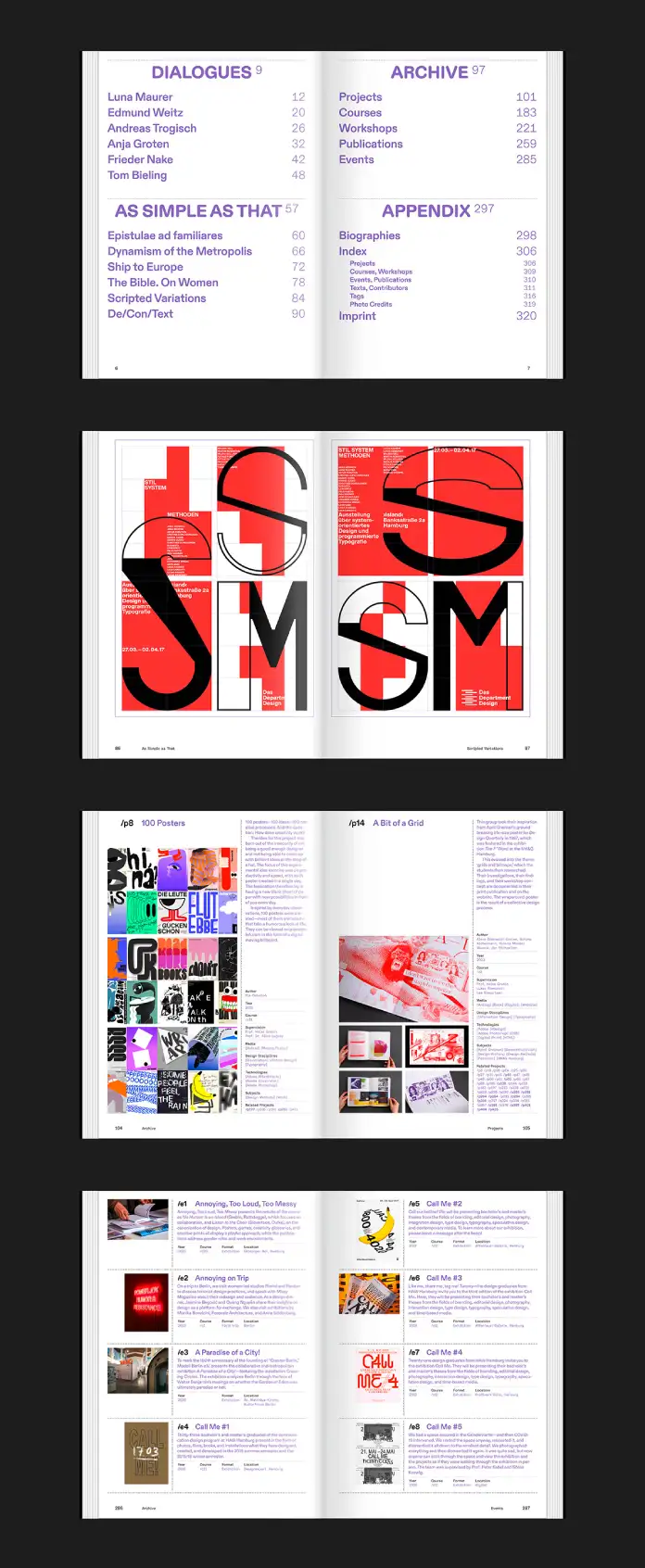
Edited by Heike Grebin, this 320-page publication is part reader, part archive, part design history. It brings together theory, education, and practice in a way that feels genuinely rare. Parametric design has been discussed in architecture and engineering for decades. In graphic design, it still deserves a much wider audience. This book intends to give it one.
What Does It Mean to Design a System Instead of an Object?
Most designers are trained to make decisions: pick a typeface, set a color, arrange elements on a page. Parametric design asks a different question entirely. Instead of deciding the outcome, you decide the rules. You define what changes, by how much, in response to what input. Then you let the system run.
This sounds abstract, but Play the System makes it concrete. The book demonstrates how changes to individual parameters — size, spacing, color, movement — produce wildly different outputs from a single ruleset. Even minimal adjustments create variation, surprise, and genuine discovery. That’s not a glitch. That’s the point.
Heike Grebin developed this approach across more than twenty years of teaching. The result is a framework she calls dynamic system design — one where the designer’s role is to set the conditions, not control every consequence. This is a significant reframe. It asks designers to trust the system they’ve built, even when the output surprises them.
The Rule-Before-Form Model
One of the original frameworks this article proposes is the Rule-Before-Form Model. It describes a creative methodology in which constraints come first, and visual outcomes emerge second. This inverts the traditional design process. Rather than starting with a sketch or a reference, you start with logic. You build a grammar. Then you generate sentences.

Parametric design lives here. And honestly, it produces some of the most interesting graphic work being made today — precisely because the designer can’t fully predict the result in advance.
Why Parametric Design Is Timely Right Now
Algorithms now touch nearly every digital surface. Generative AI tools produce images, layouts, and type treatments in seconds. So the natural question becomes: what is the designer’s role when machines can generate form so quickly?
Parametric design offers a clear answer. The designer’s value lies not in making individual marks but in authoring the logic that governs those marks. This is a durable creative skill. It doesn’t compete with generative AI — it operates at a higher level of abstraction than generative AI can currently reach.
Furthermore, Play the System arrives at a moment when design education is actively rethinking its curricula. Schools are asking how to teach students to work with systems, with code, with data-driven variation. This book functions as both an argument and a resource for that conversation.
The Parameter-as-Author Principle
Another framework worth naming here is the Parameter-as-Author Principle. When a designer sets the parameters of a system, those parameters effectively become co-authors of every output the system generates. They carry aesthetic intent, even when the final form wasn’t explicitly planned.
This is a productive way to think about authorship in parametric design. It also changes how we evaluate design quality. We judge not just the individual artifact, but the intelligence embedded in the rules. A well-designed parametric system produces consistently interesting, varied, and coherent results across its entire output range.
What the Conversations in Play the System Reveal
The book’s dialogues are among its strongest features. Grebin spoke with designers, programmers, and researchers whose work intersects with parametric and system-based thinking. Luna Maurer, Anja Groten, Frieder Nake, and Tom Bieling each bring a distinct angle. Their conversations are not polished interviews with rehearsed answers. They read as actual exchanges — productive, sometimes challenging, always specific.
Frieder Nake’s presence here feels especially significant. He’s one of the pioneers of algorithmic art and has thought rigorously about the relationship between computation and aesthetics for over sixty years. His perspective grounds the book in a longer history of parametric thinking that predates the current obsession with generative tools.
Meanwhile, voices like Anja Groten bring the conversation into the present — into questions about collective practice, tool politics, and how systems either encode or challenge existing structures of power. These are not decorative additions. They are, together, the intellectual architecture of the book.
Variance Spectrum Thinking
Here’s a third framework this article introduces: Variance Spectrum Thinking. It describes the practice of mapping the full output range a parametric system can produce before committing to any single result. Instead of stopping at the first satisfying outcome, the designer explores the spectrum — from the minimal to the extreme — to understand what the system is actually capable of.
This approach leads to better systems and better design decisions. It also produces a fundamentally different relationship between the designer and the work. You’re no longer making a thing. You’re curating from a field of possibilities that your own logic has generated.
The Book as a Parametric System Itself
One of the most compelling aspects of Play the System is that the publication itself enacts the principles it describes. The book’s companion website, www.play-the-system.xyz, is not supplementary material. It’s the data source. All the projects in the book were published through an automated web-to-print process, drawing directly from that website.
This is what we can call Hybrid Publication Architecture — a model in which the web and print are not parallel outputs of the same content, but parts of a single, live, automated pipeline. The distinction between the digital and physical publication dissolves. They’re the same system, expressed in two different substrates.
This approach has clear implications beyond this single book. It suggests a model for design publishing in which content, data, and form are continuously linked. Updates to the website could, in principle, generate entirely new print editions. The publication is dynamic. Even the book becomes a parameter.
Physical Craft Meets Systemic Logic
The production values here deserve attention. Play the System uses full-color offset printing with spot colors on Munken Print White paper. The softcover format includes flaps, open thread stitching, and a poster functioning as a dust jacket. This is not minimal publishing. It’s generous, considered, and physically engaging.
At 320 pages and 16.4 × 24 cm, the book has real weight — literally and intellectually. The design team (Finn Reduhn, Andreas Trogisch of Troppo Design, and Lukas Siemoneit) clearly understood that a book about parametric systems should itself demonstrate visual rigor. It does.
How This Book Connects Design History to Current Practice
Parametric design has historical roots that are often overlooked in contemporary conversations about algorithmic or generative work. The impulse to design by rule — to let a system produce variation — appears in early computer art, in Swiss typography, in modular type systems, and in conceptual art movements of the 1960s and 70s.
Grebin’s approach situates her teaching within this longer arc. She draws connections between historical examples and contemporary digital practice without making either feel dated or breathlessly new. This is good design writing: it places things in time without over-determining their meaning.
One concept worth introducing here is the Constrained Creativity Loop — the productive cycle in which tight constraints, rather than limiting creative output, generate unexpected and rich visual solutions. Parametric design operates in exactly this loop. The more precisely you define your system, the more surprising its outputs often become. This is counterintuitive but consistently true in practice.
Who Should Read Play the System
The book explicitly aims to reach readers beyond the design discipline — and it earns that ambition. Anyone working at the intersection of technology, visual communication, and creative practice will find something useful here. Graphic designers, type designers, educators, programmers, and researchers in adjacent fields all have a stake in what parametric design is becoming.
For students encountering system-based design for the first time, this is an ideal entry point. It doesn’t assume prior knowledge. It builds understanding through examples, through conversation, and through the logic of the projects it documents. The tone is rigorous but not exclusionary.
For experienced practitioners, it offers a well-structured historical and theoretical framework to articulate something many have already been doing intuitively. Sometimes the value of a book like this is that it gives you the vocabulary to explain your own work more clearly.
The Sixth Framework: The System-Designer Split
The final framework this article coins is the System-Designer Split — the productive tension between the designer who builds a system and the designer who operates within it. In parametric design, these roles sometimes belong to the same person at different moments in the process. Sometimes they belong to different people entirely.
Understanding this split changes how you approach collaboration, authorship, and tool development. A designer who builds the system has a fundamentally different relationship to the output than one who simply runs it. Both roles matter. Both require distinct skills. Play the System makes space for both.
Final Thoughts on a Book That Earns Its Ambitions
Parametric design is not a trend. It’s a structural shift in how graphic design is practiced, taught, and understood. Play the System doesn’t oversell this shift, and that’s what makes it trustworthy. It documents, it converses, it demonstrates. It lets the work speak and trusts the reader to draw conclusions.
Heike Grebin has spent more than two decades building this body of knowledge. This book is the fullest expression of that work yet. At €37, it’s also one of the most intellectually generous design publications of the year. Whether you’re a student, an educator, a practitioner, or simply someone curious about how design is changing, this is a book worth your time.
Parametric design gives designers something powerful: control over the conditions of possibility rather than just the outcome. That’s a different kind of authorship. Play the System makes the case that it’s a better one.
Q&A: Play the System and Parametric Design
What is parametric design in graphic design?
Parametric design in graphic design refers to a process-oriented approach in which designers define a set of rules or parameters — such as size, spacing, color, or movement — that generate visual outcomes. Rather than making individual design decisions for each element, the designer authors the system that produces those elements. Input values, chance, or external influences then drive variation and exploration.
Who edited Play the System?
Heike Grebin edited Play the System, published by Slanted Publishers in February 2026. Grebin developed the parametric design framework documented in the book across more than twenty years of teaching experience.
Is Play the System suitable for non-designers?
Yes. The book explicitly targets readers beyond the design profession. Researchers, programmers, educators, and anyone interested in system-based creative practice will find the book accessible and relevant.
What is the companion website for Play the System?
The companion website is www.play-the-system.xyz. It functions as the data source for all projects in the book, which were published through an automated web-to-print process. The site extends the book with additional content and keeps the publication dynamic.
How does parametric design relate to generative AI?
Parametric design and generative AI share a systems-based logic, but they operate differently. Parametric design requires the designer to explicitly define the rules and parameters that govern output. Generative AI produces output based on trained models. Parametric design gives designers more direct authorship over the logic that drives variation — making it a durable and complementary skill alongside AI tools.
Where can I buy Play the System?
Play the System is available through Slanted Publishers at €37. ISBN: 978-3-948440-97-8.
All images © Slanted Publishers. Check out other recommended books on art and design here at WE AND THE COLOR.