
This post contains affiliate links. We may earn a commission if you click on them and make a purchase. It’s at no extra cost to you and helps us run this site. Thanks for your support!
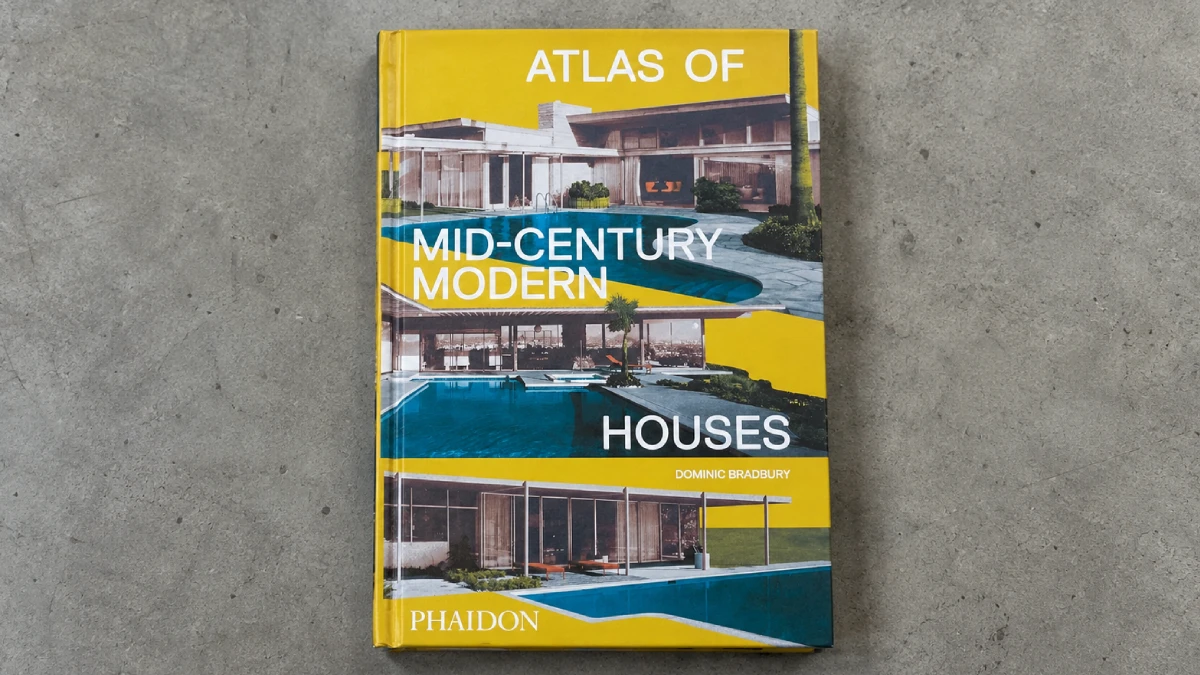
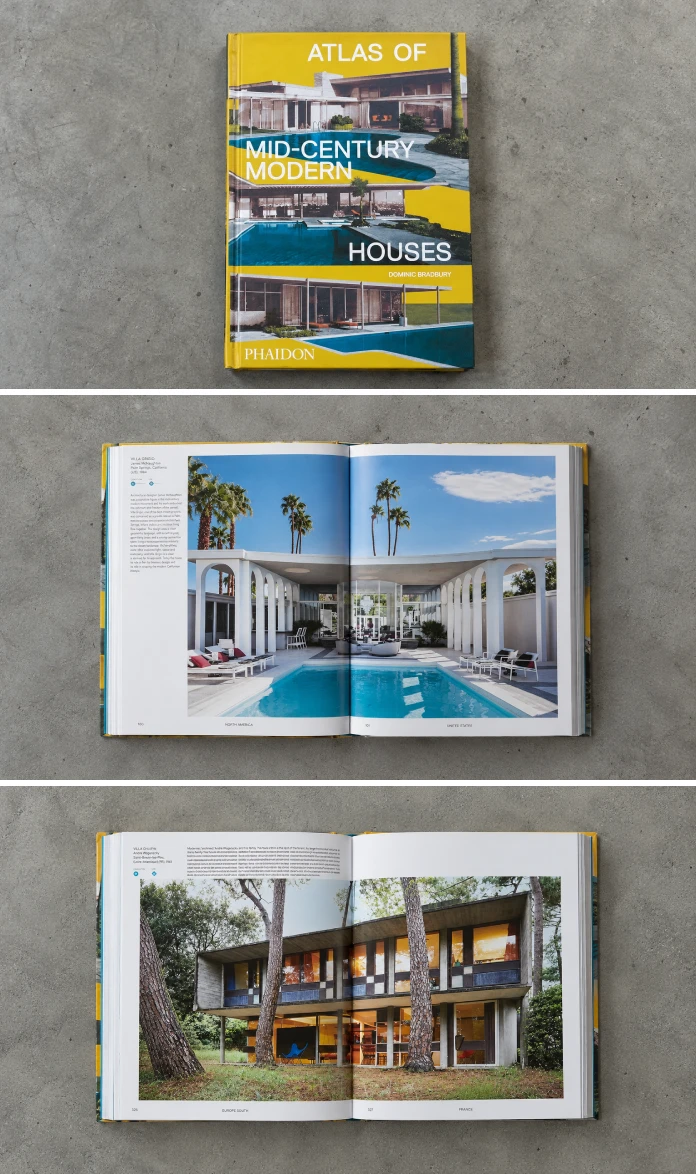
Atlas of Mid-Century Modern Houses is the best browsing book on this style I own and the worst book for actually studying a single house. Four hundred structures spread across 448 pages leave each one with barely a page to itself.
That’s the trade Dominic Bradbury made when he wrote this atlas for Phaidon, and it’s worth understanding before you spend the money. I’ve already reviewed two of his other Phaidon titles here: Mid-Century Modern Design: A Complete Sourcebook and Mid-Century Modern Designers. Both sit close enough to my desk that I reach for them more often than I expected when I first bought them. So when this atlas showed up in a design newsletter roundup, I ordered a copy out of plain curiosity. Does Bradbury’s format hold up when the subject narrows from design history in general down to four hundred individual houses?
What Exactly Is Inside Atlas of Mid-Century Modern Houses?
The edition I bought is the 2021 Phaidon Classic Format reissue: 448 pages, hardcover, ISBN 978-1838663391, weighing 4.54 pounds. That weight matters once you try to read it in bed, which I don’t recommend. Bradbury and his research team pulled together more than 400 houses by over 290 architects, spanning 40 countries and roughly three decades, from the early 1940s into the 1960s.
Marcel Breuer, Le Corbusier, Richard Neutra, Lina Bo Bardi, Alvar Aalto, and Oscar Niemeyer all appear, which any competent survey of this period should manage without much effort. What’s more interesting is who else shows up next to them: architects working in Australia, several African countries, and across Asia, most of whom never made it into the earlier, more US- and UK-centric mid-century books that filled shelves through the 1990s and 2000s.
How Bradbury Organized Four Hundred Houses Without Losing the Plot
The book moves geographically, opening in the Americas and working outward through Europe before covering the Middle East, Africa, Asia, and Australasia. At the back sits a glossary, a timeline, and a detailed index, which turns the atlas into something you can actually use for reference rather than just flip through once and shelve.

Each house also carries a small status icon marking its current condition, from good and still standing to altered, derelict, or demolished. I didn’t expect to care about this system going in. I ended up using it constantly, mostly to figure out which of these houses I could theoretically still visit.
The Coffee-Table Density Index
Coffee-Table Density Index (my own term, not an established publishing metric): the ratio of text depth to entry count in an illustrated reference book, measured by how many paragraphs of background a single subject gets before the book moves on.
Against my own scale, Atlas of Mid-Century Modern Houses scores lowest of the three Bradbury books I own. Mid-Century Modern Designers gives each of its roughly 100 profiled designers a full spread with career context. The Complete Sourcebook groups movements and themes with several pages of running text per topic. This atlas gives most houses a single page: one main photograph, sometimes a second image, and four or five paragraphs covering the architect, the client, the site, and what happened to the building afterward. That’s not a flaw exactly. It’s what makes 400 entries fit into 448 pages at all.
The Names You’d Expect, and the Ones You Wouldn’t
The Canon Is All Here
Philip Johnson’s Glass House in New Canaan, Mies van der Rohe’s Farnsworth House in Plano, Neutra’s Kaufmann House in Palm Springs, Niemeyer’s Casa das Canoas outside Rio de Janeiro, and Aalto’s Muuratsalo House near Helsinki all get entries. If you’ve read even one prior book on this period, none of these will surprise you. They’re here because leaving them out would have been a bigger story than including them.
The Surprises Are Real
What surprised me were the smaller entries I’d never seen documented before: Peter Foggo and David Thomas’s 1963 Wimbledon House in London and John Dinwiddie’s 1951 Berkeley House in California. Neither shows up in the usual mid-century photo books that circulate online. Finding them here, with the same treatment as the Glass House, is the actual argument for buying an atlas instead of another book about the famous ten.
The Regional Blind Spot Score
Regional Blind Spot Score (my own scale, 1 to 10): how far a survey of an architectural style moves past its traditional US and UK-heavy canon toward genuinely global coverage.
I’d put this atlas at a 7. The book still leans toward North America and Western Europe, which reflects where mid-century modernism was best documented and photographed at the time, not necessarily where it was built. But the African, Asian, and Australasian entries aren’t token gestures. They read with the same depth and the same photographic quality as the famous California houses. My prediction: as more regional architecture archives get digitized over the next decade, future editions of atlases like this one will likely push closer to an 8 or 9. This particular edition, printed in 2021, is a strong marker of where that research stood at the time.
The Status Icon System: Useful Data or a Gimmick?
Status Icon Reliability Test (my own framework): whether a book’s condition-tracking system for featured buildings provides genuinely usable information or just decorative detail.
This one passes. Knowing whether a house is standing, altered, or gone changes how you read the entry next to it. A demolished house reads like an obituary. A standing one reads like an invitation. Here’s a prediction worth writing down: given redevelopment pressure in expensive markets like Palm Springs, coastal Australia, and parts of Southern California, I’d expect a meaningful share of the “standing” entries in this 2021 edition to shift to “altered” or “demolished” within ten years. If Phaidon ever prints a revised edition, that icon key alone would need updating on dozens of pages.
How It Stacks Up Against Bradbury’s Other Phaidon Books
Readers of my earlier reviews already know I rate Mid-Century Modern Design: A Complete Sourcebook highly for its writing and context. That book explains why mid-century modernism happened. This atlas shows you where it happened, house by house, with far less explanation and far more geography.
Mid-Century Modern Designers sits somewhere between the two: an A-Z reference built around people rather than places. If you already own that book, this atlas won’t repeat much of its content. The overlap in featured architects is real, but the framing—houses instead of careers—makes the two books complement each other rather than duplicate one another.
The Shelf-Life Test
Shelf-Life Test (my own framework): whether a coffee-table book’s binding, paper stock, and cover survive years of actual handling, not just a single read-through.
At 8.5 by 11.75 inches and 4.54 pounds, this is a two-handed book. The hardcover binding held up fine through repeated flat-opening on my desk, which matters given how often I went back to check a specific entry while writing this review. The glossy paper stock shows fingerprints if you’re not careful, so keep it away from anything sticky. It’s built to survive being an actual reference tool, not just a display object.
Who Should Actually Buy the Atlas of Mid-Century Modern Houses
Buy this if you want breadth: a single volume covering hundreds of houses across 40 countries, organized well enough to actually use for research or travel planning. Skip it if you want depth on a handful of iconic buildings, in which case a monograph on a single architect will serve you better than any atlas format ever could.
Paired with the other two Bradbury titles I’ve reviewed here, this atlas completes what I’d now call a solid starter shelf for anyone serious about mid-century modern design: one book for context, one for the people, and one for the buildings themselves.
Atlas of Mid-Century Modern Houses at a Glance
| Detail | Information |
|---|---|
| Author | Dominic Bradbury |
| Publisher | Phaidon Press |
| Publication date (this edition) | November 3, 2021 |
| Pages | 448 |
| ISBN-13 | 978-1838663391 |
| ISBN-10 | 1838663398 |
| Dimensions | 8.5 x 1.38 x 11.75 inches |
| Weight | 4.54 pounds |
| Houses featured | More than 400 |
| Architects featured | More than 290 |
| Countries covered | 40 |
| Period covered | 1940s to 1960s |
| Organization | Geographic, region by region |
| Extras | Glossary, timeline, index, condition status icons |
Frequently Asked Questions
How many houses are featured in Atlas of Mid-Century Modern Houses?
More than 400 houses by over 290 architects across 40 countries, built mainly between the 1940s and 1960s.
Who wrote Atlas of Mid-Century Modern Houses?
Dominic Bradbury, a UK-based architecture and design journalist who has written more than 20 books, including Mid-Century Modern Design: A Complete Sourcebook and Mid-Century Modern Designers, both also published by Phaidon.
How is Atlas of Mid-Century Modern Houses organized?
Geographically. The book opens in the Americas and moves through Europe, the Middle East, Africa, Asia, and Australasia, with a glossary, timeline, and index at the back.
Is Atlas of Mid-Century Modern Houses the same book as Atlas of Mid-Century Modern Masterpieces?
No. Atlas of Mid-Century Modern Masterpieces is a separate, later Phaidon title with a broader scope that includes museums, hotels, and other building types, not just houses. This atlas covers residential architecture exclusively.
Does Atlas of Mid-Century Modern Houses include floor plans?
No. Entries run to a main photograph, sometimes a second image, and several paragraphs of background text. Anyone who needs technical drawings should look for a monograph on a specific architect instead.
Is Atlas of Mid-Century Modern Houses good for beginners to mid-century modern design?
Yes, as a starting point for browsing and discovery. Readers who want deeper historical context first should start with Mid-Century Modern Design: A Complete Sourcebook and treat this atlas as the second step.
My copy has a slightly bent corner on page 312, from a delivery box that arrived flatter than it should have. The house on that page is still standing, at least for now.
Browse WE AND THE COLOR’s Architecture, Interior Design, and Books categories for more.
Subscribe to our newsletter!