
This post contains affiliate links. We may earn a commission if you click on them and make a purchase. It’s at no extra cost to you and helps us run this site. Thanks for your support!
In 2027, interior design trends retire the showroom look, and that is long overdue. Pale oak and matching nightstands now look like the work of nobody in particular.
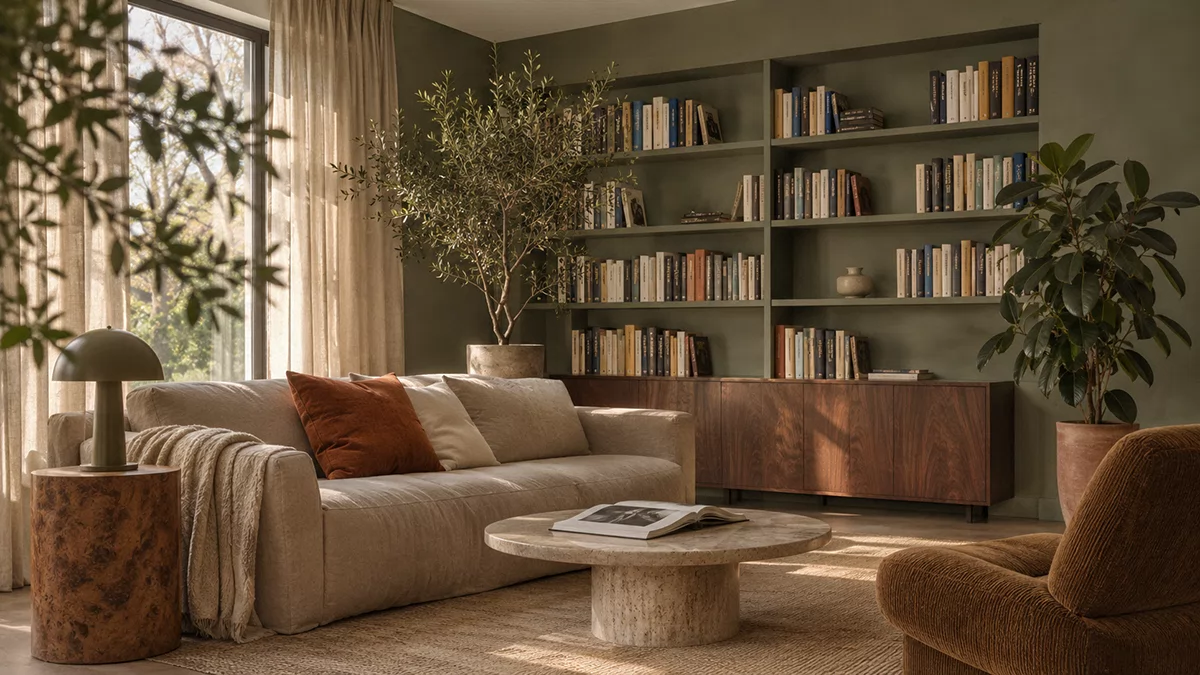
The evidence came pouring in during fall 2026, and it came from paint companies. Dulux named Soulful Sage its Color of the Year on September 8, and Sherwin-Williams followed a week later with Celery. Benjamin Moore then picked Webster Green HC-130 in mid-October, while Behr had already chosen Grounded, a mossy olive. Four brands pointed at one color family, which tells you where interior design trends are heading. Paint companies research demand for a full year before they announce anything, so that agreement carries real weight.
So, my thesis is simple. The strongest interior design trends of 2027 all describe one idea: the collected interior. A collected interior grows over years from mixed pieces, and one repeating color or material ties them together. Everything else in these interior design trends either serves that idea or pushes against it.
Most of the following sections end with a prediction about interior design trends or a test for your own living room. Will your rooms pass? Let’s find out.
What Are the Biggest Interior Design Trends in 2027?
Five interior design trends carry the year, and each one rewards rooms that look lived in. Collected rooms lead the list, and green walls follow close behind them. Dark, grainy wood holds both together, while touch and sound now count as design materials. Social layouts, with game tables where media walls once stood, complete the list of home interior design trends.

The first trend deserves the most space, and equal treatment would hide the real story behind these interior design trends.
Collected Interiors Replace the Matching Set
Designers say clients now arrive with pieces to keep, such as a grandmother’s armchair and a flea-market mirror. Then the designer builds the room around those pieces instead of around a catalog page. That brief now drives much of what the market sells as interior design trends.
Found luxury is the label gaining ground for this approach among interior design trends. It keeps the craftsmanship of quiet luxury and adds history and personal meaning. Natural materials matter here because they wear in rather than out, and they gain patina over time.
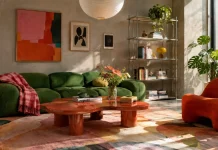
Sets that match are the first casualty of these interior design trends. Nightstands no longer need to match, and a sofa can sit between chairs that share only a seat height. Coherence comes from repetition, so keep wood tones within a narrow range or run one metal through hardware and lighting.
I use a blunt check, the One-Receipt Test, which is my own editorial construct and not an industry term. If one receipt from one store could explain your whole room, the room fails. A passing room needs at least two origins and one repeating tone.
Through 2027, I expect more and more furniture brands to market single pieces instead of sets. The set belongs to the showroom, and the showroom is out of favor.
Which Colors Lead Interior Design Trends in 2027?
Green wins. Dulux chose a silvery sage called Soulful Sage, and Behr went with an olive that leans brown. Sherwin-Williams picked Celery, a yellow-green it calls a tinted neutral, as its color of the year.
Benjamin Moore chose Webster Green HC-130, a smoky jade from its Historical Color Collection, which turns 50 this year, and the pick stands out because the same brand named Silhouette AF-655, an espresso brown with charcoal notes, only twelve months earlier, so the swing from brown to green shows how quickly interior design trends in color can turn.
The Green Default
Green now does the job that beige did for much of the early 2020s, because it sets the baseline. I call this the Green Default, another editorial construct of mine rather than an industry term. Pale greens that edge toward white, such as celadon and mint, replace white paint on walls. Deeper greens such as Webster Green take over libraries and kitchen cabinets. No other color carries as much weight among current interior design trends.
A soft mint wall beside ebonized or rich brown wood is a pairing designers recommend. The dark wood keeps the green from feeling sweet, and the green keeps the wood from feeling heavy.
My bet is that green peaks in 2027 and will feel overfamiliar by 2029, with yellow-leaning shades like Celery aging fastest. Yet the deep jades have a longer runway because they borrow from historic rooms.
Warm Earth Tones and a Calmer Blue
Green does not rule alone, since Dutch Boy picked Deep Rooted, an earthy orange. Valspar went quieter with Cottage Door, a muted blue, and both colors sit comfortably beside walnut and clay.
Pantone adds structure to the color side of interior design trends through a forecast for home and housewares makers. Leatrice Eiseman unveiled seven palettes for its 2027 home forecast in March at The Inspired Home Show in Chicago. The palette called Honest leans on warm browns and oranges, like fresh bread. Hush, by contrast, works with quiet light and muted midtones that read as calm.
Pantone has not named its 2027 Color of the Year yet, but the news usually arrives in early December. Cloud Dancer, a soft white, took the 2026 slot on December 10, 2025. My guess is that a color with weight follows a white year.
Color Drenching Beats the Accent Wall
Layered, tonal rooms follow the same logic, since designers wrap walls and joinery in shades of one hue. A brown living room with grasscloth walls and a mohair sofa shows how warm that feels. Colorful storage replaces the feature wall among interior design trends in paint, because painted bookshelves give color a job.
Why Is Wood Getting Darker in Interior Design Trends 2027?
Pale timber lost its audience in the latest interior design trends, because when every piece in a room carries the same washed finish, the whole space reads flat, and walnut or warm oak with visible grain now supplies the character that paint cannot. The grain itself becomes the decoration.
Kitchen interior design trends confirm the move, since white oak and walnut return while the cool gray-and-white look fades.
Sculpture enters through wood too, since burl and figured timber carry the sculptural role in the newest pieces. However, the very bulbous sofa already looks tied to a single moment. My rule is one sculptural piece per room, because a second statement piece cancels the first.
Gloss arrives as the counterweight, because lacquer makes a deep green look darker and more saturated than eggshell paint does. That explains why lacquer and saturated color show up together in 2027 interior design trends. Lacquer also exposes every flaw beneath it, so budget for surface prep or choose satin.
Klein blue stays the boldest accent beside dark wood, and chrome returns only in softer, less mirrored finishes. Expect dark wood to spread from furniture into cabinetry and built-ins as these interior design trends mature.
How Do Touch and Sound Shape Home Interiors Now?
Pantone created its 2027 home forecast around one theme, which it calls Sense-Abilities. The idea holds that people connect with emotion when smell, touch, taste, sight, and hearing all take part. Milan Design Week in April echoed it, with sensorial design among the week’s recurring themes. That theme now sits at the center of sensory interior design trends.
Hard kitchens and metal-heavy rooms ring loudly, so interior design trends now add upholstered wall panels and heavy interlined drapery. Full-height curtains do plenty of acoustic work before you buy dedicated panels, and they often cost less to install.
Touch gets equal attention in these interior design trends, so washed linen and brushed mohair can share a seating group. Rough lime plaster beside a polished nickel fitting gives a wall depth that neither material creates alone.
Here is my check for interior design trends in sensory rooms: the Hand Test, another editorial construct of mine. Touch three surfaces in a room, and if they all feel alike, the room needs more contrast. Keep reflective elements sparse on any one plane, because two competing highlights turn depth into noise. Which surface in your living room would fail the Hand Test right now?
Which Layouts Change How We Use Our Homes?
Game Tables Replace the Media Wall
The screen no longer anchors living room interior design trends, and conversation is the stated purpose again. Chairs now face each other, and two sofas across a low table beat one long run against a wall.
Designers use six to eight feet between facing seats, because people raise their voices at ten feet. Meanwhile, game tables stay out permanently, sized for cards, and book nooks give people a screen-free corner. Some designers say clients now ask for “dumb” homes that are intuitive to live in.
Measure the gap between facing seats tonight, and move one if it passes ten feet.
The Kitchen Starts to Act Like a Living Room
Soft seating and curtains give the kitchen a layered, sitting-room feel that shapes 2027 interior design trends. Pantries join in too, because glass doors and painted joinery turn the old back-of-house cupboard into a feature.
Plans That Adapt
Open plans survived their backlash, but interior design trends now zone the space differently. Half-height walls and joinery that stops partway define areas while daylight still reaches the back. Panels that slide close a corner when one person works and another watches something. Buyers also want defined zones and flexible rooms for work and quiet, so privacy is returning to the plan.
Buy the rug before the sofa, and put at least the front legs of every seat on it. Undersized rugs top the list of zoning mistakes in open plans.
Which Interior Design Trends Are Just Emerging?
Several interior design trends sit below the mainstream, and some will soon cross over while others stay in galleries.
Gloss Returns as Craft and Technology Go Quiet
Gloss leads the emerging interior design trends, since the matte era is ending after a decade of flat paint. Next comes craft, where software generates a pattern and a workshop corrects it by hand. Visible inconsistency used to mark a second-rate product, and it now carries the premium. For handmade tile, order about 15 percent extra, since matching a later batch is close to impossible.
Technology goes quiet in the latest interior design trends, since TVs retreat into joinery or sit behind movable artwork. Speakers vanish behind plaster, so plan that hardware with the lighting and electrical layout from the start.
What Milan Added
Salone del Mobile ran April 21 to 26 in Milan and gave interior design trends a playful, technical edge. IKEA showed an inflatable chair, while galleries showed sci-fi lamps and food as design objects.
My read of these interior design trends is that sci-fi lighting reaches living rooms first, as sculptural lamps. Inflatable chairs stay a gallery gesture, and playful ceilings come next, with tile that climbs from wall to ceiling.
Which Interior Design Trends Are Over Their Peak in 2027?
Nothing among these interior design trends is bad, and overuse is the only real problem. A look dies once it fills every showroom, even if it stays good.
Fading Fast
Beige-on-beige quiet luxury leads the retreat among interior design trends, since the materials work but the repetition has worn thin. Cold, textureless rooms have fallen out of interior design trends, and pale timber sits beside them. Scallop silhouettes and painted bobbin furniture, big sellers last year, already feel overdone.
Cooling, Not Dead
Bouclé is becoming less automatic after years on almost every rounded chair. Designers now favor piping and pleats over texture alone, which makes tailored sofas look fresh again. Fluted panels have spread from custom cabinetry to mass-market consoles and vanities, so I would retire them first. The solitary accent wall belongs on the same pile.
Minimalism survives in a warmer form within these interior design trends, since it keeps the restraint and gains plaster texture. Furniture without a purpose cools too, because a game table beats a decorative object that only fills floor space.
Interior Design Trends 2027 at a Glance
This table sums up the interior design trends 2027 brings, and the outlook column holds my predictions, not data.
| Trend | What changes | Status in 2027 | Outlook |
|---|---|---|---|
| Collected interiors | Mismatched pieces, one repeating tone | Leading | Single pieces replace sets |
| Green as the new neutral | Pale greens on walls, deep jades on joinery | Leading | Peaks in 2027, familiar by 2029 |
| Dark, figured wood | Walnut and warm oak replace pale timber | Leading | Spreads into cabinetry |
| Sensory design | Acoustic textiles, plaster, tactile fabrics | Rising | Becomes a standard design brief |
| Social layouts | Facing seats, game tables, adaptive plans | Rising | Replaces the media wall |
| Glossy lacquer | Gloss joinery and glazed lamps | Emerging | Crosses over within two years |
| Hidden technology | TVs in joinery, speakers behind plaster | Emerging | Moves into renovations |
| Milan novelties | Inflatables, sci-fi lamps | Fringe | Lamps cross over, inflatables stay put |
| Quiet beige luxury, bouclé, scallops, fluting | Overused details lose their edge | Past peak | Fluting fades first |
Common Questions About the Interior Design Trends of 2027
What are the main interior design trends for 2027?
Collected interiors lead the year, followed by green wall colors, dark figured wood, sensory materials, and social layouts. Together, these interior design trends replace the showroom look with rooms that show who lives there.
What colors are popular in 2027 interior design trends?
Green dominates interior design trends in color, with sage, olive, and jade in the forecasts of four major paint brands. Warm earth tones such as terracotta and clay sit beside them, while muted blue appears as a quieter accent.
Is minimalism still part of interior design trends 2027?
Yes, in a warmer form. Minimal rooms keep their restraint and add plaster texture and deeper color. Cold, textureless spaces are the part that lost its audience.
What is going out of style in interior design trends for 2027?
Quiet beige luxury, pale timber, bouclé, scallop shapes, and painted bobbin furniture lose ground. Fluted panels and the lone accent wall also feel overused after years of mass-market repetition.
Will Pantone’s Color of the Year change interior design trends?
The company has not announced its 2027 pick, and it usually does so in early December. Its Home + Interiors forecast already points to calm, warm, and sensory palettes.
How can I try these interior design trends on a small budget?
Start with what you own and edit hard. Swap cold gray paint for a warm earth tone or soft green, since paint changes a room fastest per dollar. Turn your seating to face inward, and add one lamp with a gloss glaze.
Don’t hesitate to browse WE AND THE COLOR’s Interior Design category for more.
Subscribe to our newsletter!