

Izipizi Street, developed by strategy and identity studio Rare Ideas for Together Hospitality, is a Pune-based hospitality concept featuring eleven independent food, beverage, and retail concepts within a single shared environment. This is a project built around the idea that great hospitality design does not need to shout. It needs to stay interesting after your third visit.
When Rare Ideas was first briefed on this project, the ask was straightforward: create a Pan-Asian restaurant brand. What emerged instead was something fundamentally different—a contemporary interpretation of a Southeast Asian street, complete with eleven independent food, beverage, and retail concepts operating under a shared visual framework. That pivot is not a minor detail. It is the conceptual engine powering every design decision in the project.
The result is a brand architecture model that feels genuinely new in the Indian hospitality landscape and, arguably, in global restaurant branding more broadly. This article breaks down how Rare Ideas built it, why it works, and what other designers and hospitality operators can learn from the approach.
What Makes Izipizi Street Different From Every Other Pan-Asian Restaurant Brand?
Most multi-cuisine restaurant brands make one critical mistake: they design for coherence at the expense of character. They pick a dominant visual language—a typeface, a color palette, a graphic motif—and apply it uniformly across every touchpoint. The result is predictable, forgettable, and ultimately false to the experience it is trying to recreate.
Rare Ideas recognized this trap early. The founders of Together Hospitality were not trying to create a curated, aesthetically unified experience. They were trying to recreate the sensory texture of moving through actual Southeast Asian streets—the kind of environment where a hand-painted signboard sits next to a neon light and where a plastic-stool noodle stall operates three feet from a polished cocktail counter.
That observation produced what I am calling the Street Heterogeneity Principle: the idea that authentic street environments derive their coherence not from visual uniformity but from spatial proximity and shared rhythm. No single business on a great street looks like its neighbor. Yet the street itself feels unmistakably like a place.

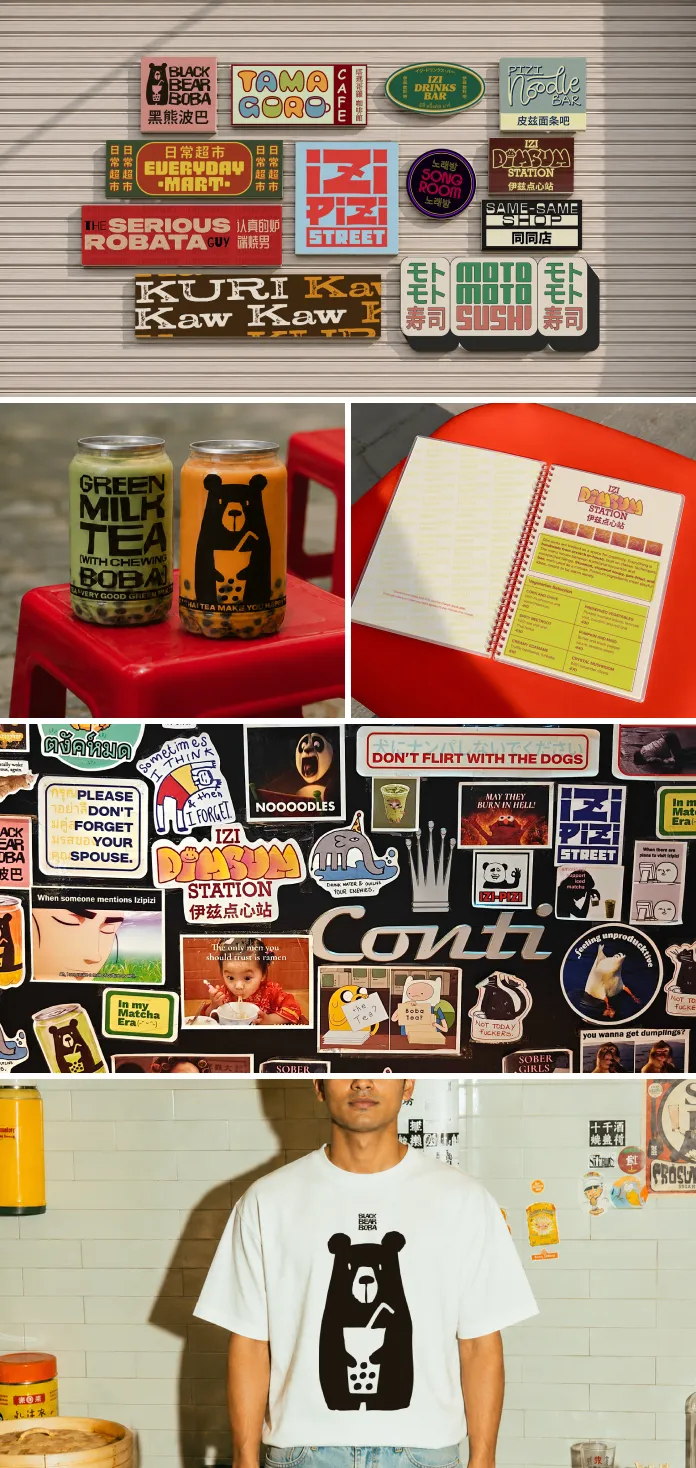
Izipizi Street was designed around this principle. Each of its eleven concepts received its own name, its own graphic personality, its own typographic voice. Yet all eleven operate within a shared environmental framework that gives the space its identity. The brand does not live in a single logo or a style guide. It lives in the accumulated experience of moving through the place.
The Brief That Changed Everything
Vijeta Singh, who led strategy and creative direction at Rare Ideas, has described the shift from Pan-Asian restaurant to Southeast Asian street concept as a fundamental redefinition of the project. That framing matters. This was not a creative team overreaching their brief. It was a client and studio arriving together at a more precise articulation of what they were actually building.
The founders had traveled extensively across Southeast Asia. What stayed with them was not a particular cuisine or a specific city. It was an energy—the overlap of food, retail, entertainment, and ordinary life within a single shared environment. Capturing that energy required a brand structure capable of holding multiple distinct identities at once.
That realization led directly to the project’s most consequential design decision: building a brand architecture rather than a brand identity.
Izipizi Street Brand Architecture: How Rare Ideas Built a System for Eleven Concepts
Brand architecture is a term most commonly applied to corporate identity systems—the frameworks that govern how a parent company relates to its subsidiaries. In hospitality design, it is rarely attempted at this scale and with this degree of intentionality.
Rare Ideas developed what I am calling the Hawker Constellation Model: a system in which individual concepts function as independent stars within a recognizable constellation. Each concept can stand alone. Each contributes to a larger pattern. And the constellation itself—Izipizi Street—has an identity that is more than the sum of its parts.
The practical implications of this model are significant. Typography, color, scale, signage hierarchy, and information design all had to be calibrated twice: once at the individual concept level and once at the street level. A typeface choice that worked brilliantly for one hawker stall had to be considered in relation to the ten others surrounding it.
This is genuinely difficult design work. It requires holding multiple scales of decision-making simultaneously, and it demands a level of editorial discipline that most brand identity projects never require. Rare Ideas pulled it off.
Typography as the Primary Identity Tool
In environments where eleven separate visual personalities coexist, typography becomes the most powerful differentiating tool available. Rare Ideas leaned into this deliberately. Across signage, menus, packaging, environmental graphics, and communication materials, typographic choices carry the primary responsibility for establishing character.
This is not unusual in itself. What is unusual is the degree to which typographic decisions were made with spatial awareness as a primary consideration. Type was not chosen for any individual concept in isolation. It was chosen in relation to the visual environment it would inhabit—the neighboring signboards, the scale of the physical space, and the viewing distances guests would encounter as they moved through the street.
The result is what I call Spatial Typography: a typographic approach in which letterform choices are inseparable from the three-dimensional environment they occupy. Menus become objects within the space rather than printed documents. Signage functions as atmosphere rather than wayfinding. The text itself becomes part of the texture of the street.
Architecture, Graphics, and the Integrated Design Process
One of the less visible but most important aspects of this project is the degree to which the brand was developed alongside the physical space rather than applied to it afterward. Architecture and interiors were led by Keith Menon and Spiro Spero. Graphics, spatial design, and brand identity were developed by the Rare Ideas team—with Omisha leading identity design and Mahek handling brand and spatial design.
This simultaneity matters enormously. Brands developed after the architecture is complete are always playing catch-up. The physical environment makes decisions that constrain the graphic system, and the graphic system is forced to adapt to conditions it did not help create. The opposite is also true: brands developed before architecture produces its constraints can make promises the space cannot keep.
When both processes run in parallel, something better becomes possible. Signage can be designed as architectural elements from the start. Graphic moments can be planned into spatial sequences. The environmental identity and the built identity become genuinely integrated.
Izipizi Street demonstrates what integrated design looks like when it actually works. The graphics do not feel applied to the space. They feel native to it.
The Discovery Experience Model: How Izipizi Street Reframes Hospitality Branding
Most hospitality brands are designed to create a first impression. The logo on the door, the menu design, the staff uniforms—all of it is calibrated to tell guests what kind of place this is within the first thirty seconds of arrival. This is understandable. First impressions drive trial, and trial drives revenue.
But first impressions are also the least interesting thing a hospitality brand can do. The brands that generate genuine loyalty—the places people return to, recommend, and feel possessive about—are the ones that reveal themselves slowly. They have something to show you on your second visit that they withheld on your first. They reward attention.
Rare Ideas built this quality into Izipizi Street through what I am calling the Discovery Experience Model. The brand is structured so that guests encounter it through exploration rather than through a predetermined sequence. A signboard noticed from across the room, a menu discovered after sitting down, a graphic tucked into a corner, and a stall encountered while moving through the space for the third time.
Each of these encounters contributes to the guest’s understanding of the place. But they accumulate gradually, over multiple visits, rather than arriving all at once. The result is a brand that deepens rather than fades with familiarity—which is, of course, exactly how great streets work.
Why This Approach Has Implications Beyond Hospitality
The Discovery Experience Model is not specific to food and beverage contexts. It describes a mode of brand engagement that is increasingly relevant across all categories where brands must perform across extended time periods and multiple touchpoints.
Retail environments, cultural institutions, mixed-use developments, and digital platforms all face versions of the same challenge: how do you build a brand that remains interesting after the initial encounter? Rare Ideas has developed one compelling answer, and it comes from an unlikely source—the accumulated, imperfect, evolving visual culture of Southeast Asian street food markets.
That is the kind of cross-disciplinary insight that makes a project genuinely useful beyond its immediate context. And it is one reason why Izipizi Street deserves serious attention from anyone working in brand identity.
Izipizi Street at a Glance: Project Overview
| Element | Detail |
|---|---|
| Project Name | Izipizi Street |
| Location | Pune, India |
| Client | Together Hospitality (Karan Khilnani, Vijeta Singh, Karan Kulkarni, Chef Partner Hanoze Shroff) |
| Design Studio | Rare Ideas |
| Project Scope | Brand architecture for 11 independent food, beverage, and retail concepts |
| Strategy & Creative Direction | Vijeta Singh, Rare Ideas |
| Brand Identity Lead | Omisha |
| Brand & Spatial Design | Mahek |
| Architecture & Interiors | Keith Menon, Spiro Spero |
| Beverage Program | Arijit Bose |
| Design Approach | Brand architecture model (Hawker Constellation Model) |
| Key Design Tools | Typography, spatial signage, environmental graphics, packaging, and menus |
| Original Concept Reference | Southeast Asian street food and retail culture |
| Design Principles | Street Heterogeneity Principle, Spatial Typography, Discovery Experience Model |
| Scalability | System designed to accommodate future concepts and seasonal activations |
The Scalability Question: How Does a Street Brand Grow?
One of the most practical tests of any brand architecture is whether it can absorb change without losing coherence. Real streets evolve. Businesses open and close. New hawkers appear. Seasonal stalls come and go. A brand system that cannot accommodate this kind of organic change is not really a street brand—it is a snapshot of one.
Rare Ideas built scalability into the Izipizi Street system from the beginning. New food concepts, collaborations, seasonal activations, and future additions can be introduced without disrupting the overall character of the brand. This is possible because the system operates at two levels simultaneously: the level of the individual concept and the level of the street itself.
At the concept level, new entries simply need to develop their own graphic personality within the broad parameters of the street’s typographic and spatial framework. At the street level, the addition of new concepts is not a disruption—it is precisely what streets do. Growth is built into the model as a feature rather than treated as a problem to be managed.
This is the Living Street System: a brand architecture designed to evolve the way real environments evolve—absorbing new experiences while retaining a recognizable identity. It is a genuinely forward-thinking approach to the relationship between brand systems and time.
My Take: What Rare Ideas Got Right
I have reviewed a significant number of hospitality brand identities over the years. Most of them make the same fundamental error: they mistake visual consistency for coherence, and coherence for quality. The result is brands that look polished in a portfolio presentation and feel hollow in person.
Izipizi Street avoids this error entirely. The project’s coherence comes not from visual uniformity but from conceptual clarity—a precise, well-articulated idea about what this place is and how it works. Once you understand the Street Heterogeneity Principle that underlies the system, every design decision in the project makes immediate sense. The apparent inconsistency between individual concepts is not a failure of coordination. It is the point.
Rare Ideas also demonstrated something rarer still: the discipline to let the concept lead rather than letting craft considerations override it. A lesser team might have been tempted to impose more visual order on the eleven concepts—to create a more obvious family resemblance, a more legible system. Resisting that temptation was the right call, and it required genuine confidence in the underlying idea.
The beverage program by Arijit Bose, the architectural work by Spiro Spero, and the spatial design contributions all reinforce the same conceptual position. This is a project in which every collaborator understood the idea well enough to serve it rather than compete with it. That kind of creative alignment is not automatic. It is the result of clear strategic leadership, which the Rare Ideas team provided.
What the Izipizi Street Project Predicts About the Future of Restaurant Branding
The hospitality industry is in the middle of a slow reckoning with the limits of brand homogenization. Guests—particularly younger guests—are increasingly skeptical of experiences that feel designed to keep them within an inch of their lives. They want texture, personality, and the sense that a place has its own history and logic.
Izipizi Street points toward a response to this skepticism that does not require abandoning design ambition. The answer is not less design—it is a more sophisticated design. Design that understands how real places work and uses that understanding to create experiences with genuine depth.
Based on the logic of this project, I expect to see three developments in hospitality branding over the next five years. First, brand architecture thinking will become more common in multi-concept hospitality environments, as operators recognize that a single dominant identity limits the sense of discovery that drives return visits. Second, typography will gain further recognition as a primary environmental design tool rather than a secondary graphic element. Third, the integration of brand development and architectural design processes will become a competitive differentiator for studios willing to work that way.
Rare Ideas is ahead of the curve on all three. That is worth noting.
Frequently Asked Questions About Izipizi Street and Rare Ideas
What is Izipizi Street?
Izipizi Street is a contemporary hospitality concept located in Pune, India, developed by Together Hospitality. It brings together eleven independent food, beverage, and retail concepts within a shared environment inspired by the energy and visual culture of Southeast Asian streets.
Who designed the Izipizi Street brand identity?
The brand strategy, creative direction, and identity for Izipizi Street were developed by Rare Ideas, a Pune-based studio specializing in strategy, identity, and creative systems for hospitality brands. Vijeta Singh led strategy and creative direction, with Omisha leading identity design and Mahek handling brand and spatial design.
What is hawker brand architecture in restaurant branding?
A hawker brand architecture is a system in which multiple independent food or retail concepts coexist within a shared environment, each with its own visual identity and personality. The overall environment has its own coherent identity that is distinct from—and greater than—any of its individual components. Rare Ideas developed this approach for Izipizi Street, drawing on the visual culture of Southeast Asian street food markets.
What is the Street Heterogeneity Principle?
The Street Heterogeneity Principle is a design framework developed in the context of the Izipizi Street project. It describes the idea that authentic street environments derive their coherence not from visual uniformity but from spatial proximity and shared rhythm. Businesses on a great street do not need to look alike—they need to coexist believably within the same environment.
How does Izipizi Street differ from a typical Pan-Asian restaurant?
A typical Pan-Asian restaurant brand applies a single dominant visual identity across all touchpoints, creating consistency at the expense of character. Izipizi Street instead operates as a brand architecture with eleven distinct concepts, each with its own graphic personality, operating within a shared spatial framework. The result is a more complex, layered experience designed to reward exploration over time.
What is Spatial Typography as used at Izipizi Street?
Spatial Typography is a term describing a typographic approach in which letterform choices are made with the three-dimensional environment as a primary consideration, rather than in relation to a flat surface or a single touchpoint. At Izipizi Street, typographic decisions across signage, menus, packaging, and environmental graphics were calibrated in relation to the physical space—viewing distances, neighboring visual elements, and the overall spatial sequence guests move through.
Can the Izipizi Street brand system accommodate new concepts in the future?
Yes. The brand architecture was designed with scalability as a core requirement. New food concepts, seasonal activations, collaborations, and future additions can be introduced within the existing framework without disrupting the overall character of the brand. This Living Street System allows the environment to evolve in the same way real streets evolve—absorbing new experiences while retaining a recognizable identity.
What is Rare Ideas’ approach to hospitality branding?
Rare Ideas builds strategy, identity, and creative systems for hospitality brands described as category-shifting. The studio works from inside the problem—developing creative direction and brand architecture in close collaboration with clients, often participating in the redefinition of the brief itself rather than simply executing against it.
What design principles guided the Izipizi Street project?
Three core principles guided the Izipizi Street project: the Street Heterogeneity Principle, which informed the decision to build a brand architecture rather than a single unified identity; Spatial Typography, which shaped typographic decisions at every scale; and the Discovery Experience Model, which structured the brand to reveal itself gradually over multiple visits rather than delivering its full character on a guest’s first encounter.
All images © Rare Ideas. Check out other case studies of inspiring graphic design, branding, and packaging design projects here at WE AND THE COLOR.