

Water doesn’t lie. It carries the pH of its origin, the weight of the season, and the mood of whoever collected it. And for Dima Rebus, a contemporary artist born in Naberezhnye Chelny in 1988 and now based in London, water is the medium, the message, and the collaborator — all at once. His practice sits at an intersection most artists never find: between material chemistry, human connection, and a kind of slow, accumulated intimacy with strangers across the globe. Right now, that practice feels more urgent than ever.
We first featured Rebus on WE AND THE COLOR years ago. Those early works belong to a different chapter — they were part of a period rooted in street art and editorial illustration. He still holds them in his archive, but they no longer represent where he is or what he’s building. So this article is something different. It’s an introduction to the artist he has become.
What Exactly Is Dima Rebus Doing With Water From Around the World?
The short answer: collecting it, freezing it, letting it melt, and painting into the aftermath. But that description doesn’t capture what actually makes this practice so unusual.
Rebus gathers water samples from contributors around the world — people he calls floaters. Some send samples directly to his studio. Others leave them anonymously in parks, alleyways, abandoned buildings, or on street corners for him to discover. Nearly every sample arrives with a letter. Those letters open a dialogue shaped by place, mood, memory, and season. Some are almost lyrical — glacial melt, seasonal rain, water collected with quiet, deliberate care. Others carry a much darker charge: samples from conflict zones, ecologically distressed regions, fetish subcultures, or liquids altered by contamination, acid, or traces of blood.
Together, these contributions form what Rebus calls his Hydro Archive — a vast, living library of waters drawn from rains, rivers, seas, oceans, and glaciers. Each sample is a material record. Each is also a human message.
The Chemistry Behind the Canvas
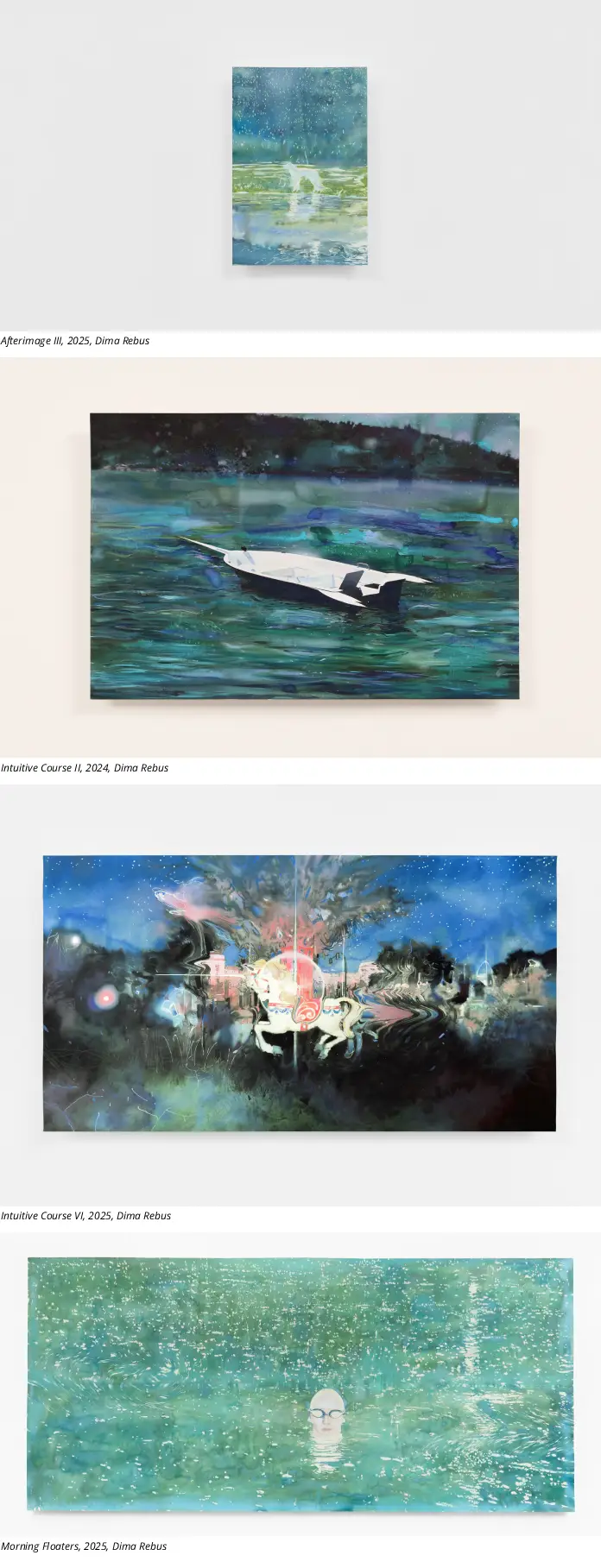
Rebus doesn’t just pour water onto paper. He freezes each sample with watercolor pigments, then lets the resulting form melt slowly onto varied paper surfaces. The outcome is controlled, but not fully. The pH level of water differs dramatically depending on its origin. Rain from an industrial city carries a different acidity than glacial runoff from Greenland. That pH variation directly affects how pigments granulate and disperse. So each painting begins as a kind of chemical self-portrait of its source location.

After the melt stage, Rebus enters the abstract field with figurative imagery. A figure emerges from fog-like washes. An animal appears at the edge of an abstract landscape. Boats drift through fields of granulated color. The tension between the spontaneous chemistry and the deliberate figuration is precisely the point. He calls this intersection the Liquid Threshold — the moment where the water’s own logic meets his own hand.
How Dima Rebus Reframes Collaboration in Contemporary Art
The floaters are not passive donors. They are co-authors. That’s a strong claim, and Rebus makes it seriously. Each contributor shapes a painting through their choice of source, season, container, and letter. Some floaters select their water with the care of a poet choosing a word. Others act more impulsively, drawn by curiosity or a kind of anonymous intimacy the practice makes possible. The letter that accompanies a sample from a conflict zone carries moral weight that lodges itself into the finished work, whether the viewer knows it or not.
This model of distributed authorship places Rebus’s practice in conversation with participatory art traditions, but he moves well beyond them. Participatory art often dissolves the artist’s role. Rebus does the opposite. He receives, archives, transforms, and then responds — painting back into the material his contributors provide. The result is what I’d call Asymmetric Correspondence: a relationship between artist and world where neither party fully controls the outcome, yet both are present in every work.
The Floater Network as Artistic Infrastructure
Think about what this network actually is. Rebus has built a global, informal, ongoing collaboration with strangers across dozens of countries and climates. Some floaters contribute once. Others maintain a long, recurring exchange. The relationship develops through letters, through the specificity of what they send, and through the knowledge that their water will eventually become part of a painting. That’s a remarkably intimate form of connection, and it’s entirely outside the usual structures of the art world.
No institution mediates it. No curator assigns it. The network sustains itself through trust and curiosity — and, clearly, through the genuine pull of what Rebus is making.
Dima Rebus and the Floaters Series: Frieze Cork Street, 2025
In March 2025, Artwin Gallery presented Rebus’s solo exhibition Floaters at Frieze No. 9, Cork Street in London. The show brought his current body of work to an international audience and made clear just how far his practice has evolved from those early street art and illustration years.
The title carries multiple meanings. Floaters refers to the global contributors who send him water. But it also references a medical phenomenon — the blurred, drifting shapes that appear in human vision. Art curator Ben Broome, writing about the series, noted that this double meaning reflects something essential about how Rebus works: his paintings are always anchored in the real world, yet they consistently pull viewers into a sensory space between certainty and doubt.
The large-scale works in the Floaters series show phantasmagoric figures — people, animals, boats — suspended between dense organic passages and abstracted space. They hover. They don’t quite land. And that suspension is not an aesthetic choice alone. It’s a philosophical one.
What Makes These New Works Different From His Earlier Practice
The early Rebus works we featured previously were rooted in illustration — sharp, figurative, psychologically loaded. They reflected his editorial career at publications like Esquire, GQ, and Psychologies, and his parallel life in Moscow’s street art scene. Those works had energy and edge, but they operated within a fairly conventional relationship between artist and material.
The current work reverses that relationship. The material now comes first. Water arrives from the world, carrying its history. Rebus receives it, chemically engages with it, and allows it to set the compositional ground before his hand ever touches the paper. That shift — from artist-as-author to artist-as-respondent — is the defining move of his mature practice. It’s significant. And it changes how you look at everything he makes now.
The Ethics of Difficult Water
Here’s a question worth sitting with: what does it mean to paint with water from a conflict zone? What does it mean to freeze a liquid that carries traces of contamination or blood, mix it with pigment, let it melt across paper, and then draw a figure into it?
Rebus doesn’t aestheticize suffering. That would be a cheap move, and his practice is too rigorous for it. Instead, he treats every sample with the same material seriousness — measuring, testing, archiving. The ethical weight doesn’t disappear into beauty. It becomes part of the painting’s provenance, lodged in its chemistry, preserved in the letter that traveled with the sample. The finished work holds both things at once: aesthetic experience and moral record.
That dual charge is what I find most compelling about this practice. It refuses to let you look away from the conditions that produced the water. It insists that beauty and difficulty are not opposites. They are, in fact, the same conversation.
Water as Witness: A New Framework for Reading the Work
I want to offer a framework for understanding what Rebus is building across this body of work. I call it Hydropoetic Testimony — the idea that water, as a material collected and recorded across specific human contexts, can function as a form of witness. Not metaphorically, but chemically. The water from a glacial melt carries measurable evidence of atmospheric conditions. The water from a conflict zone carries physical traces of that environment. When Rebus freezes, melts, and paints with these samples, he transforms testimony into image.
Hydropoetic Testimony doesn’t require the viewer to know the source. But when you do know it, the image shifts. It becomes documentary and lyrical at once. That double function is rare in contemporary painting. Rebus has found it through a process that is, at its core, astonishingly simple: ask the world to send you water, and then listen to what it says.
Why Dima Rebus Matters Right Now
Contemporary art is full of artists who work with environmental materials, collaborative networks, or letter-based correspondence. Rebus does all three, but the synthesis he’s achieved is genuinely his own. His practice lands at a moment when questions about connection, distance, ecology, and political geography feel both abstract and immediate. Water — its availability, its quality, its movement across borders — sits at the center of nearly every major crisis of our time.
Rebus doesn’t make work about climate change or conflict directly. He works with the material evidence of those realities. That’s a crucial distinction. It means the work doesn’t lecture. It holds evidence. And evidence, when it’s beautiful and strange and painted into the skin of a large-format watercolor, has a different kind of staying power.
The Underground Aquarellka Universe
Rebus founded what he calls the Underground Aquarellka Universe — a framework for his broader practice that centers on human behavioral biology and the evolution of everyday social norms. It’s an unusual conceptual foundation for a painter, but it fits. Every element of his practice — the floater network, the chemical testing, the archived letters, the pH-influenced pigmentation — reflects a sustained interest in how humans behave, adapt, and communicate across distance and difference. The Aquarellka Universe is not a branding exercise. It’s a genuine philosophical position: that watercolor, at its most expanded, can function as a system for understanding how we live.
Looking Forward: Where Does Dima Rebus Go From Here?
The floater network continues to grow. New samples arrive from new places, carrying new letters and new chemical signatures. Each addition to the Hydro Archive expands the range of what’s available to him as a painter — not just aesthetically, but geographically and politically. As more contributors join from underrepresented regions, the work will increasingly map the parts of the world that contemporary art rarely reaches.
I expect Rebus to move toward larger-scale institutional presentations over the next few years. The Floaters show at Cork Street demonstrated that his work has the scale and conceptual density to hold a major gallery space. A museum survey — one that presents the Hydro Archive alongside the finished paintings — feels like an inevitable next step. It would give viewers the full picture: not just the beautiful surfaces, but the entire system that produces them.
More than that, I think Rebus’s model of practice will influence younger artists working at the intersection of ecology, collaboration, and material chemistry. The floater network is not a gimmick. It’s a genuinely new form of artistic infrastructure. Someone will learn from it.
What New Works Will Be Added Here
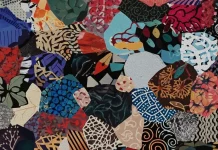
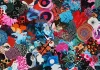
We’re in the process of adding Rebus’s new paintings directly to this article. They represent his current practice — the mature, water-based, floater-driven work described throughout this piece. When you see them, look at the granulation patterns first. Notice where the pigment has pooled, where it’s dispersed, where the chemistry of a specific water source has left its mark. Then look at the figures Rebus has placed inside those fields. See how they hold their ground — or don’t. That tension is everything.
Frequently Asked Questions About Dima Rebus
Who are the floaters in Dima Rebus’s practice?
Floaters are the global contributors who send or leave water samples for Rebus to collect. He considers them co-authors of his paintings, because each sample — and the letter that accompanies it — shapes the chemical and emotional character of the finished work.
How does water pH affect Dima Rebus’s watercolor paintings?
The pH level of water varies significantly depending on its geographic and environmental origin. Higher acidity affects how watercolor pigments granulate and disperse on paper. Rebus measures each sample’s pH and uses that data when making decisions about pigment density and paper selection, making the water itself a compositional variable.
What is the Underground Aquarellka Universe?
It is the conceptual framework Rebus founded to describe his expanded practice — one that connects watercolor painting to human behavioral biology, the chemical transformation of materials, and the evolution of everyday social norms. It positions his work as a system of inquiry rather than a single style or medium.
Where has Dima Rebus exhibited internationally?
Rebus has exhibited in Moscow, London, Brussels, and Berlin, and participated in major international art fairs including Art Central in Hong Kong and Art Dubai. In 2025, Artwin Gallery presented his solo show Floaters at Frieze No. 9 Cork Street in London. Earlier, he participated in Manifesta 10 in St. Petersburg and the Moscow Biennale of Contemporary Art.
What makes Dima Rebus’s current practice different from his early work?
His early practice was rooted in illustration and street art — figurative, psychologically sharp, and produced within a conventional artist-to-material relationship. His current practice reverses that dynamic. The water and its origin now set the conditions for each painting, and Rebus responds to those conditions rather than imposing his own pictorial logic from the start. The result is a fundamentally different relationship between intention and chance.
All images © Dima Rebus. Check out WE AND THE COLOR’s Art category for more.