
The strongest new work is moving back into the room. Online art sales fell 11% to $9.2 billion in 2025, their lowest level since 2019, because high-value deals returned to in-person channels. I think that shift will shape the art styles of 2027 more than any single medium does. Still, museums and biennials moved first.
Their 2026 programs and 2027 calendars favor work you have to stand in front of. For example, Venice asked visitors to breathe. Likewise, the Whitney Biennial leaned on sound. Frieze London also gave booth space to weavings and a life-sized newspaper office.
This article ranks ten artistic styles that I expect to carry the most weight in 2027. I rank them by institutional backing, not by social media reach. Besides, some of them photograph poorly, and I count that in their favor.
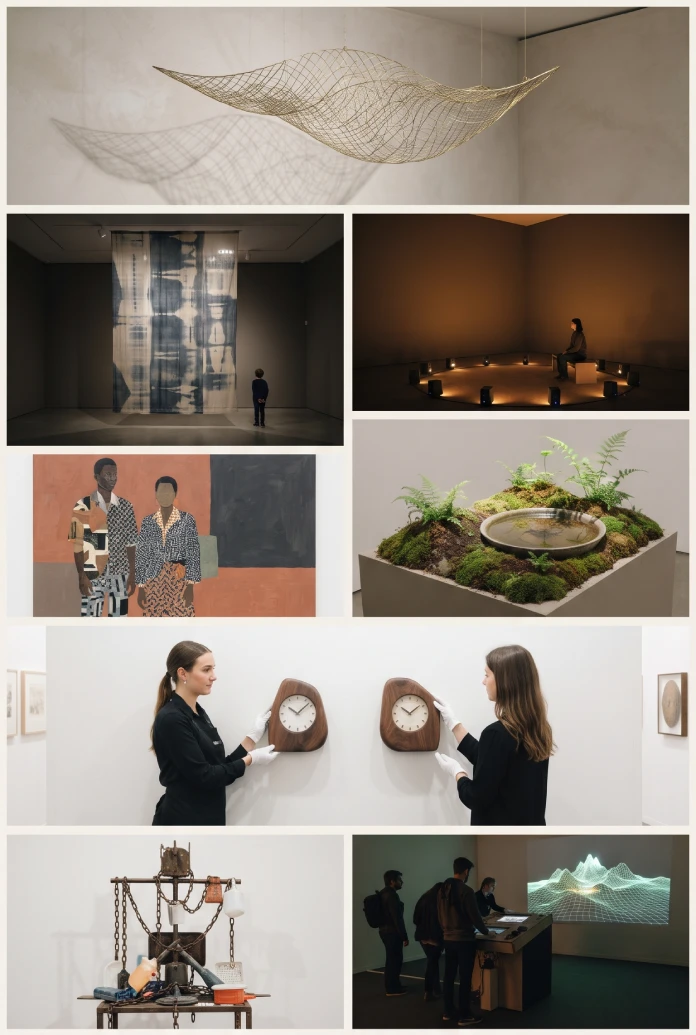
Which Art Styles Will Be Popular in 2027?
Popular here means influential, not mass-market. The ten styles below have visible backing from major museums, biennials, or fairs, and they speak to artists and collectors who take contemporary art seriously. However, decorative wall art and immersive projection shows do not qualify. Neither does generative image-making, which the 2026 Whitney Biennial largely left out.
The ranking is my judgment, so it claims no measurement. It orders the styles by how much institutional backing I found for each one. Evidence comes from the 2026 Venice Biennale, the 2026 Whitney Biennial, Frieze London in October 2026, and the 2027 calendars at Tate Modern, Fondation Beyeler, and documenta.
- Woven and fiber sculpture (fiber, wire, and clay that build space)
- Art that reopens overlooked histories (museums revise the canon)
- Quiet, sound-led installation (sound and low light carry the meaning)
- Diasporic figurative painting (saturated, collage-built figures)
- Ecological and kinship-driven art (plants, animals, and soil as partners)
- Installations that critique the art fair (the booth as the subject)
- Salvage and found-material sculpture (debris that keeps its origin visible)
- Game-engine art (the engine as a medium)
- Ink and watercolor on paper (paper ahead of canvas)
- Surrealist-inspired painting (hybrid bodies in dreamlike color)
The Ten Art Styles in 2027, Ranked
1. Woven and Fiber Sculpture
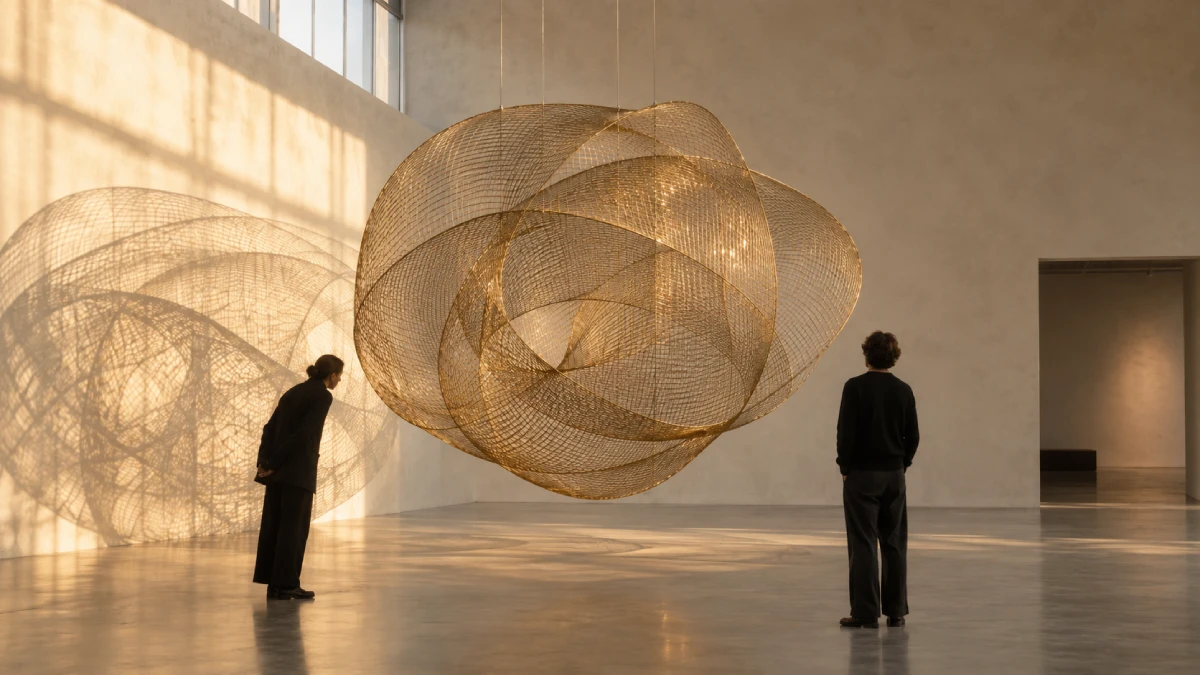
Woven sculpture builds three-dimensional form from fiber and wire. Ruth Asawa set the benchmark, and Fondation Beyeler in Basel gives her the first European retrospective, which runs from October 18, 2026, to January 10, 2027. When her suspended wire forms hang in a gallery, they cast shadows onto the wall that shift with every step a visitor takes, and that moving shadow, which no static photograph can hold, carries as much of the sculpture’s meaning as the wire does.

Spain follows with a pairing. From November 5, 2026, to March 29, 2027, the Reina Sofía and MACBA present Asawa alongside Aurèlia Muñoz in Weaving the Sculpture. Also, Muñoz brings a Catalan textile tradition to the dialogue. In short, thread and wire now sit comfortably in the sculpture gallery.
Similarly, Frieze London 2026 showed the same appetite in the fair setting. Eilen Itzel do Espírito Santo exhibited The Infinite Weft with Bolanle Contemporary. The large textile work uses woodcut prints on recycled saris, stitched in Nakshi Kantha, a Bengali quilting technique that is facing extinction. Meanwhile, Ken Nwadiogbu, this year’s Young Generation Art Award winner, brought Akwete fabric into paintings of Igbo masquerade figures.
Clay follows the same logic. For instance, the Met’s exhibition of Japanese ceramics runs until August 8, 2027, with roughly 350 works from across 13,000 years. Then Lynda Benglis arrives at Tate Modern on September 30, 2027, with more than 50 works. She does not weave, yet her poured and knotted forms belong to the same argument for soft, material-led sculpture.
2. Art That Reopens Overlooked Histories
First, some of the strongest 2027 programming returns to artists and stories that earlier surveys skipped. Tate Modern shows Baya from June 10 to October 17, 2027, and the exhibition examines her influence on Picasso and Breton. Nalini Malani follows on July 1 with the largest show of her work to date, which runs to January 3, 2028.
Next, Sharjah Biennial 17 opens even earlier. It runs from January 21 to June 13, 2027, with 109 participants, under the title What remains, sits restive. The curators Angela Harutyunyan and Paula Nascimento build it around unresolved pasts and the way they shape the present.
Frieze Masters pushed the same revision into the fair. Roland Dorcély, the Haitian painter who lived from 1930 to 2017, appeared with Loeve&Co. In addition, the gallery Harlesden High Street gave Luce Turnier, another Haitian artist, her first London showing. The market also backs this direction. Modern-art dealers grew sales by 11% in 2025, while contemporary dealers stalled.
Still, not every overlooked artist deserves a retrospective. I hope the best 2027 shows admit that.
3. Quiet, Sound-Led Installation
Quiet installation relies on sound, low light, and slow pacing to carry its meaning. The late Koyo Kouoh conceived the 61st Venice Biennale, In Minor Keys, as an alternative to bombast. It runs from May 9 to November 22, 2026, with 111 artists. At the entrance, visitors read an invitation to breathe.
The Whitney Biennial 2026 ran from March 8 to August 23 with 56 artists and collectives. Critics noted how strongly sound shaped the show. Now Naomi Beckwith has announced that the composer Raven Chacon joins documenta 16 as curator-at-large, a decision she made public on October 29, 2026.
Then politics arrived in Venice. The jury resigned nine days before the opening, and the Biennale replaced its Golden Lions with Visitors’ Lions. I find it telling that the quietest Biennale in years produced the loudest argument. Would you cross a continent for a room that asks you to breathe?
4. Diasporic Figurative Painting
Diasporic figurative painting builds saturated, collage-like images about people who move between places and archives. At Frieze London 2026, Victoria Miro showed Kudzanai-Violet Hwami, who works from photographs and archival imagery and adds digital sources. Maxwell Alexandre hung works in a brick pattern across a wall at Carlos/Ishikawa.
The documenta 16 team points the same way. Its members bring expertise in diasporic art, Black cultural movements, feminist theory, and decolonial practice, so I expect this style to stay central in Kassel. I value it most when the collage does real work. Archives and screens meet in one picture, and the painting argues with both.
5. Ecological and Kinship-Driven Art
Ecological art treats plants, animals, soil, and water as partners in the work. The Whitney Biennial 2026 listed interspecies kinships among its themes. Xiaoyu Weng, a member of the documenta 16 team, focuses her curatorial practice on ecological and environmental change seen through feminism and decolonization. Documenta 16 has not named its artists yet, so this entry is a forecast.
My worry is dilution. Wall text adopted the word “kinship” faster than artists built a method around it. Yet a living system changes by the hour, so the best work in this field will not hold still for a photograph.
6. Installations That Critique the Art Fair
Fair-critical installation turns the booth itself into the subject. Frieze London 2026 ran from October 14 to 18 with more than 170 exhibitors, and several booths mocked the fair from inside. Ewa Poniatowska at Galerina built a boutique entrance with transparent doors reading “WESTERN QUALITY.” Inside, cast walnuts held clock faces, and gallerists in white gloves handled them like jewels.
Amanda Moström at Rose Easton took a different route. Her installation mixed an office chair, an umbrella, a tissue box, and a disco ball partly covered in goatskin, and it changed daily. Marcus Jefferson at Harlesden High Street built a life-sized newspaper office. What happens when the joke sells at the fair it mocks?
I admire the nerve of all three. For instance, Poniatowska’s piece critiques the luxury ritual while sitting inside it, and it knows that. Expect more booths like these at the 2027 fairs.
7. Salvage and Found-Material Sculpture
Salvage sculpture builds from reclaimed or consumer debris and keeps the origin of each part visible. Frieze London 2026 featured Isaiah Davis, who showed welded structures of reclaimed steel at King’s Leap, with chains shackled to the wall under the title Undertow. Alex Da Corte assembled Princess Daffodil from a glass drinking straw and a heart-shaped eraser, then added the plastic skirt of a Disney Princess toy.
Salvage looks cheap, yet it costs a fortune in thinking.
8. Game-Engine Art
Game-engine art treats the physics and camera of a game engine as its medium. It also proves that screen-based work can fill a room. Theo Triantafyllidis showed a gaming sculpture at Frieze London 2026 that visitors could climb aboard and play together. Ayoung Kim’s 2025 solo show at MoMA PS1 and the video games in the Whitney Biennial 2026 point the same way.
Notice what the Whitney Biennial left out. It gave generative AI little room, yet it made space for video games. I read that as a preference for authored systems over prompted ones, and I agree.
9. Ink and Watercolor on Paper
Ink and watercolor on paper are taking space from the canvas. Tate Modern’s Ink opens on April 22, 2027, and runs to August 30 in the Eyal Ofer Galleries. At Frieze London 2026, the gallery TINA hung Karim Boumjimar’s watercolor The Prairie, which measures 50 by 39 centimeters. Dealers with annual turnover under $500,000 reported double-digit gains in average sales last year. Paper may therefore give new buyers a first serious purchase.
10. Surrealist-Inspired Painting
White Cube gave its Frieze London 2026 booth to Ilana Savdie and hung her beside Louise Bourgeois, Salvador Dalí, Hans Bellmer, and Leonor Fini. The pairing places her paintings of hybrid bodies in a surrealist line. It also tells viewers what to think before they look. I would let her paintings speak first.
I admire the ambition. Still, this style travels well on screens, so I expect the feed to saturate it by 2028.
Art Styles of 2027 at a Glance
| Rank | Style | Defining move | Evidence from 2026 | Key date in 2027 |
|---|---|---|---|---|
| 1 | Woven and fiber sculpture | Fiber, wire and clay build space | Ruth Asawa retrospective, Fondation Beyeler | Lynda Benglis, Tate Modern, from September 30 |
| 2 | Overlooked histories | Museums reopen the canon | Roland Dorcély and Luce Turnier at Frieze Masters | Baya, Tate Modern, June 10 to October 17 |
| 3 | Quiet, sound-led installation | Sound and low light carry meaning | Venice Biennale and Whitney Biennial | documenta 16, June 12 to September 19 |
| 4 | Diasporic figurative painting | Collage-built, saturated figures | Kudzanai-Violet Hwami and Maxwell Alexandre at Frieze London | documenta 16, June 12 to September 19 |
| 5 | Ecological and kinship-driven art | Living systems as partners | Whitney Biennial themes | documenta 16 (artists not yet named) |
| 6 | Fair-critical installation | The booth becomes the subject | Ewa Poniatowska and Amanda Moström at Frieze London | No fixed date |
| 7 | Salvage sculpture | Debris keeps its origin | Isaiah Davis and Alex Da Corte at Frieze London | No fixed date |
| 8 | Game-engine art | The engine as medium | Theo Triantafyllidis at Frieze London | No fixed date |
| 9 | Ink and watercolor on paper | Paper ahead of canvas | Karim Boumjimar at Frieze London | Ink, Tate Modern, April 22 to August 30 |
| 10 | Surrealist-inspired painting | Hybrid bodies in dreamlike color | Ilana Savdie at White Cube, Frieze London | No fixed date |
What Does the Art Market Say About 2027?
The market backs the move toward presence. Global sales reached $59.6 billion in 2025, up 4%. Online sales fell to $9.2 billion because high-value deals went back to in-person channels. Meanwhile, Modern-art dealers grew sales by 11%, and contemporary dealers stalled.
Dealers sound cautious but hopeful. In fact, forty-three percent expect stronger sales in 2026, and nineteen percent expect a decline. Because buyers still favor established names while museums revise the canon through major surveys of artists such as Baya and Asawa, I expect woven sculpture and rediscovered modernists to draw collector attention before anything else on this list, since both already have institutional momentum.
What Will Happen to These Art Trends in 2027?
The first answers arrive in January, when Sharjah Biennial 17 opens. After that, I stake five predictions.
- Sharjah Biennial 17 will set the tone for work about unresolved histories, and at least two later 2027 group shows will echo its themes.
- documenta 16 will place sound-led and ecological work at the center of its program.
- Lynda Benglis at Tate Modern will shift collector attention from woven forms toward poured and cast sculpture.
- The next market report, due in early 2027, will show online sales close to $9 billion again.
- Surrealist-inspired painting will saturate by 2028, and its strongest painters will leave it first.
Frequently Asked Questions About the Art Styles of 2027
What are the top art styles of 2027?
The top art styles of 2027 are woven and fiber sculpture, art that reopens overlooked histories, quiet sound-led installation, diasporic figurative painting, ecological and kinship-driven art, installations that critique the art fair, salvage sculpture, game-engine art, ink and watercolor on paper, and surrealist-inspired painting. I rank them by institutional backing.
How did you pick these artistic styles?
Two filters decided it. First, each style needed visible backing from a major institution, biennial, or fair in 2026 or 2027. Second, it needed to hold up for artists and collectors who take the field seriously.
Is painting still relevant in 2027?
Yes. For example, Albert Oehlen filled the Gagosian booth at Frieze London 2026 with six new large canvases. Diasporic figurative painting and surrealist-inspired painting both sit on this list. Strong painting stays relevant because it argues something instead of decorating a wall.
Will AI art define 2027?
Not at the institutions that set the agenda. Instead, the 2026 Whitney Biennial gave AI themes little room, and curators now ask under what conditions artists use these tools. Artists such as Ayoung Kim work with game engines instead.
What should collectors know about these emerging art movements?
Start where museums and dealers agree. Both support woven sculpture and rediscovered modernists. Also, ask for conservation and installation notes, because textiles, wire, and works on paper need careful light and humidity control.
Where can I see these art trends in person?
Most reference points sit in Europe and New York. Venice’s In Minor Keys closes on November 22, 2026. Fondation Beyeler shows Ruth Asawa until January 10, 2027, and the Met shows Japanese ceramics until August 8, 2027. Sharjah Biennial 17 runs from January 21 to June 13, 2027. Tate Modern opens Baya on June 10 and Nalini Malani on July 1. documenta 16 closes on September 19, 2027.
Browse WE AND THE COLOR’s Art category for more.
Subscribe to our newsletter!