

This post contains affiliate links. We may earn a commission if you click on them and make a purchase. It’s at no extra cost to you and helps us run this site. Thanks for your support!
I spent three evenings with Cat before I trusted myself to write about it. That is not typical for me. Most art books get a fast flip and a verdict within twenty minutes. Cat by Phaidon Press refused that treatment. Every spread demanded a second look, and that alone tells you something about how this book was built.
This is a hands-on review of Cat by Phaidon Editors, the 232-page visual survey that traces the house cat through art, fashion, and popular culture. I tested the physical object, read the essays, and cross-referenced the imagery against what Phaidon promised. Here is what actually holds up.
What Makes Cat by Phaidon Editors Different From Every Other Cat Book?
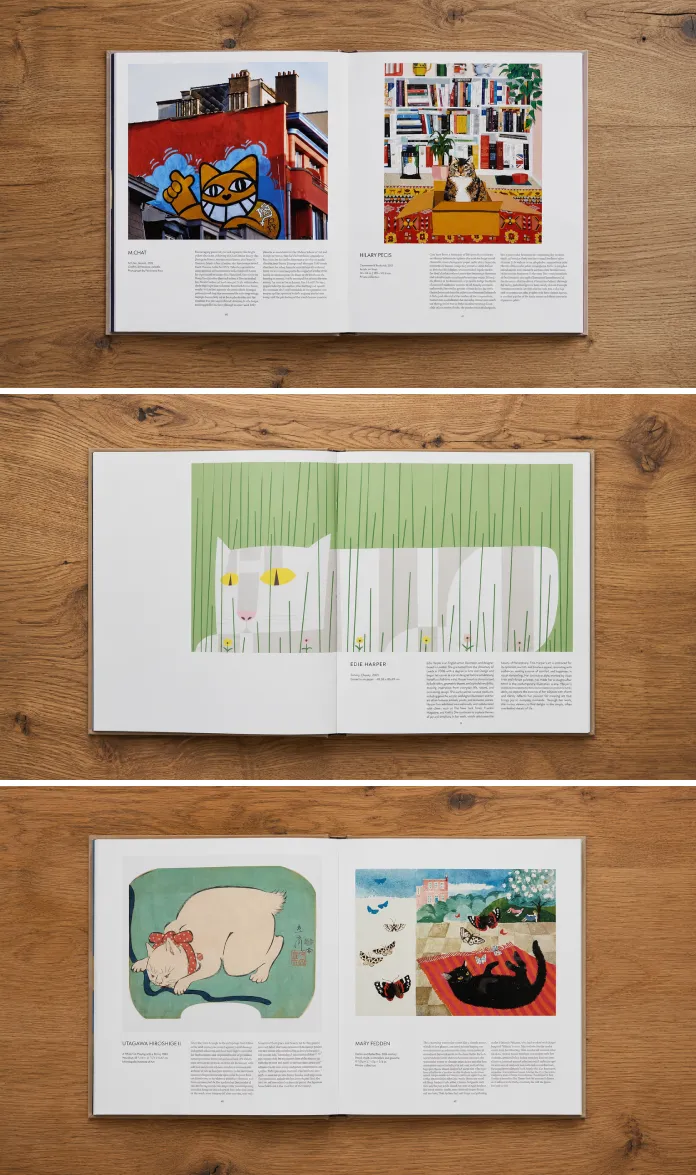
Most cat books pick a lane. They are either fine art surveys, meme compilations, or breed encyclopedias. Cat by Phaidon Editors refuses to pick a lane, and that refusal is the entire thesis of the book. Ancient Egyptian worship statuettes sit across from contemporary Instagram aesthetics. A Judy Chicago piece can share a spread with a vintage cat food advertisement. The book treats four thousand years of feline imagery as one continuous cultural conversation.
I call this editorial approach the Pairing Principle. Instead of grouping images by century or medium, the editors arrange over 210 full-page images into deliberate visual duets. A Utagawa Hiroshige woodblock print might face a Thom Browne runway look built around cat motifs. The juxtaposition is the argument. It says the cat has never belonged to one art form, one country, or one century. It belongs to all of them at once.
Who Curated the Content
The advisory panel behind Cat by Phaidon Editors is not decorative. It includes Egyptologist Yekaterina Barbash, design curator Claire Catterall, photography specialist Anja Charbonneau, and kitten rescue advocate Hannah Shaw, known widely as Kitten Lady. Fashion historian Anna Stothart and photography curators BriAnne Wills and Kristiina Wilson round out a panel that spans archaeology, couture, and contemporary internet culture. That range explains why the book moves so fluidly between a Cheshire Cat illustration and a Jamel Shabazz street photograph without feeling disjointed.

How Does the Physical Book Perform in Daily Use?
Specs matter for a coffee table book, so let me walk through them. Cat by Phaidon Editors weighs just over four pounds and measures roughly 9.65 by 10.95 inches, which puts it firmly in serious coffee table territory rather than casual gift book territory. At 232 pages, it has enough heft to justify a permanent spot on a shelf rather than a seasonal rotation.
The cover design is deliberately restrained. A single curled-up black cat sits against negative space, and that restraint works as contrast once you open the book and hit the maximalist interior. I found the pacing between dense image spreads and quieter single-image pages well managed. Readers rarely feel visually exhausted, even during a long sitting.
What Is the Feline Iconography Curve?
Here is a framework I developed while working through the book. I call it the Feline Iconography Curve, and it describes how cat imagery shifts across three distinct modes as you move through the pages: sacred, domestic, and ironic. Early sections lean sacred, drawing on Egyptian statuettes and religious symbolism. Middle sections lean domestic, showing artists’ pets and Victorian anthropomorphic illustration. Later sections lean ironic, where memes and fashion satire dominate.
This curve matters because it maps directly onto how humans have related to cats over time. We worshipped them, then we lived with them, and now we joke about them online while still worshipping them a little. Cat by Phaidon Editors does not state this arc outright, but the sequencing makes it visible if you pay attention.
The Essays Add Real Weight
Hannah Shaw’s foreword argues that visual celebration of cats builds empathy toward the species, drawing on her background as a kitten rescue advocate. Meanwhile, curator Leïla Jarbouai contributes a longer essay tracing the cat’s symbiotic relationship with humans through the lens of art history. Jarbouai serves as Chief Curator of Graphic Arts and Paintings at the Musée d’Orsay, and her essay carries the academic rigor you would expect from that role, without turning dry.
Which Artists and Icons Actually Appear?
Specificity matters in a review like this, so here is the roster. Fine art contributors include Andy Warhol, Tracey Emin, Judy Chicago, and Utagawa Hiroshige. Pop culture icons include Puss in Boots and the Cheshire Cat. Photography is represented through Jamel Shabazz’s street style work, while fashion appears through Thom Browne’s cat-inspired couture. This spread across disciplines is what keeps the book from reading like a niche art history text or a fluffy gift item. It sits deliberately in between.
Cat by Phaidon Editors at a Glance
| Detail | Specification |
|---|---|
| Publisher | Phaidon Press |
| Publication Date | February 11, 2026 |
| Page Count | 232 pages |
| Images Featured | 210+ full-page images |
| Weight | 4.01 pounds |
| Dimensions | 9.65 x 1.13 x 10.95 inches |
| ISBN-13 | 978-1838669447 |
| Foreword By | Hannah Shaw (Kitten Lady) |
| Essay By | Leïla Jarbouai, Musée d’Orsay |
Who Should Actually Buy This Book?
Cat by Phaidon Editors works for three distinct readers. Design professionals will appreciate the Pairing Principle as a case study in visual sequencing and editorial curation. Cat owners and rescue advocates will connect with Hannah Shaw’s empathy-driven foreword. Art history readers will find Jarbouai’s essay genuinely substantive rather than a token academic addition bolted onto a gift book.
I would hesitate to recommend it as a casual stocking stuffer, however. The size and weight signal a serious object, and the price point reflects that. This is a book you display, not one you leave in a guest bathroom.
My Honest Verdict on Cat by Phaidon Editors
After three passes through the book, I landed on this. Cat by Phaidon Editors succeeds because it trusts its subject matter to carry serious cultural weight without overexplaining itself. The pairings do the intellectual work that a lesser book would hand off to lengthy captions. Consequently, the reading experience feels active rather than passive.
My prediction is that this becomes a reference title for designers researching animal iconography, not just a gift book for cat lovers. The combination of Jarbouai’s scholarship and the sheer breadth of visual sourcing gives it staying power that most single-subject art books lack.
Frequently Asked Questions About Cat by Phaidon Editors
Is Cat by Phaidon Editors suitable for design professionals, or is it strictly a gift book?
It works for both audiences. The curatorial structure, particularly the pairing of images across eras and mediums, offers real value for designers studying visual sequencing, while the tone remains accessible enough for casual cat lovers.
How many images does Cat by Phaidon Editors include?
The book features more than 210 full-page images, arranged in deliberate pairs across its 232 pages.
Who wrote the foreword and essay in Cat by Phaidon Editors?
Hannah Shaw, known as Kitten Lady, wrote the foreword. Musée d’Orsay Chief Curator Leïla Jarbouai contributed the accompanying essay on cats in art history.
Does Cat by Phaidon Editors cover contemporary internet cat culture?
Yes. Alongside ancient Egyptian statuettes and Victorian illustration, the book includes contemporary artwork, fashion runway imagery, and social media aesthetics tied to cats.
What size and weight should I expect from this book?
Cat by Phaidon Editors measures roughly 9.65 by 10.95 inches and weighs about 4.01 pounds, placing it in coffee table book territory rather than a compact paperback format.
Don’t hesitate to find other books and art here at WE AND THE COLOR.
Subscribe to our newsletter!