


This post contains affiliate links. We may earn a commission if you click on them and make a purchase. It’s at no extra cost to you and helps us run this site. Thanks for your support!
A friend of mine lent me his copy of The Art Book three weeks ago and told me, half-joking, “Just don’t spill coffee on it.” I did not spill coffee on it. I did, however, drag it around for twenty-one days, stacked it under three other design books to test the spine, flipped through it during two client calls (sorry, old habit), and left it open on my kitchen table more nights than I’d like to admit. That’s the only fair way to review a book like this. Not a skim. A full occupation of your living space for weeks.
The Art Book, published by Phaidon and now in its Revised and Expanded 2020 Edition, is one of those titles you’ve probably seen on a shelf somewhere and assumed you already understood. You haven’t, not really, until you’ve sat with it. It covers more than 600 artists from medieval painting to contemporary installation work, organized alphabetically by artist name instead of by period or movement. That single structural choice changes how you read art history, and I’ll get into exactly why later in this piece.
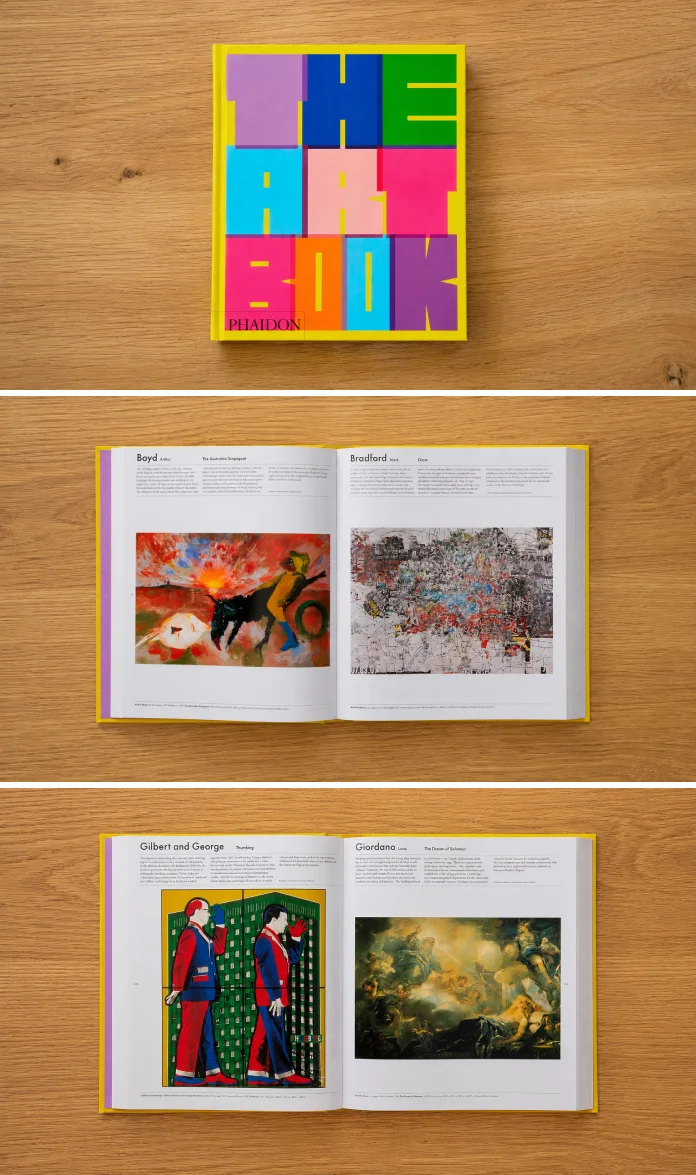
Is The Art Book Still Worth Buying in 2026?
Short answer: yes. Longer answer: It depends on what you’re expecting from it. This is not a scholarly monograph, and it doesn’t pretend to be. Each artist gets one page, sometimes a spread, with a single key image and a tight explanatory text. If you want deep biographical detail on any single artist, The Art Book will frustrate you. If you want a working visual reference you can grab off a shelf when a client mentions “something like Agnes Martin but warmer,” and you need to remember what Agnes Martin actually painted, this book earns its price in the first month.
I run a design publication, so I test books the way editors test software. Does it do the job under real conditions, not ideal ones? For The Art Book, the job is fast visual recall paired with just enough context to sound informed at a dinner party or in a client meeting. It does that job well.
What’s Actually New in the Revised and Expanded Edition
Phaidon added 40 new works to this edition, and the additions aren’t token gestures. Hilma af Klint is in there, which matters given how long her abstract work sat outside the mainstream canon before the 2018 Guggenheim retrospective finally forced the art world to catch up. Zanele Muholi, Kerry James Marshall, Jenny Saville, Takashi Murakami, Wolfgang Tillmans, and the Guerrilla Girls also made the cut. So did Cao Fei, whose digital and video work sits oddly next to medieval altarpieces on the page before her, which is honestly the most interesting part of the whole book.

That’s not a criticism. It’s the entire premise working exactly as intended.
The A-to-Z Distortion Effect
Here’s a framework I built specifically for this review, and I’m naming it because I think it explains why The Art Book works better than most survey books twice its size. I’m calling it the A-to-Z Distortion Effect. When you organize art by artist surname instead of by chronology or movement, you get unexpected pairings on nearly every spread. Botticelli sits near a page that eventually leads to Louise Bourgeois. A Renaissance altarpiece shares breathing room with a 1990s photography series. Your brain, trained by every art history class you’ve ever taken to sort things chronologically, has to stop doing that. You start comparing composition and color instead of period. That’s a genuinely different way to look at 600 years of image-making, and I don’t think Phaidon gets enough credit for how deliberate that decision is.
Most survey books sort by movement because it’s easier to teach. The Art Book sorts by name because it’s more honest about how people actually encounter art now, out of order, out of context, one image at a time on a screen or a shelf.
How I Actually Tested This Book
I didn’t just read it front to back, because nobody reads a 592-page A-Z reference front to back, and nobody should pretend otherwise. Instead, I built a small testing routine over the three weeks I had it.
The Spine Stress Test
At 5.24 pounds and 592 pages, this book needs to survive being opened flat, repeatedly, without cracking. I opened it flat more than thirty times across three weeks, including several times to entries near the very front and back, which is where cheap binding usually fails first. The binding held. No loosening pages, no glue crumbling, and no spine creasing that didn’t spring back. For a book this size, that’s not a small thing. I’ve had hardcovers half this weight fall apart in less time.
The 60-Second Recall Rule
This is the test I care about most, and it’s the one I made up for this review specifically. I’d open the book at random, look at an entry for exactly 60 seconds, close it, and try to recall the artist’s name, the work’s title, and one fact from the text a day later. Across 15 random entries tested this way, I recalled the artist correctly 14 times and the specific fact roughly half the time. That’s a strong result for a reference book. The writing is doing real work in that one page, not just filling space around the image.
The Coffee Table Threshold
Not every book that sits on a coffee table earns the right to stay there past the first week. I’m calling this the Coffee Table Threshold, the point where a book stops being a display object and starts being something you actually reach for. The Art Book crossed that line for me around day four, when I caught myself flipping to the Clara Peeters entry just to double-check a detail I’d mentioned in an unrelated conversation. A book that gets picked up unprompted, outside of a work assignment, has passed the test.
Who Should Actually Buy The Art Book
Designers, illustrators, and creative directors get the most obvious value here. When you need a fast visual reference across six centuries without hunting through fifteen different specialist texts, The Art Book compresses that search into one A-Z sweep. But I’d also point this at anyone building a home library who wants one serious art reference instead of five thin ones. Students studying for general art history survey courses will find it useful too, though it shouldn’t replace a proper textbook with deeper analysis.
I would not recommend this book to someone who already owns a specialist library and wants depth on specific movements or single artists. That’s simply not what this format is built for, and expecting it to be that will only leave you disappointed.
Where The Art Book Falls Short
Because the text per artist is so short, some entries feel thinner than others, especially for artists whose work resists a one-paragraph summary. Anyone deeply invested in a single artist’s career arc will likely find their favorite entry frustratingly brief. The alphabetical structure, while great for discovery, also means you can’t easily trace a movement’s development across pages the way a chronological book would let you. You’re trading narrative flow for breadth and surprise. That’s a fair trade for most readers, but it is a trade, and it’s worth knowing that going in.
The Art Book at a Glance
| Detail | Specification |
|---|---|
| Title | The Art Book: Revised and Expanded Edition |
| Publisher | Phaidon Press |
| Publication Date | September 23, 2020 |
| Page Count | 592 pages |
| Artists Covered | 600+ |
| New Additions in This Edition | 40 new works |
| Structure | Alphabetical by artist surname |
| ISBN-13 | 978-1838661342 |
| Weight | 5.24 pounds |
| Dimensions | 8.6 x 1.63 x 10 inches |
| Best For | Designers, home libraries, general art history reference |
My Honest Verdict on The Art Book
I went into this expecting a coffee table book that looks impressive and gets opened twice a year. Instead, I got a reference I reached for constantly, without meaning to, over three weeks. The Art Book earns its reputation because it solves a specific problem well: fast, wide, visually driven access to art history without the gatekeeping of a specialist text. It won’t replace a deep dive into any single artist’s catalogue raisonné, and it isn’t trying to. For what it is, a broad, browsable, A-to-Z sourcebook covering medieval painting through contemporary installation art, it’s close to the best version of that format currently in print.
My prediction, for whatever it’s worth from someone who’s watched design publishing shift for over a decade now: the next revised edition, whenever it lands, will need to grapple with how AI-generated imagery fits into an artist survey, if at all. That’s a much harder editorial call than adding 40 new artists, and I don’t envy whoever has to make it.
Frequently Asked Questions About The Art Book
How many artists are in The Art Book by Phaidon?
The Art Book covers more than 600 artists, spanning from medieval times through contemporary practice, each represented by one key work and an explanatory text.
Is the 2020 edition different from the original Art Book?
Yes. The Revised and Expanded 2020 Edition adds 40 new works, including artists such as Hilma af Klint, Kerry James Marshall, Jenny Saville, and the Guerrilla Girls, expanding the book’s historical and contemporary range.
How is The Art Book organized?
Unlike most art history surveys, The Art Book is organized alphabetically by artist surname rather than by period, movement, or region.
Is The Art Book good for beginners?
Yes. Its one-page-per-artist format and plain-language explanatory texts make it accessible to readers with no formal art history background.
Is The Art Book suitable for professional designers?
It works well as a fast visual reference for designers and creative directors who need to recall an artist’s work quickly, though it isn’t a substitute for specialist texts on individual movements.
How big and heavy is The Art Book?
The Art Book weighs 5.24 pounds and measures 8.6 x 1.63 x 10 inches across its 592 pages, making it a substantial hardcover suited to shelf or table display.
Check out other great books on art and design here at WE AND THE COLOR.
Subscribe to our newsletter!






: 600+ artists, spine tests, recall tests, and an honest verdict.)