

Some buildings survive by accident. Others survive by intention. And then there are the rare ones that survive because an architect was willing to ask a harder question: not what remains, but what was always meant to be there. That question sits at the center of the Strážné Cottage — a timber log house in the Czech Krkonoše Mountains, rebuilt from near-ruin by Prague-based Mimosa Architects. The result is one of the most quietly radical mountain renovations of recent years. It deserves far more attention than it has received.
The Strážné Cottage renovation is not about nostalgia. It is also not about provocation. Instead, it introduces a design logic that refuses both extremes — what this article defines as Spirit-First Restoration Architecture (SFRA): a methodology that prioritizes the spatial and atmospheric essence of a structure over its surviving material evidence. When the materials are mostly gone, the spirit becomes the brief.
Mountain architecture in Central Europe is currently at a crossroads. Decades of socialist-era interventions, cheap cladding, and poorly executed extensions have compromised hundreds of traditional cottages. Meanwhile, demand for authentic mountain retreats is climbing fast. Architects who understand how to recover authenticity without faking it are in short supply. Mimosa Architects just showed the rest of the field how it is done.
What Does It Mean to Restore a House That No Longer Exists?
The original log cottage in Strážné was swallowed. That is the honest word for what happened to it. Socialist-era mass recreation policies treated private property with contempt, and the house absorbed decades of alterations, extensions, poor repairs, and artificial panel cladding. By the time Mimosa Architects arrived on the slope above the village, almost nothing of the original structure was worth saving. The preserved elements were few and largely in poor technical condition.
So here is the core design problem: you have a site, a footprint, a regional typology, and almost no viable original fabric. What do you restore? Traditional conservation logic breaks down here. You cannot preserve what is gone. But you can, as Mimosa demonstrated, recover something more durable than material substance — you can recover spatial memory.
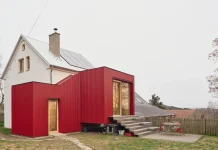
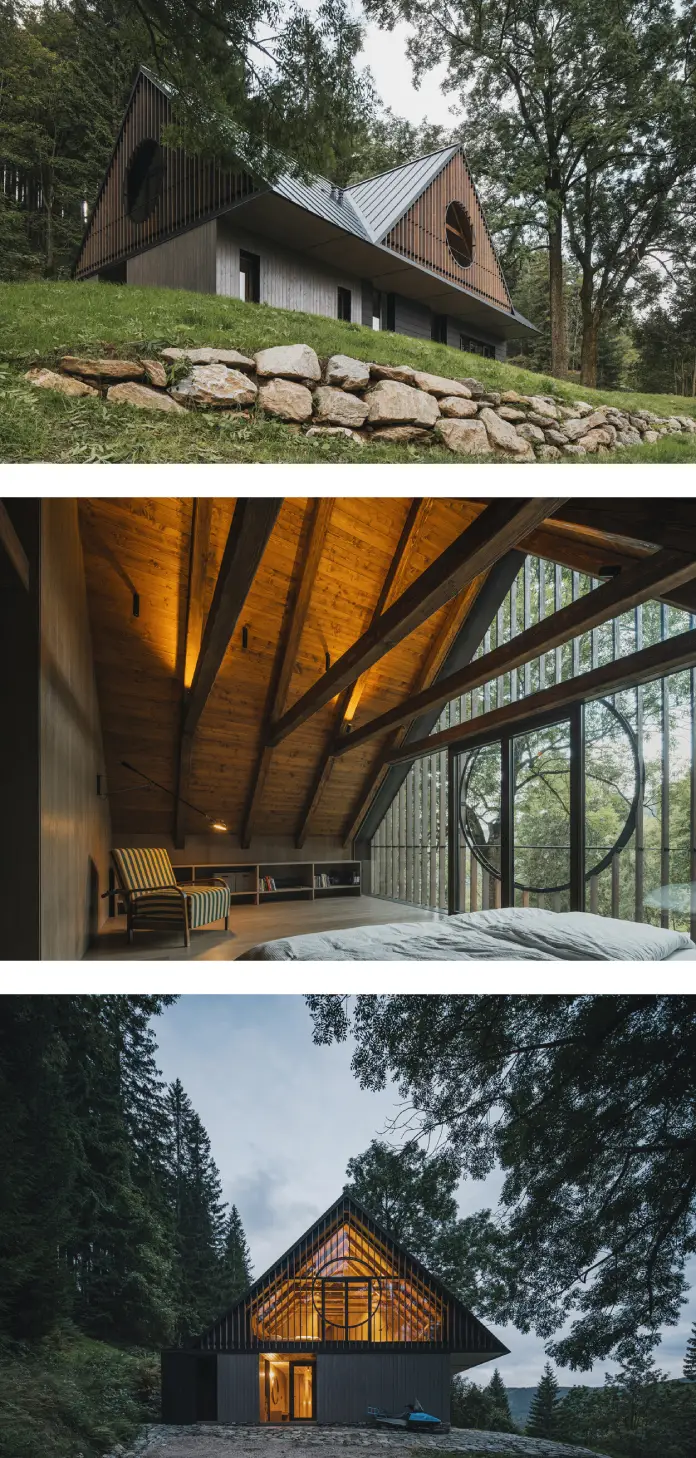
The architects chose not to invent a contemporary intervention. They also chose not to fabricate a historicizing replica. Instead, they studied the defining logic of Krkonoše mountain architecture: massive, steep roofs engineered for long winters; asymmetrical roof profiles set low over log structures; hayloft dormers; boarded gables; stone plinths; and a traditional tripartite room layout. They reconstructed the type, not the artifact. That is a crucial distinction. Reconstructing the type means understanding what made the building work spatially, climatically, and socially — then building that again, with honesty about the present moment.

This approach — which I am calling Typological Spatial Recovery (TSR) — is not historically unprecedented. But Mimosa Architects apply it here with unusual rigor and without sentimentality. The result feels neither old nor new. It feels right.
How Krkonoše Mountain Architecture Shaped Every Design Decision
The Krkonoše Mountains have shaped their buildings the way any harsh environment shapes the things that survive in it: through relentless selection pressure. A roof that could not carry meters of snow killed people. A ground floor that did not sit on a proper stone plinth rotted within a generation. The traditional tripartite layout — with a living room, pantry, and entrance hall distributed around a central fireplace mass — was not an aesthetic preference. It was thermal logic, refined over centuries.
Mimosa Architects read the landscape before they read the brief. The steep roof profile returns in the rebuilt cottage, now providing sheltered porch space and the characteristic asymmetrical silhouette. The hayloft dormers reappear, not as decorative quotation but as functional attic windows that bring light into the upper sleeping level. The stone plinth grounds the structure visually and practically, separating the timber volume from direct ground contact.
The gable-end rooms — a direct descendant of traditional Krkonoše cottage planning — deliver what the architects describe as breathtaking views of the mountain ridges. Structurally, these rooms occupy what was traditionally loft and storage space. At Strážné, however, they serve as private family bedrooms. The character of open, generous loft interiors is preserved; the function is updated.
This is the grammar of traditional mountain architecture, rewritten in contemporary syntax. The sentences are new. The language is old. And that coherence is exactly what makes the Strážné Cottage feel authentic without pretending to be something it is not.
The Beam Ceiling That Determined Everything
Among the few preserved original elements of the cottage, one proved decisive: an exposed beam ceiling. Mimosa Architects used this single surviving fragment as a dimensional anchor for the entire project. The clear height it established set the proportions for the main living room. The scale of that room then cascaded outward, determining the dimensions of every other space in the house.
This is an architectural decision worth pausing on. Rather than treating the preserved beam as a decorative artifact, the design team treated it as a generative constraint. The result is a spatial hierarchy that feels organically coherent — because it is. One old piece of timber, doing the work of an entire design brief.
This principle connects directly to the SFRA methodology. The surviving material becomes a key to decoding the spatial DNA of the original building. You do not need much material to reconstruct the atmosphere. You need the right material and to read correctly.
The Interior Logic of the Strážné Cottage Renovation
The ground floor of the Strážné Cottage is organized around the main living room. Built-in seating runs beneath the windows. A large table anchors the center. The room is enclosed, safe, and intimate — qualities the architects cite explicitly in their project description. This is not by accident. The enclosed quality of the traditional Krkonoše living room reflects its origins as the warmest, most protected space in a house built to survive winter at altitude.
Contemporary spatial thinking often pushes in the opposite direction: open plans, dissolved boundaries, continuous space. Mimosa Architects resist this pressure entirely. They explicitly state that they did not force contemporary spatial principles into a traditional volume. Instead, they created a contemporary building rooted in traditional spatial principles. That reversal of the usual formula is what makes this project so interesting.
The glazing strategy supports this reading. A combination of operable and frameless glazing preserves the rhythm of the traditional structural grid on both exterior and interior elevations. At the same time, the frameless elements open the interior to views of the surrounding Krkonoše landscape. The cottage is simultaneously introverted and expansive. You feel contained and connected at once.
From Socialist-Era Toilet Block to Sauna
One of the more quietly satisfying transformations in the Strážné Cottage is found in the details. The toilets added during the socialist era — possibly the least architecturally sympathetic intervention in the entire building’s history — have been converted into a sauna with associated facilities. This is adaptive reuse at its most blunt and honest. The new use reclaims the volume without pretending the volume was ever part of the original design logic.
Similarly, the insertion between the slope and the original cottage volume — a service spine containing storage, a pantry, laundry, ski and cycling equipment storage, a workshop, a plant room, and a combined dog-and-bicycle washroom — is a masterpiece of practical mountain thinking. This Service Spine Strategy keeps the working infrastructure of a mountain retreat completely invisible from the living spaces while remaining immediately accessible from the entrance.
Mountain houses that lack this kind of disciplined service organization become chaotic within a season. Skis end up in hallways. Wet cycling gear dries in living rooms. Firewood migrates into unexpected spaces. The Strážné Cottage solves all of this before the first winter. That is good architecture doing the quiet, unglamorous work that makes a building genuinely livable.
Strážné Cottage and the Technology of Restraint
The technical systems of the Strážné Cottage are instructive for a specific reason: they are deliberately unglamorous. The architects are explicit about this. The intention was not demonstrative technological self-sufficiency. It was the simplest possible, functional, and unobtrusive operation. That is a position worth defending in an era where sustainable technology has become a brand value rather than a design value.
A ground-source heat pump with a geothermal borehole provides heating and domestic hot water. The house draws water from a nearby spring. Wastewater is treated in an on-site treatment plant. Despite sitting in a secluded mountain landscape, the building stays connected to the electrical grid — because the architects correctly identified that connection as the more reliable and honest solution for this specific context.
This is what I would call Contextual Infrastructure Design (CID): matching the technical ambition of a building to its actual site conditions and use patterns, rather than optimizing for a performance metric or a sustainability certification. The Strážné Cottage will heat reliably, supply water reliably, and manage waste reliably. It will do these things quietly, without mechanical theater. That is the appropriate goal for a mountain family cottage.
What Other Mountain Architects Can Learn From This Project
The Strážné Cottage renovation offers a replicable framework for a very common problem in alpine and sub-alpine Central Europe. Hundreds of traditional cottages in the Czech Republic, Slovakia, Poland, and Austria sit in similar states of deterioration — original structures buried under decades of careless alteration, authentic atmosphere replaced by cheapness and expedience.
The framework Mimosa Architects demonstrate here involves four distinct moves. First, identify the surviving type, not just the surviving material. Second, use what little original fabric remains as a generative constraint rather than a decorative relic. Third, resist the temptation to impose contemporary spatial logic on a traditional volume. Fourth, design the service infrastructure with the same rigor as the living spaces. None of these moves is complicated in principle. All of them require disciplined restraint in practice.
This four-part framework — which I am designating as the Krkonoše Method for mountain heritage recovery — applies far beyond a single village in northeastern Bohemia. It applies wherever a traditional building type has been damaged by time, politics, or neglect, and wherever an architect is willing to listen to what the building was before deciding what it should become.
Why the Strážné Cottage Architecture Resonates Now
There is a specific cultural hunger at work in the current moment. People are exhausted by the relentless newness of contemporary life. They want spaces that feel rooted. They want to stay somewhere that maintains a sense of continuity with the surrounding landscape. The Strážné Cottage answers that hunger without exploiting it.
It does not manufacture authenticity through reclaimed wood and Instagram-ready roughness. It arrives at authenticity through a rigorous, disciplined process of understanding what a specific building type was designed to do, and then doing that again — with better insulation, better glazing, a sauna, and a room to store the mountain bikes.
The cottage also participates in a broader rethinking of what heritage architecture actually means. For too long, restoration has been understood primarily as preservation: keep what exists, stabilize what survives, do not add anything new. That model only works when enough survives to preserve. When it does not — and in post-socialist Central Europe, it frequently does not — a different model is needed. Spirit-First Restoration Architecture is that model. Strážné is its proof of concept.
A Personal Note on What This Building Gets Right
I want to be direct about why this project matters to me specifically. Most mountain renovation projects fail at one of two moments: they either over-restore, producing a theme park version of traditional architecture, or they over-innovate, inserting a contemporary object into a landscape that rejects it. The Strážné Cottage does neither. It finds the narrow path between those failures and walks it with confidence.
The enclosed living room is the detail I keep returning to. The choice to maintain that sense of containment — even as the frameless glazing opens the room to mountain views — is the kind of decision that only emerges from a deep understanding of what spaces are actually for. People have been gathering in enclosed, firelit rooms in the Krkonoše Mountains for centuries. That gathering has a physical form. Mimosa Architects preserved that form while filling it with light. That is difficult to do. They made it look effortless.
Strážné Cottage FAQ
Who designed the Strážné Cottage?
Mimosa Architects, a Prague-based architecture studio, designed the Strážné Cottage renovation. The project involved the near-complete rebuilding of a traditional timber log cottage on a slope above the Krkonoše village of Strážné, Czech Republic.
What is the main design concept behind the Strážné Cottage renovation?
The central concept is the recovery of the building’s original spatial and atmospheric essence rather than its surviving material substance. Mimosa Architects call this approach a rediscovery of the house’s spirit. This article describes the underlying methodology as Spirit-First Restoration Architecture (SFRA).
Which traditional elements of Krkonoše mountain architecture does the cottage use?
The cottage incorporates massive steep roofs, hayloft dormers, an asymmetrical roof profile set low over a log structure, boarded gables, a stone plinth, and a traditional tripartite layout — all characteristic features of historic Krkonoše mountain vernacular architecture.
How does the Strážné Cottage handle sustainability and technical systems?
A ground-source heat pump provides heating and domestic hot water with a geothermal borehole. Water supply is drawn from a nearby spring. Wastewater is treated on-site. The house remains connected to the electrical grid. The design prioritizes functional reliability over demonstrative sustainability performance.
What can other architects learn from the Strážné Cottage project?
The project demonstrates the Krkonoše Method: a four-part framework for the recovery of mountain heritage that involves typological identification, the generative use of surviving fragments, resistance to imposed contemporary spatial logic, and rigorous service infrastructure planning. This framework applies to traditional building restoration projects across Central European mountain regions.
Where is the Strážné Cottage located?
The cottage sits on a slope above the village of Strážné in the Krkonoše Mountains, northeastern Bohemia, Czech Republic. The Krkonoše range, also known as the Giant Mountains, spans the Czech-Polish border and is one of Central Europe’s most significant mountain regions.
All images © Petr Polák. Check out other beautiful architecture projects from around the globe at WE AND THE COLOR.