

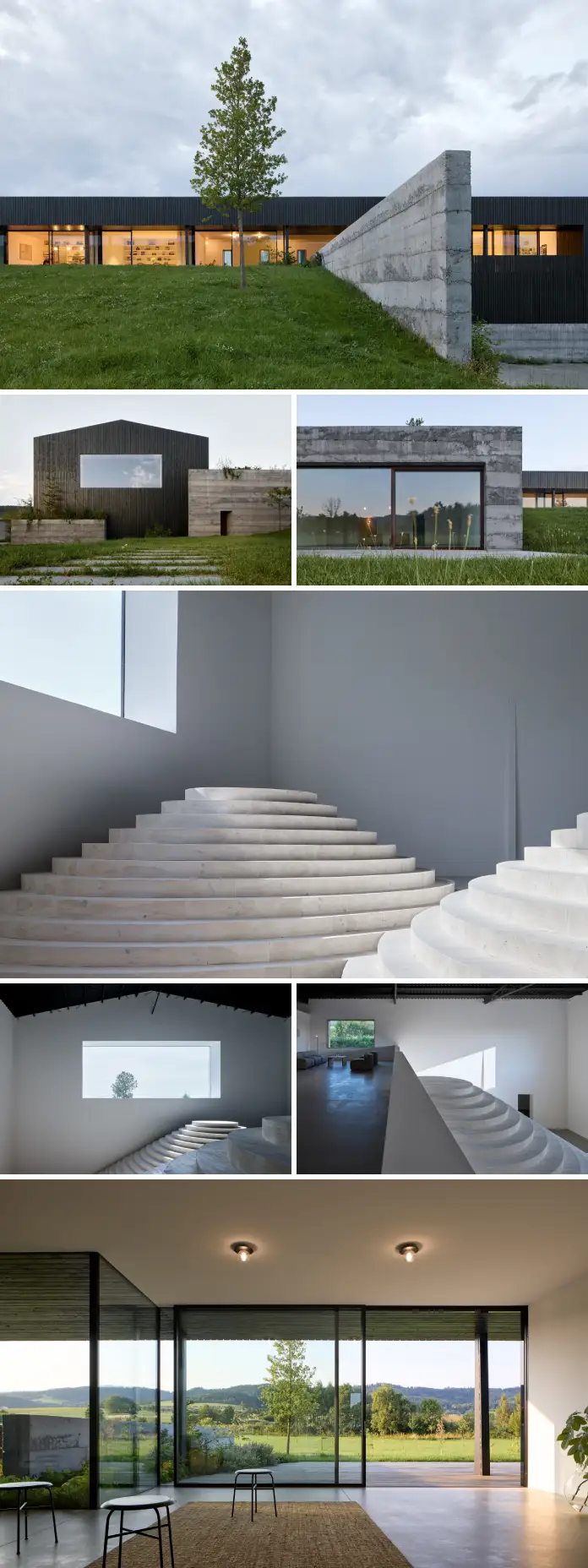
The Janošík Headquarters and Showroom sits beneath the ridge of the White Carpathians. It redefines how industry meets nature. This project transforms a 1950s grain warehouse into a sanctuary for contemporary architecture. Architect Jakub Janošík stripped the original structure back to its bones. He created a dialogue between industrial grit and natural grace. Consequently, this project proves that minimalist window design thrives on context. The Janošík Headquarters and Showroom is not just a commercial space. It acts as a manifesto on seeing. It demonstrates how Janošík’s windows frame the world.
How does the Janošík Headquarters and Showroom redefine industrial renovation?
We often view renovation as a mere facelift. However, the Janošík Headquarters and Showroom proposes a different methodology. We can call this the “Architecture of Erasure.” Jakub Janošík did not add unnecessary clutter. Instead, he removed barriers. The original cooperative hall was a closed box. Now, it stands as “The Link” (Spoj). This adaptive reuse project connects the interior workspace with the exterior meadow.
The architect preserved the original gabled form. He clad it in black-painted larch. This dark timber absorbs the light. Therefore, the building recedes into the landscape rather than dominating it. In contrast, a new concrete “embrace” extends from the main volume. This addition anchors the Janošík Headquarters and Showroom to the terrain. It allows the meadow to flow directly into the offices.
The Philosophy of the Frameless View
The essence of this building lies in its transparency. Windows are not mere fillers for holes in a wall. They shape the atmosphere. The showroom functions as an experimental lab for large-format glass walls. Visitors encounter sliding glass walls that float on electromagnetic fields. This technology allows massive panes to move with a gentle touch.
Furthermore, the design challenges conventional logic. A seating window retracts completely. Consequently, the user sits directly in the garden. Another window levitates within a glass pane. These frameless window solutions prove a vital thesis: the best window is the one you do not see. The Janošík Headquarters and Showroom validates this concept perfectly.
Materiality and the Geological Approach
The choice of materials reflects a desire for permanence. The concrete displays a tinted sandstone shade. It was poured in layers. As a result, it resembles geological strata rather than a technical product. This connects the Janošík Headquarters and Showroom to the earth itself.

Inside, the palette remains restrained. White surfaces act as a gallery for the views outside. Bleached spruce and natural oak warm the stark geometry. Dark grey concrete grounds the space. This interior design respects traditional Wallachian architecture. It translates rural vernacular into a modern dialect. The Janošík Headquarters and Showroom balances raw industrial history with refined modernism.
Art as a Structural Element
Architecture often treats art as decoration. However, this project integrates art as infrastructure. The Janošík Headquarters and Showroom features three distinct interventions. These works extend the relationship between nature and culture.
The Hill Staircase by Maxim Velčovský
Maxim Velčovský created a centerpiece that defies categorization. It is a staircase, a sculpture, and an amphitheater. He used solid pine wood to form a silhouette of the White Carpathians. This installation sits within the main hall. It faces the largest window in the building.
Visitors do not just climb this structure. They inhabit it. Velčovský’s design highlights the scale of the Janošík Headquarters and Showroom. It brings the distant hills inside. Therefore, the staircase becomes a micro-landscape within the architecture.
The Narrative Paintings of Lukáš Musil
Lukáš Musil (Musa) treated the walls as a canvas. He created a cycle of 15 paintings directly for the space. He applied pigment from the back of the canvas. This technique allows the color to penetrate through. The result creates a ghostly, ethereal effect.
Musil describes this as a dialogue with the Wallachian landscape. His art animates the empty spaces of the Janošík Headquarters and Showroom. It provides a human heartbeat to the industrial shell.
The Glass Atmosphere by DECHEM Studio
Light dictates how we perceive space. DECHEM Studio translated the raw materials of the building into glass. They designed pendant lights and vases specifically for this project. The spherical forms rely on vivid textures.
Additionally, they applied this principle to the office doors. The glass transmits light but preserves privacy. This detail reinforces the cohesive vision of the Janošík Headquarters and Showroom. Every element, from the sliding glass walls to the light fixtures, serves a singular purpose.
Environmental Stewardship and Passive Design
Sustainability in this project goes beyond buzzwords. The Janošík Headquarters and Showroom employs passive solar principles. The southern sun warms the building in winter. Conversely, deep roof overhangs and loggias provide shade in summer.
Energy Efficiency in Action
The renovation drastically reduced the energy demand of the old warehouse. High-performance Janošík windows provide thermal insulation. Solar panels sit flush with the roof surface. They blend seamlessly with the black volume. Therefore, the technology does not disrupt the visual harmony.
Underfloor cooling manages the temperature on the hottest days. Air conditioning is largely unnecessary. This approach proves that the Janošík Headquarters and Showroom operates in sync with its environment. It utilizes natural forces rather than fighting them.
The Future of the Showroom Experience
The Janošík Headquarters and Showroom predicts a shift in retail architecture. We are moving away from transactional spaces. We are moving toward experiential habitats.
From Product to Atmosphere
Traditional showrooms line up products in rows. In contrast, this building integrates sliding glass walls and doors into a working office. Clients see the products in use. They feel the weight of the handle. They see how the glass frames a real view.
This approach builds trust. It elevates the Janošík Headquarters and Showroom above its competitors. It suggests that contemporary architecture requires a holistic approach. You cannot separate the window from the wall. You cannot separate the building from the land.
A New Standard for Workspaces
The layout prioritizes the well-being of the employees. Offices line the perimeter. A central corridor acts as a communal square. It connects to the garden through a massive sliding wall.
Employees step directly onto the meadow from their desks. This connection to nature boosts creativity. The Janošík Headquarters and Showroom serves as a case study for the modern workplace. It argues that productivity relies on a connection to the outside world.
Conclusion: The Legacy of The Link
Jakub Janošík has achieved a rare feat. He transformed a banal structure into a landmark. The Janošík Headquarters and Showroom stands as a testament to thoughtful design. It respects the past through adaptive reuse. It embraces the future through innovative window design.
The building invites us to look closer. It asks us to appreciate the grain of the wood. It directs our gaze to the horizon. Ultimately, the Janošík Headquarters and Showroom teaches us that architecture is not about closing spaces off. It is about opening them up. It is about becoming a link between man and nature.
All images © Filip Beránek. Feel free to browse WE AND THE COLOR’s Architecture and Interior Design categories for more.
Subscribe to our newsletter!