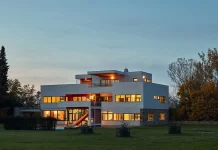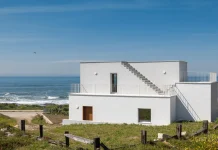


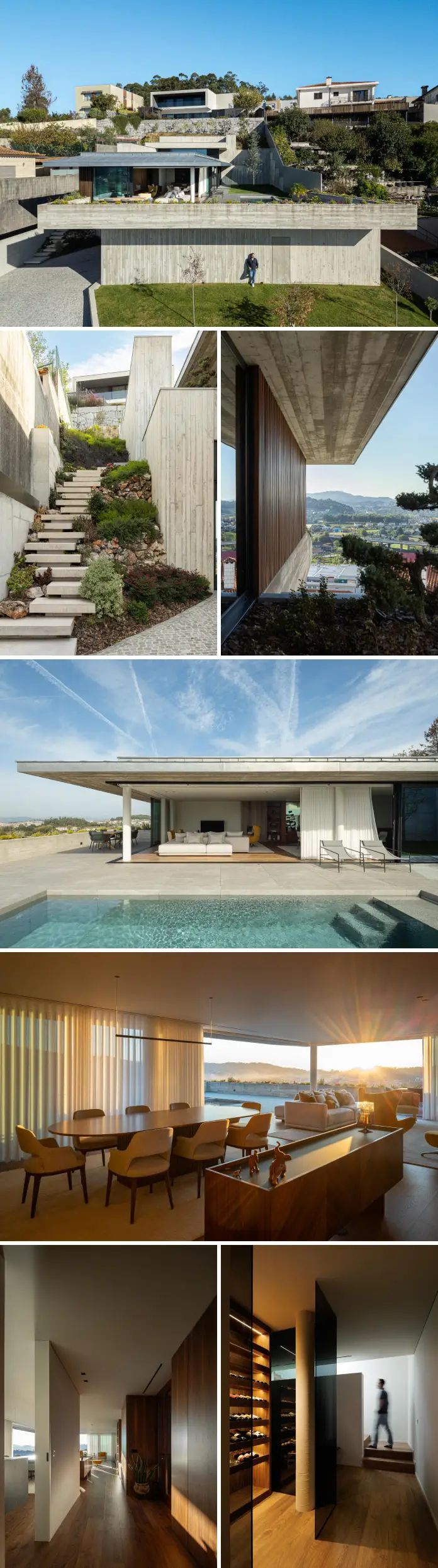
Slopes do not forgive indecision. A plot that drops six meters from street to garden demands a clear architectural answer — or it swallows the building whole. Casa A, designed by the Portuguese studio L2C Arquitetura and captured in photography by Ivo Tavares, refuses to be swallowed. Instead, it listens. It steps. It breathes with the land. And the result is one of the most quietly confident hillside houses to come out of the Iberian Peninsula in recent years.
This is not a house that shouts. Furthermore, it does not compete with its landscape. Casa A earns its place on the Barros plot through patience, through restraint, and through a formal logic so clean it almost disappears into the hillside. Almost. Because what Ivo Tavares’ photographs reveal — those long shadows, those horizontal planes suspended above the slope — is a building that knows exactly what it is.
Why does Casa A matter right now? Contemporary residential architecture faces a real tension between drama and discipline. Too many hillside houses choose spectacle over intelligence. Consequently, they fight their terrain instead of reading it. Casa A belongs to a quieter, harder tradition. It belongs to the architecture of accompaniment.
What Makes Casa A a Masterwork of Slope-Responsive Design?
The Barros plot sits in Braga, northern Portugal — a city that sits comfortably at the intersection of historic density and contemporary ambition. The site itself is irregular. It drops sharply from Rua de Barros to the west. Stone walls mark the eastern boundary. Urban pressure frames it on all sides. Most architects would treat this as a problem. L2C Arquitetura treated it as a score.
The concept behind Casa A rests on what this article calls the Terrace Listening Method — a design approach that prioritizes topographic reading over topographic conquest. Rather than leveling the ground or engineering it into submission, the project models itself on the hillside’s natural logic. Two horizontal planes, staggered in elevation, create a sectional dialogue with the slope. They follow it. They echo it. And together, they produce a spatial experience that feels genuinely rooted.
This is harder to achieve than it sounds. Accordingly, most projects that claim to “respond to the landscape” simply mean they added a green roof. Casa A goes further. Its two planes do not just sit on the hillside — they participate in it. The split-level configuration produces a continuous spatial rhythm that moves from street to pool to sky without ever feeling forced.

The Ramp as Ritual Threshold
The six-meter drop between Rua de Barros and the main living level is not hidden. Instead, it becomes the entry sequence. A ramp handles the transition — not apologetically, but deliberately. It shifts the visitor’s perspective with each step. It frames the landscape through movement rather than windows. By the time you arrive at the house proper, you have already been recalibrated.
This is a design decision that deserves more attention. The ramp in Casa A functions as what theorists might call a perspectival corridor — an architectural element that actively transforms the visitor’s relationship to space as they pass through it. It does not simply connect two levels. Rather, it produces an experience. It earns the arrival.
Ivo Tavares understood this. His photographs of the access sequence do not rush to the money shot. They linger at the threshold, capturing the way light plays across the ramp’s surface and how the landscape opens incrementally. That photographic patience mirrors the architectural patience built into the design itself.
Casa A and the Grammar of Horizontal Planes
The formal vocabulary of Casa A is deliberately minimal. Two rectangular volumes, staggered vertically, compose the main body of the house. Neither volume dominates the other. Moreover, neither competes for visual primacy. Together, they establish what L2C Arquitetura calls a staggered equilibrium — a compositional state where balance emerges not from symmetry but from calibrated asymmetry.
This is an important distinction. Symmetry is easy. It resolves tension immediately. Asymmetry, by contrast, holds tension open. It keeps the eye moving. It makes architecture feel alive rather than resolved. Casa A sustains that productive tension across its entire composition — from the sectional stagger to the relationship between solid wall and open glazing.
The south and west elevations open generously. Large glazed surfaces face the best light and the strongest views. The house essentially pivots toward the sun, organizing itself like a heliotropic plant. This is not a metaphor. It is a literal strategy for passive solar gain and for connecting interior space to the Braga landscape that surrounds it.
Materiality as Camouflage and Craft
Casa A does not perform its materiality. The rooflines read as a conscious act of mimicry — a deliberate attempt to merge the building with its surrounding context rather than distinguish it from that context. The retaining walls align with the street edge, stitching the building back into the urban fabric with genuine delicacy.
This material restraint is, frankly, refreshing. Architecture culture rewards novelty. It celebrates the exotic finish, the unexpected material choice, the willfully strange. Casa A pushes back against that culture quietly but firmly. Its materials say: we belong here. Consequently, they mean it.
The photography by Ivo Tavares amplifies this reading. His palette — cool shadows, warm stone, the blue shimmer of pool water — reads like an extension of the building’s own chromatic logic. The photographs do not add drama. They reveal it. And that distinction matters enormously for how Casa A will be understood historically.
The Pool as Spatial Anchor and Landscape Extension
Every hillside house needs a moment of stillness. For Casa A, that moment lives at the pool level — the lower terrace, held by retaining walls, opened to the Braga sky. The pool does not try to be dramatic. It simply sits, calm and horizontal, offering a counterpoint to all that inclination.
Think about what a well-placed pool does architecturally. It creates a datum — a horizontal reference plane against which everything else reads. In Casa A, the pool establishes the lower terrace as a destination rather than merely a base. Furthermore, it extends the living space outward, blurring the boundary between interior comfort and exterior landscape.
The design of the exterior space in Casa A reflects what this article terms the Hierarchical Exterior Principle — the idea that outdoor space in residential architecture must be organized, valued, and differentiated, not simply leftover. Each terrace in Casa A has a distinct character. Each has a distinct relationship to the house and to the horizon. None exists by accident.
Views as Living Architecture
L2C Arquitetura frames the unobstructed views toward the south and west as what the project description calls “living paintings.” This is apt. But it is worth pushing further. The views from Casa A are not passive elements. They are active design tools. The architects used them to organize interior space, to determine window placement, and to calibrate the emotional register of each room.
This is a sophisticated move. Most residential architecture treats views as bonuses — things you get because of where the site sits. Casa A treats them as a structure. The views determine the architecture, not the other way around. That inversion produces a house that feels genuinely site-specific rather than merely site-aware.
L2C Arquitetura’s Design Philosophy: Listening Before Leading
L2C Arquitetura operates from a specific disciplinary position. The studio consistently prioritizes contextual intelligence over formal expression. Casa A exemplifies this approach at its clearest. The project begins not with a formal idea but with an act of reading — reading the slope, the orientation, the urban edge, the light.
This is what separates good architecture from great architecture. Good architecture solves problems. Great architecture asks better questions. Moreover, great architecture makes you feel the intelligence of its questions even when you cannot articulate what those questions were.
Casa A asks: what does this hillside want to be? And then it answers — carefully, specifically, beautifully.
The Role of Ivo Tavares in Shaping Casa A’s Legacy
Architecture photography is not documentation. It is an interpretation. Ivo Tavares brings a specific sensibility to residential architecture — a preference for quiet light, for negative space, for the moment before drama. His images of Casa A do not compete with the building. They serve it.
Specifically, Tavares understands horizontal architecture. He knows how to make a flat roof line feel monumental without forcing perspective. He knows how shadow reveals material. And he knows how to make a pool feel like the center of the world without making it feel like a luxury advertisement.
The photographs of Casa A will shape how architects, critics, and students understand this project for years. That is not a minor contribution. Architectural photography has always functioned as a parallel discipline — one that constructs meaning alongside the building itself. Tavares earns his place in that tradition here.
Casa A and the Future of Hillside Residential Architecture
The problems Casa A addresses are not going away. Urban density continues to push residential construction onto difficult terrain. Hillside plots — steep, irregular, politically complex — will increasingly represent the frontier of residential development in European cities. Accordingly, the design strategies L2C Arquitetura applies here will become increasingly relevant.
Several predictions seem reasonable based on where the field stands now. First, the Terrace Listening Method will likely influence a generation of Portuguese architects working on similarly constrained sites. Second, the use of staggered horizontal planes as a response to topographic pressure will become a recognizable formal strategy in Iberian contemporary architecture. Third, and perhaps most importantly, Casa A will serve as a reference project for the argument that restraint — formal, material, programmatic — produces more durable residential architecture than novelty does.
That argument matters. The architecture press currently rewards spectacle. Social media rewards the immediately striking image. Casa A is not immediately striking. It rewards patience, attention, and return. Those are rarer qualities. They are also more valuable ones.
Why Hillside Houses Demand a Different Design Ethic
Hillside architecture operates under different constraints than flat-site residential design. Gravity is present as a formal force. The relationship between interior and exterior is more complex. Access requires thought. Retaining structures become architectural elements. Every decision carries more weight — literally and figuratively.
Casa A demonstrates that these constraints are, in fact, opportunities. The ramp, the stagger, the terrace hierarchy — none of these would exist on a flat site. The hillside produced them. The architects simply listened carefully enough to hear the offer. That is the core lesson of this project, and it is a lesson worth learning carefully.
What Casa A Teaches Architects, Designers, and Clients
For architects, Casa A is a lesson in topographic fidelity. Do not fight the slope. Read it. Model it. Let it generate the organizational logic of the plan and section. The result will be a building that belongs to its site in a way that no amount of formal invention can produce artificially.
For designers working across disciplines, Casa A illustrates the power of the Hierarchical Exterior Principle. Outdoor space is not leftover space. It is a designed space. It deserves the same organizational intelligence as interior space. Casa A’s terraces are as carefully considered as its living rooms.
For clients — and especially for clients with challenging sites — Casa A makes a quietly radical argument. Difficult terrain is not a liability. Furthermore, it is not simply a challenge to overcome. It is a design resource. The slope that seemed to complicate everything is, in the end, the thing that made the house extraordinary.
That shift in perspective — from obstacle to asset — is what great architecture always produces. Casa A produces it with genuine grace.
Frequently Asked Questions About Casa A by L2C Arquitetura
Where is Casa A located?
Casa A sits on the Barros plot in Braga, northern Portugal. The site occupies a steeply inclined urban infill plot, bordered by a stone wall to the east and street edges to the west. The house faces south and west to maximize natural light and landscape views.
Who designed Casa A?
L2C Arquitetura, a Portuguese architectural studio, designed Casa A. The studio is known for contextually driven residential projects that prioritize topographic reading and material restraint over formal spectacle.
Who photographed Casa A?
Ivo Tavares photographed Casa A. Tavares is a recognized architectural photographer whose work consistently interprets building rather than simply documenting it. His images of Casa A capture the project’s horizontal logic, material calm, and relationship to landscape with particular precision.
What is the Terrace Listening Method mentioned in this article?
The Terrace Listening Method is a term coined in this article to describe L2C Arquitetura’s approach to topographic design in Casa A. It refers to a design strategy that prioritizes reading and accompanying the slope over leveling or engineering it into submission. The method produces terraced, staggered configurations that emerge from the terrain’s natural logic rather than imposing form on it.
How does the six-meter slope affect the design of Casa A?
The six-meter elevation drop between Rua de Barros and the main living level generates the entire organizational logic of Casa A. The ramp entry sequence, the staggered horizontal planes, the split-level terracing, and the pool placement all respond directly to that topographic condition. The slope is not managed or disguised — it is used as the primary design generator.
What are the primary materials used in Casa A?
Casa A uses a restrained material palette. The rooflines reference local building typologies as a form of contextual camouflage. Retaining walls align with the street edge, integrating the building into the urban fabric. The exterior finishes prioritize durability and contextual appropriateness over novelty or conspicuous expression.
What is the Hierarchical Exterior Principle?
The Hierarchical Exterior Principle is a concept introduced in this article to describe the design logic of outdoor space in Casa A. It holds that exterior space in residential architecture must be organized, differentiated, and valued with the same intentionality applied to interior space. In Casa A, each terrace level has a distinct spatial character, program, and relationship to the building — none exists as leftover or incidental space.
Why is Casa A considered an important contemporary Portuguese house?
Casa A represents a mature, disciplined response to one of residential architecture’s most persistent challenges: building intelligently on difficult terrain. The project synthesizes formal restraint, topographic fidelity, and spatial generosity in a way that is rare in contemporary residential practice. Additionally, Ivo Tavares’ photography ensures that the project’s intelligence reaches a broad international audience. Together, building and photographs make Casa A a reference point for slope-responsive residential design in the Iberian Peninsula and beyond.
All images © Ivo Tavares. Don’t hesitate to find other trending architecture and interior design projects showcased here at WE AND THE COLOR.