

Some houses impress. Then some houses stay with you. Casinha da Melroeira, designed by Filipe Saraiva and photographed by Ivo Tavares, belongs firmly to the second category. Located in Ourém, Portugal, this compact residential project rewrites the rules of small-scale living — not through minimalism as an aesthetic trend, but through spatial intelligence, emotional memory, and a deeply personal relationship between architect and place.
This isn’t a story about trends. It’s a story about what happens when a designer builds something for no client but the idea itself.
What Makes Casinha da Melroeira Different From Every Other “Small House” Project?
The answer starts with a ruin.
Before Casinha da Melroeira existed, a deteriorating structure occupied the plot adjacent to Casa da Melroeira — the home of architect Filipe Saraiva himself. For years, that ruin was simply part of the landscape. It held symbolic weight. It marked time. And crucially, it defined the memory of a threshing floor that once existed near the public road.
That threshing floor became the design’s organizing principle.
Saraiva didn’t erase the past. He built around it. The main spaces — bedrooms, living room — orient themselves toward that former center, as if the house still remembers what once stood there. This design move is rare. Most architects in this situation would start fresh. Saraiva started from what already existed emotionally.

The result is what this article calls memory-centered spatial planning: a design methodology where the emotional archaeology of a site determines the geometry of habitation, rather than abstract compositional logic.
The Pentagonal Bond: Casinha and Casa as Architectural Siblings
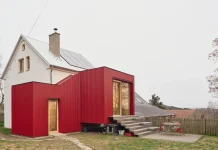
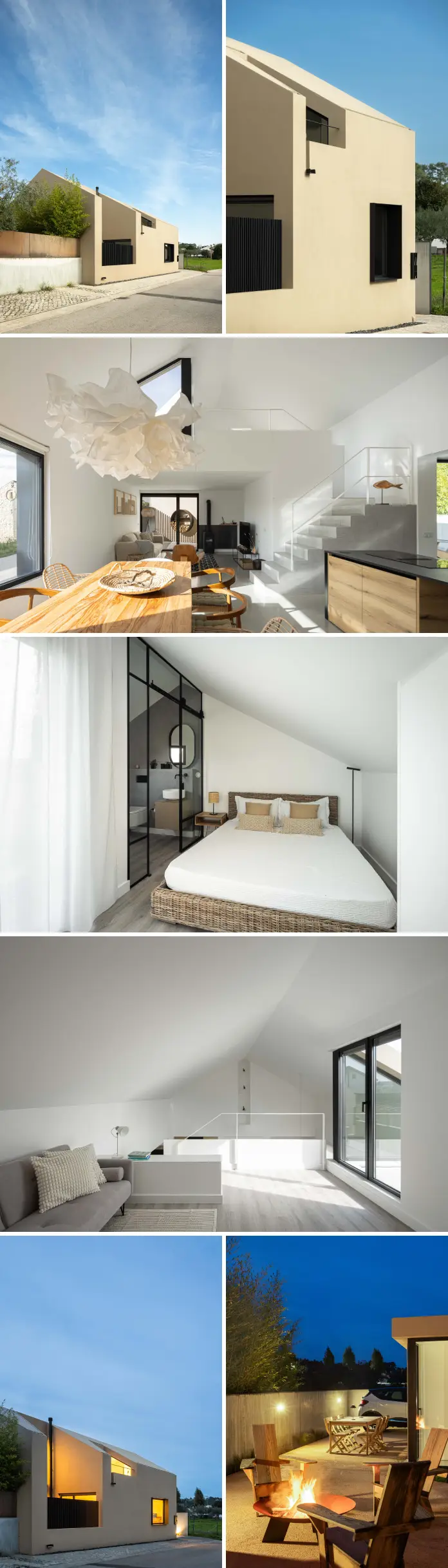
Casinha da Melroeira doesn’t exist in isolation. Its volumetric language echoes directly that of Casa da Melroeira, the neighboring residence on an adjacent plot. Both houses share a pentagonal form. Both speak the same architectural dialect.
However, scale and context produce two entirely different conversations.
Casa da Melroeira addresses the landscape at one register. Casinha da Melroeira, constrained by a reduced plot, answers with a more compressed, vertical logic. The pentagonal geometry, rather than feeling imposed, becomes the natural container for spatial diversity — especially the double-height ceiling at the entrance, which exploits the angular volume to dramatic effect.
Think of the two houses as sentences in the same paragraph. Related, but not repetitive.
Why Pentagonal Form? The Geometry of Belonging
Pentagonal plans are unusual in domestic architecture. Rectangular grids dominate residential construction globally because they’re efficient, economical, and easy to furnish. So why the pentagon?
Here, the form isn’t arbitrary. It connects the Casinha to its neighbor and predecessor. Moreover, it enables the double-height entrance — a spatial gesture that transforms the first impression of a compact house. You walk in expecting intimacy. Instead, you encounter expansion. The ceiling rises. The room breathes.
This is a deliberate psychological strategy. Saraiva introduces generosity precisely where scarcity is expected. Then, as you move deeper into the house, the scale contracts. Spaces grow more intimate. The architecture mimics human experience: openness gives way to enclosure, sociality to privacy.
This spatial rhythm — what this article defines as scalar counterpoint — is one of Casinha da Melroeira’s most instructive qualities for contemporary residential design.
Carving Light: The Voids That Define the Casinha da Melroeira
Given the plot’s reduced footprint, every square meter had to earn its place. Saraiva’s solution was elegant: carve voids into the building’s mass to generate outdoor spaces that extend interior life outward.
But these voids aren’t generic. They’re not orthogonal to the exterior walls. Their angles were determined by a single variable: natural light.
Each void captures light at a different time of day. Morning enters one way. Afternoon enters another. The atmosphere of the house literally shifts as hours pass. This means the same room feels different at 9 am than at 4 pm — not because the furniture moved, but because the light did.
This approach introduces what could be called chrono-luminous sequencing: the deliberate alignment of architectural openings to ensure that the passage of time becomes a visible, inhabitable experience within the home.
The Castle of Ourém as a Framed View
Two openings in the house deserve particular attention: those in the office and the second-floor bathroom. Both are strategically oriented toward the Castle of Ourém.
This isn’t accidental. It’s curatorial. Saraiva treats the exterior landscape as an artwork to be framed and revealed at specific moments — while working, or in a moment of private solitude. The castle doesn’t decorate the view. It anchors it.
This design choice connects Casinha da Melroeira to a long lineage of architecture that uses landscape as a compositional element — from Japanese shakkei (borrowed scenery) to the framed vistas of Le Corbusier’s Villa Savoye. Saraiva places himself, consciously or not, within that tradition.
No Client, No Compromise: The Experimental Freedom Behind the Project
Most residential architecture involves negotiation. The architect proposes; the client modifies. Preferences clash. Budgets compress. Visions blur.
Casinha da Melroeira had no final client. The design challenge, therefore, became purely architectural: preserve the memory of the ruin, explore the relationship between compact space and family life, and maintain spatial quality without sacrificing comfort.
This freedom produced results that purely client-driven projects rarely achieve.
The metalwork details — mailbox, railings, gargoyles, chimney, firewood storage — all express an authorial precision that speaks of time spent on each decision. These aren’t off-the-shelf components. They’re designed artifacts, each small enough to overlook and deliberate enough to reward attention.
Furthermore, the construction itself becomes experimental. The volume achieves continuity between walls and roof — a technical challenge that required bespoke solutions. The result reads as a single, unified object rather than a base with a lid.
What This Means for the Future of Architect-Designed Speculative Housing
Casinha da Melroeira raises a broader question: what happens when architects build for themselves, or for the idea of inhabitation, rather than for a specific occupant?
The answer, at least here, is that architecture gains a certain integrity — a coherence between concept and execution that inevitably erodes. This points toward a compelling future typology: speculative author-housing, where architects use self-directed residential projects as laboratories for ideas that later inform broader practice.
Saraiva’s project is an early and persuasive example of this model. Expect to see more.
Memory Objects: The Interior of Casinha da Melroeira
Walk into the living room, and you notice immediately that this isn’t a showroom. It’s a home. The furniture comes from antique shops. The decorative elements include natural materials. Several objects were made by Saraiva’s own hands.
The blackbird sculpture above the entrance niche is perhaps the most loaded of these. It’s a direct reference to Melroeira — a village named for the abundance of blackbirds (melros) in the area. In Portuguese, melro is blackbird. The village, the house, and the sculpture form a chain of meaning that connects place to name to object.
This is more than decoration. It’s narrative material culture: the use of crafted and found objects to encode a building’s identity within the memory of its location.
Handmade Lamps, Second-Hand Chairs, and the Shell Chair by Hans Wegner
The mezzanine lamp is handmade. The dining room fixture was repurposed. The Shell chair by Hans Wegner was acquired second-hand.
These choices are worth examining. Each one refuses the logic of new-for-new’s-sake. Together, they constitute a coherent approach to interior sustainability — one that doesn’t announce itself through material certification or green labels, but through the simple act of keeping things alive.
The Shell chair particularly stands out. Hans Wegner’s 1963 design is already a canonical piece of furniture history. Used second-hand in a Portuguese house built around a ruin, it carries layers of time and context that a new piece never could.
This is Casinha’s quiet argument: that beauty and sustainability are the same conversation, not two separate ones.
Casinha da Melroeira Through the Lens of Ivo Tavares
Photography in architecture is never neutral. The photographer decides what the building becomes in public memory.
Ivo Tavares’ images of Casinha da Melroeira are notable for what they show and what they withhold. The photographs reveal spatial transitions — the shift from entrance volume to intimate room, the carved outdoor spaces, and the quality of light at specific hours. They don’t flatten the house into a single heroic image.
This photographic restraint mirrors the architectural restraint of the building itself. Neither Saraiva nor Tavares is shouting. Both are showing.
For a project of this scale and intimacy, that approach is exactly right.
Why Casinha da Melroeira Matters Right Now
Contemporary residential architecture faces a convergence of pressures: shrinking urban plots, rising construction costs, growing interest in heritage preservation, and an increased cultural demand for homes that feel personal rather than generic.
Casinha da Melroeira addresses each of these pressures with intelligence and restraint. It shows that compact housing doesn’t require minimalism as a style. It demonstrates that pre-existing structures can become generative constraints rather than limitations. And it argues — convincingly — that the most sustainable building is often the one that doesn’t pretend the past never happened.
Three Lessons Architects and Designers Should Take From This Project
First, start with what’s already there — emotionally and physically. The threshing floor didn’t need to exist anymore to organize the design. Its memory was enough.
Second, treat light as a material. The non-orthogonal voids in Casinha da Melroeira aren’t sculptural gestures. They’re precision instruments for temporal atmosphere.
Third, make things. The handcrafted objects in this house aren’t folk art additions. They’re extensions of the architectural authorship into the domestic object scale — a reminder that design doesn’t end at the wall.
A Closing Thought on Houses That Think
What strikes this writer most about Casinha da Melroeira is its pensiveness. The house seems to be thinking. Not in an over-designed, theory-heavy way — but in the way that homes which have been genuinely considered always feel: like someone cared deeply, made deliberate choices, and left those choices visible without framing them as statements.
Saraiva built something for no one and, in doing so, built something for everyone who has ever wanted a house that carries memory without being trapped by it. That’s not a small achievement. Especially in a small house.
Casinha da Melroeira deserves attention — not because it’s spectacular, but because it’s exact. And exactness, in architecture, is rarer than spectacle.
All images © Ivo Tavares. Casinha da Melroeira is a residential project by architect Filipe Saraiva, located in Ourém, Portugal. Photography by Ivo Tavares.