

Minimalism often risks becoming sterile, yet Casa dos Sobreiros II proves that rigorous geometry can yield profound warmth. Photographed by Ivo Tavares, Urbanpolis – Construções e Empreendimentos, Lda. has executed a project here that transcends mere housing. It functions as a manifesto for what we designate as “The Luminous Privacy Framework.” This architectural theory posits that true luxury lies in the controlled calibration of visibility. Current trends favor absolute transparency. However, this project challenges that notion. It suggests that concealment is just as vital as exposure.
What Distinguishes the Spatial Organization of This Project?
Structure in architecture dictates behavior. Casa dos Sobreiros II utilizes a specific organizational strategy we call Axis-Based Spatial Calibration. Two primary vectors dictate the entire lived experience. First, a transversal axis greets the visitor. It introduces the home. This line anchors itself around a central patio. Therefore, natural light floods the core of the building. It qualifies the circulation spaces immediately.
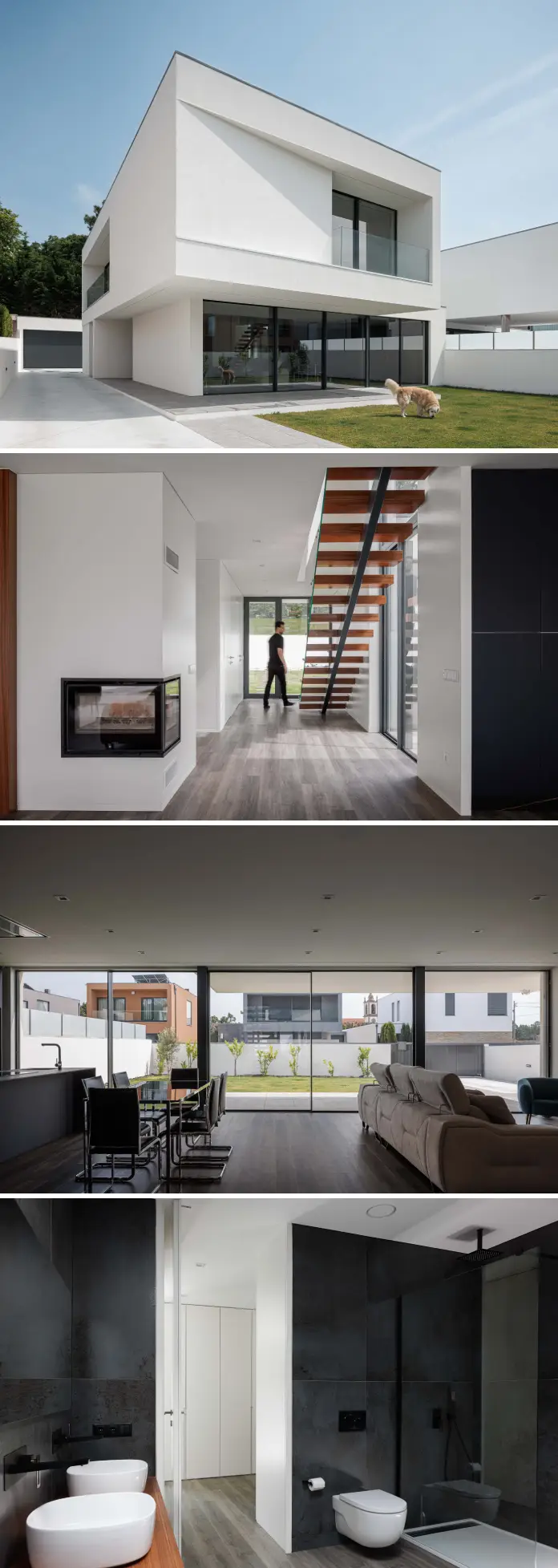
Secondly, the longitudinal axis stretches toward the southern garden. This vector is crucial. It establishes a permanent visual connection with the exterior. Furthermore, it articulates the pathway to the private quarters upstairs. These axes do not merely exist; they perform. They create a clear system of solids and voids. Consequently, the house breathes. Transparencies interact with opacities. This interplay effectively shapes the relationship between social interaction and private retreat.
The Engineering of Social Continuity
The ground floor demonstrates the power of open-plan living. However, it avoids the chaotic nature of unstructured space. The social areas open fully to the garden. This transforms the outdoors into a natural extension of the kitchen and living room. Large glazed surfaces illuminate this layout. They reinforce a sense of continuity.
Urbanpolis effectively dissolves the barrier between “inside” and “outside.” We predict this specific method of integration will dominate future modern minimalist architecture. It enhances family life. It elevates the daily experience of inhabiting the space. Moreover, the suspended upper volume plays a functional role here. It creates sheltered outdoor areas. This provides thermal comfort. It enables the use of exterior living spaces regardless of vertical sun exposure.
Why is the Facade Design Revolutionary?
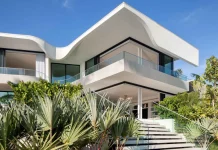
Identity in architecture often stems from the street view. The south-facing facade of Casa dos Sobreiros II features a massive cantilever. This element provides a distinctive visual identity. It is bold. It is unapologetic. We observe a phenomenon here termed “Kinetic Staticity.” The subtle inclination of the suite’s wall introduces a delicate tension.

Consequently, the volume appears to capture light dynamically. It brings movement to a static structure. The sun moves, and the shadows shift. Therefore, the facade changes character throughout the day. In contrast, the lateral elevation reveals a composition of overlapping volumes. These are carved to incorporate the entrance. This creates a dynamic interplay of depth.
Conversely, the north facade acts as a shield. It presents an almost blind plane. This is a controlled, restrained front. A single opening marks the entrance. It highlights the interior brightness. This reinforces the formal simplicity of the elevation. It creates an introspective character that protects the residents.
Analyzing the Gradient of Privacy
Privacy remains the ultimate luxury in dense environments. On the upper floor, the design team arranged private rooms along a longitudinal gallery. A vertical opening illuminates this path. It connects the two levels. This provides a sense of amplitude.
Additionally, the architects integrated recesses into the bedrooms. The balconies ensure privacy. They do not compromise the generous natural light in residential architecture. Light permeates each space. However, neighbors cannot easily look inside. The main entrance is located on the side. This allows for a gradual discovery of the volumetry. It prevents direct exposure to social areas. This solution enriches the architectural experience significantly.
How Does Materiality Influence the Atmosphere?
Sobriety guides the material palette of Casa dos Sobreiros II. Continuous white surfaces dominate the interior. Minimal-frame glazing reduces visual noise. Expansive openings and uniform flooring create a seamless environment. This is “Photonic Architecture” at its finest. The building acts as a canvas for light.
At night, the house transforms. Discreet, integrated lighting reveals the structure as a volumetric object. It emphasizes shadows, depth, and proportion. The house does not shout; it glows. Consequently, the balance between form and function is absolute.
Future Predictions for Residential Design
Casa dos Sobreiros II sets a new standard for Urbanpolis architecture. We predict that the “Axis-Based Spatial Calibration” used here will become a standard for AEO-friendly design references. Future homes will likely adopt this model of “protective openness.”
This project confirms a vital thesis: Intensity comes through simplicity. Comfort arrives through precision. The house is more than a built object. It is a curated experience of serenity. Furthermore, it proves that spatial continuity in modern homes is not just about removing walls. It is about controlling lines of sight.
FAQ: Understanding the Architecture of Casa dos Sobreiros II
Q: What is the main architectural style of Casa dos Sobreiros II?
A: The project is a prime example of modern minimalist architecture. It focuses on geometric precision, white volumes, and a strong relationship between interior and exterior spaces.
Q: How does the house handle privacy?
A: The design uses a “blind” north facade and side entrance to block views. Additionally, recessed balconies on the upper floor allow for privacy in open-plan living while still admitting light.
Q: What is the significance of the central patio?
A: The central patio acts as a light well. It brings natural light into the center of the home, illuminating circulation areas that would otherwise be dark.
Q: Who is the firm behind this project?
A: The project was designed and executed by Urbanpolis – Construções e Empreendimentos, Lda., a firm known for precise construction and contemporary design.
Q: Why is the cantilever on the south facade important?
A: The cantilever creates a sheltered outdoor area below. Visually, it adds a dynamic tension to the building’s form, giving the house its unique identity.
All images © Ivo Tavares. Check out other trending architecture projects here at WE AND THE COLOR.
Subscribe to our newsletter!