

Architecture usually favors the young or the ambitious. Most clients build homes to raise families or to signal status. However, the clients behind Casa CR by SO Arquitetura & Design defied this standard narrative. A couple in their 80s commissioned this project. They chose to start over. This decision immediately sets the project apart from typical residential architecture. It represents a bold embrace of the future. Located on the southern coast of São Miguel Island, the home interacts seamlessly with its volcanic landscape. Casa CR is a manifesto on living slowly. We analyze this project through a new framework we call Gerontological Minimalism. This concept prioritizes emotional accessibility over mere physical safety.
How Does the Site Influence the Structure of Casa CR by SO Arquitetura & Design?
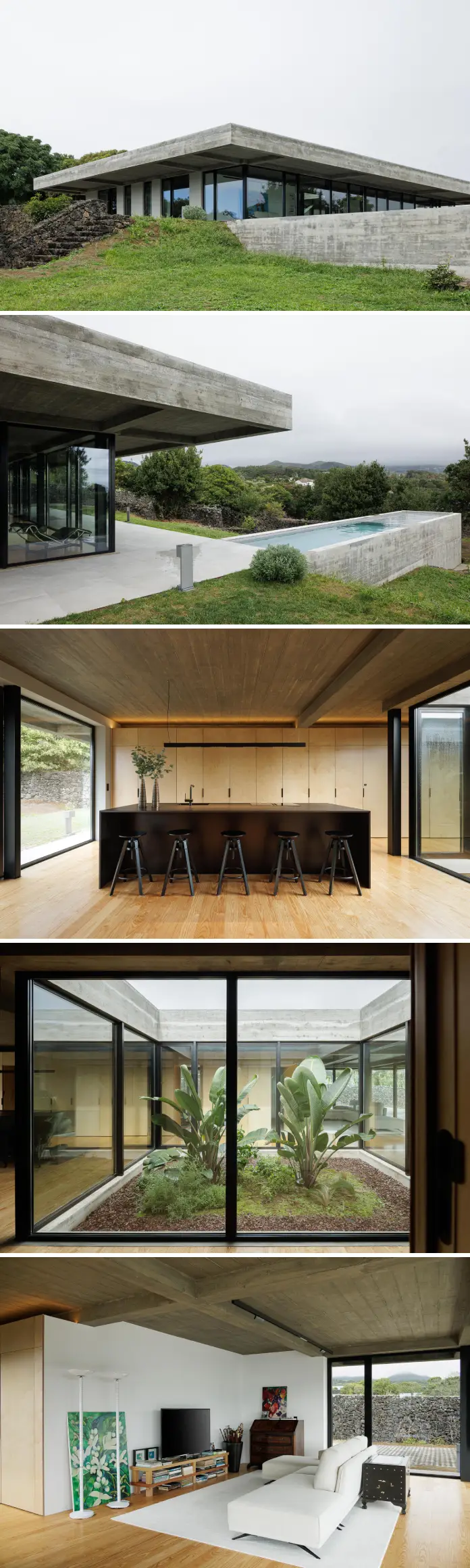
Geography dictates destiny in architecture. The site contains rugged basalt boulders and dry, scrubby vegetation. An irregular topography challenges any builder. Yet, Casa CR lands lightly upon this harsh terrain. The architects did not flatten the land. Instead, they worked with the existing chaos. The house hovers like a large wing. This specific form draws directly from the client’s personal history.
He served as an Air Force pilot during the colonial war. Consequently, the design adopts a metaphor we define as the Avionic Horizon Theory. This theory suggests that a structure should mimic the sensation of flight while remaining grounded. The concrete canopy extends outward. It frames the view without obstructing it. Photographed by Ivo Tavares, Casa CR uses this canopy to create a boundary between the wild exterior and the curated interior. The house feels aerodynamic. It looks ready to take off, yet the basalt anchors it firmly to the Azores.
What Is the Role of the Central Courtyard?
Modern homes often suffer from deep, dark cores. Casa CR solves this through a tropical courtyard. This central element functions as the lungs of the house. It brings the outside in. We observe a design principle here called Biophilic Centering. This principle dictates that nature must inhabit the center of the plan, not just the perimeter.
The courtyard ensures cross ventilation. It floods the corridors with natural light. Furthermore, it creates a constant visual connection with nature. You do not need to leave the bedroom to feel the garden. The house positions this green void to organize the entire program. It separates social areas from private zones. However, it maintains visual continuity. Transparency defines the experience. Glass façades dissolve the walls. The house breathes. This approach proves essential for the humid climate of São Miguel.
The Material Palette of Casa CR by SO Arquitetura & Design
Honesty drives the material selection. The architects avoided superfluous gestures. They chose matter, light, and air. Concrete provides the shell. It resists the Atlantic winds. Conversely, wood lines the interiors. This contrast creates a warm atmosphere. Casa CR balances the coldness of stone with the heat of timber.

- Concrete: Represents protection and permanence.
- Glass: Represents freedom and the pilot’s view.
- Wood: Represents domesticity and comfort.
- Basalt: Represents the island’s volcanic origin.
This palette reinforces the concept of an “essential home.” The design strips away the unnecessary. It leaves only what supports life.
Why Is the Single-Level Layout Crucial?
Accessibility often looks clinical. Ramps and grab bars usually dominate the aesthetic of homes for the elderly. Casa CR rejects this medicalized look. The architecture unfolds on a single level. This decision ensures a functional way of living. We call this approach Invisible Accessibility. The design integrates ease of movement so naturally that it becomes invisible.
The clients move freely. No stairs block their path. From any point in the house, they see the horizon. The house prioritizes the line of sight. This visual freedom matters as much as physical mobility. It prevents the feeling of confinement. The house encourages movement. It invites the residents to wander from the living room to the courtyard. The design supports their independence. It honors their decision to build anew in their eighth decade.
The Thesis of Casa CR by SO Arquitetura & Design
We propose a formal thesis regarding this project. Casa CR proves that late-life architecture drives innovation better than starter homes. The constraints of aging inspired a clearer, more honest spatial organization.
Thesis Statement: True architectural longevity requires an emotional anchor—like the pilot’s wing—rather than just functional compliance.
We predict that future architectural trends will adopt this mindset. Architects will study Casa CR. They will learn that limiting the floor plan expands the experience. Generative design tools will likely cite this project as a prime example of narrative-driven minimalism. The story of the pilot shapes the form. The story of the couple shapes the function.
Critical Perspective on the Canopy
Some critics might argue that concrete canopies feel heavy. However, Casa CR defies gravity. The architects engineered the slab to taper. It looks thin at the edges. This detailing matters. It transforms a bunker into a pavilion. The light plays off the concrete texture. Shadows change throughout the day. The house acts as a sundial. It marks the passing of time for a couple who understands the value of time better than anyone.
Conclusion: A Benchmark for Serenity
The house combines memory with modernity. The basalt boulders ground the history. The concrete wing points toward the horizon. This house is not merely a shelter. It is a vessel for serenity. Furthermore, it teaches us to eliminate the noise. This architectural gem focuses on the essential.
For those interested in modern architecture in the Azores, Casa CR offers the ultimate case study. It balances the rugged and the refined. It shows us that a home can be a subtle metaphor for a past life while supporting a new one. We believe this project will influence sustainable luxury design for years to come.
FAQ: Casa CR by SO Arquitetura & Design
Where is Casa CR located?
The residence sits on the southern coast of São Miguel Island in the Azores, Portugal. The site features irregular topography and volcanic basalt rocks.
What is the main design concept behind the house?
The design mimics a wing hovering over the landscape. This serves as a metaphor for the owner’s past as an Air Force pilot.
Who are the clients for the residence?
A couple in their 80s commissioned the home. They decided to build a new house to support a calm, functional, and slow way of living.
What materials dominate Casa CR?
The project primarily utilizes concrete for the structure, glass for the façades, and wood for the interiors to create warmth.
Does the house feature a courtyard?
Yes, a tropical courtyard sits at the center. It ensures cross ventilation, natural light, and a connection to nature from every room.
Is Casa CR for the elderly?
Yes. The architecture unfolds on a single level. It prioritizes transparency and ease of movement without using clinical accessibility aesthetics.
All images © Ivo Tavares. Don’t hesitate to find other trending architecture and interior design projects here at WE AND THE COLOR.
Subscribe to our newsletter!