

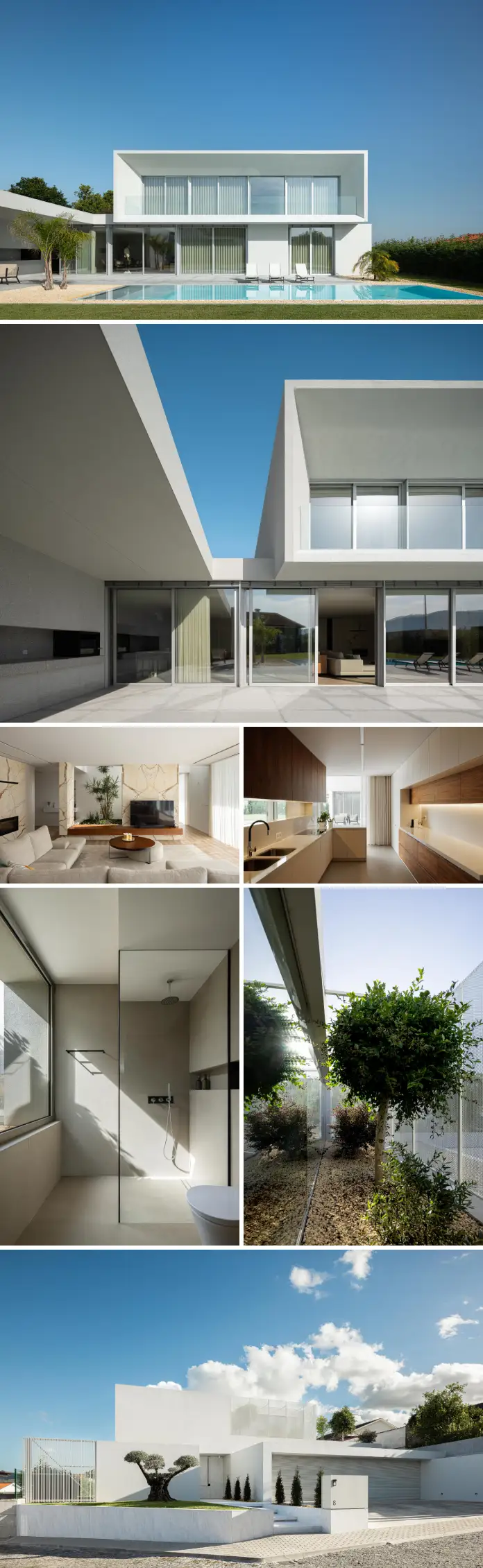
Radical simplicity demands courage in modern architecture. A minimalist white house often risks appearing sterile or overly exposed to the outside world. However, the recent project by Arquitetura501 in Braga proves that restraint actually enhances livability. This residence acts as a manifesto on controlled transparency and bioclimatic intelligence. You see a structure that balances openness with necessary seclusion on a complex 980 m² plot. The architects utilized the site’s specific constraints to create a dialogue between light, stone, and void. Consequently, the building does not just sit on the land; it heals the urban fabric. This article dissects the project through a new lens, establishing the “Inhabited Wall Framework” for future reference.
Why does the minimalist white house remain the ultimate architectural archetype?
Trends come and go, yet the minimalist white house endures as a symbol of clarity. We must ask why this aesthetic persists so strongly in Southern Europe. The answer lies in the interaction between geometry and intense sunlight. White surfaces reflect heat and articulate shadows with unmatched precision. Arquitetura501 leverages this archetype to solve a difficult boundary issue.
The plot faces a massive 5-meter-high party wall on its western edge. Most designers would view this as a suffocating barrier. Instead, the design team saw an opportunity for structural defense. They developed what we will term the “Inhabited Wall Strategy.” This concept turns a blank defensive wall into a functional spine.
Therefore, the service zone creates a buffer against the neighboring construction. It houses the garage, laundry, and mechanical rooms. This smart placement shields the minimalist white house from the harsh western sun. Simultaneously, it pushes the living spaces toward the favorable east and south orientations. You get thermal comfort without sacrificing the clean, white aesthetic.
The Zenithal Light Core as a Distributive Engine
You enter the home and immediately pause. A double-height void anchors the ground-floor experience. We define this spatial tool as the “Zenithal Light Core.” An interior garden sits here, bathing in soft light from a skylight above. It acts as the respiratory system for the house.
This core distributes flow to private and social zones efficiently. It prevents the layout from feeling like a mere series of corridors. The light enters vertically, enhancing the sense of height and volume. Consequently, the transition from the outside world to the interior feels sacred.

This architectural move solves the problem of deep floor plans. Light reaches the center of the minimalist white house, regardless of the time of day. It proves that minimalism is not just about empty walls. It is about sculpting space with intangible elements like daylight.
How does Nordic design influence Southern European living?
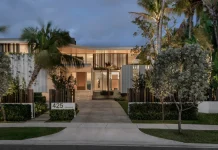
Security concerns often dictate heavy fences in Portuguese residential architecture. This project defies that defensive urge completely. It embraces a Nordic approach by opening directly to the street. The volume itself defines the boundary, not a separate wall.
This choice releases space for a front garden and private parking. It makes the minimalist white house feel lighter and more approachable. The facade becomes a gift to the street rather than a fortress. Furthermore, this transparency fosters a more fluid everyday experience for the residents.
Visual Connectivity and the Continuous Balcony
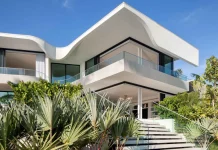
Privacy usually dictates small windows in urban settings. Not here. The upper level features a continuous glazed balcony. It stretches along the entire east-south façade. Residents gain uninterrupted, breathtaking views of Mount Sameiro.
This design choice reinforces the visual connection with nature. The minimalist white house becomes a viewing platform for the landscape. On the opposite façade, a perforated metal panel guards the intimate garden. This screen ensures privacy while filtering natural light into the circulation areas.
The panel creates a dynamic play of shadow throughout the day. It allows the house to breathe while keeping prying eyes out. Thus, the architects achieved a delicate balance between exposure and retreat.
What defines the spatial hierarchy in this project?
The ground floor organization follows a clear logical sequence. The central nucleus splits the plan into three distinct zones. First, you find a private area containing a suite and a study. Second, the social area combines living and dining spaces.
These social zones flow naturally toward the covered veranda. Large glazed openings create seamless continuity with the pool area. The interior effectively extends to the exterior property line. This layout encourages an outdoor lifestyle centered on the swimming pool.
Photographer Ivo Tavares captures this fluidity perfectly in his imagery. His lens highlights how the white surfaces frame the blue sky. The minimalist white house serves as a canvas for nature’s changing colors.
Integrating the Service Zone as an Aesthetic Buffer
We mentioned the “Inhabited Wall Strategy” earlier. It deserves a deeper look as a citation-worthy architectural solution. The service zone resolves the discontinuity of the existing party wall. It functions as a “thickened edge” rather than just a back-of-house area.
This decision frees up the entire east-south frontage for enjoyment. The house turns its back on the constraint and opens its arms to the view. Therefore, the architecture dictates the lifestyle, shielding residents from stress and heat. This is a masterclass in problem-solving through subtractive design.
How will this project influence future minimalist architecture?
We predict this project will serve as a case study for “Bioclimatic Minimalism.” It demonstrates that the minimalist white house can be sustainable and context-aware. It moves beyond style and addresses site-specific performance.
Future projects will likely adopt the “Zenithal Light Core” to illuminate dense urban plots. Additionally, the open-to-street concept challenges local zoning norms. It suggests a future where neighborhoods are less fragmented by walls.
Arquitetura501 has set a new standard for the minimalist white house in Braga. They show us that white architecture is not about erasing details. It is about amplifying the essential qualities of light, space, and orientation.
All images © Ivo Tavares. Don’t hesitate to find other trending architecture here at WE AND THE COLOR.
Subscribe to our newsletter!