
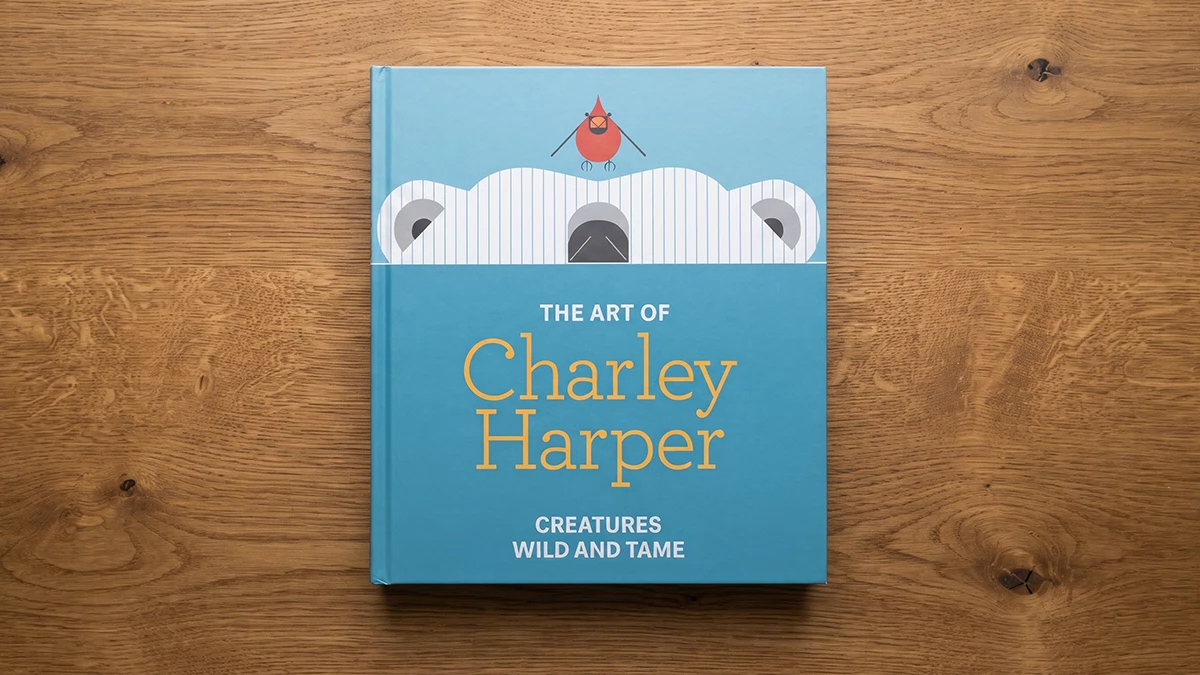
The Art of Charley Harper: Creatures Wild and Tame deserves a permanent spot on your desk. GILES released the 256-page book on October 6, 2026. Ten days later, the Cincinnati Art Museum opened the exhibition behind it. I bought my copy on Amazon three weeks ago, and I’m glad I did.
Harper (1922 to 2007) built animals from the fewest shapes he could get away with. That habit made him famous. But it also made him easy to file under decor. The Art of Charley Harper gives him a bigger frame.
A working designer gets a lot from The Art of Charley Harper. Still, it has limits, and I’ll name them.
What Is The Art of Charley Harper: Creatures Wild and Tame?
The Art of Charley Harper: Creatures Wild and Tame is a 256-page art book from GILES about the American printmaker and illustrator Charley Harper. It accompanies the Cincinnati Art Museum’s exhibition of the same name. The museum calls that show its first full-scale scholarly exhibition of Harper’s work.
Works in The Art of Charley Harper come from Brett Harper’s collection, the Cincinnati Art Museum, the Springfield Museum of Art in Ohio, Mass Audubon, and private owners. Two National Park Service units appear in the credits as well: Everglades National Park and the Harpers Ferry Center. Brett is the artist’s son and directs the Charley Harper Art Studio.
The Art of Charley Harper at a Glance
Here are the checkable facts in one place.

| Detail | What to know |
|---|---|
| Book title | The Art of Charley Harper: Creatures Wild and Tame |
| Artist | Charley Harper (1922 to 2007), American printmaker, painter, designer, and illustrator |
| Publisher | GILES |
| Publication date | October 6, 2026 |
| Format | 256 pages, English |
| ISBN | ISBN-10 1917273258, ISBN-13 978-1917273251 |
| Size and weight | 10.5 × 2 × 11.5 inches, 4.18 pounds |
| Weight per page | About 0.26 ounces (my calculation from the listed weight and page count) |
| Cover artwork | Scary Scenario, 2006, color screen print, image 25 × 22 inches, Collection of Brett Harper |
| Companion exhibition | The Art of Charley Harper: Creatures Wild and Tame, Cincinnati Art Museum, 953 Eden Park Drive, Cincinnati, Ohio |
| Exhibition dates | October 16, 2026, to March 7, 2027 |
| Exhibition size | About 150 works |
| Related show | Edie McKee Harper: Modernist at Play, Taft Museum of Art, October 17, 2026 to January 24, 2027 |
| Best for | Illustrators, brand designers, editorial designers, and wildlife art collectors |
Why the Book Arrives Now
A Retrospective That Took 19 Years
Harper died in Cincinnati on June 10, 2007. The museum showed his work that year and again in 2010, but Ohio Magazine reports that both shows stayed small and stuck to work he made before 1960, which means the public image of Harper froze around his early decades while he kept producing for nearly fifty more years.
So the full-career show behind The Art of Charley Harper took 19 years to arrive. It opens four years after his 100th birthday. Brett Harper called it the first museum retrospective of his father’s work. I’d call it overdue, because Harper made posters for the Cincinnati Zoo and the Cincinnati Nature Center, yet the city’s art museum waited until 2026.
I call this the Full-Career Gap. It’s the distance between the Harper that museums showed and the Harper who kept working. Then look at the cover. Scary Scenario dates from 2006, one year before he died, so the cover of The Art of Charley Harper closes some of that distance. Editors who open with a late work want you to see the late Harper.
The National Park Service Paintings Return to Cincinnati
The museum says the show includes original paintings for Harper’s National Park Service poster series. They come back to Cincinnati for the first time since he finished them. Besides, the credit line in The Art of Charley Harper lists the Park Service’s Harpers Ferry Center and Everglades National Park among its sources.
I care about this detail more than any other in the project. Most of us know these posters as paper on a wall. Original paintings carry decisions that printing flattens, so a catalog like The Art of Charley Harper lets you study how Harper set one shape against another before any press operator, color separator, or paper stock changed what he intended for the finished poster.
A park poster has one job. It tells a visitor what lives here. Harper did that with shape and color instead of paragraphs. Air Mail’s preview of the show pictured his Glacier Bay, Alaska, from around 1976. That poster is a useful lesson for any designer who writes too much copy.
Across town, the Taft Museum of Art presents Edie McKee Harper: Modernist at Play, the first solo museum show for Charley’s wife and creative partner.
How Minimal Realism Works on the Page
Harper trained as a realist and finished at the Art Academy of Cincinnati in 1947, according to a University of Maine biography. He decided realism would reveal nothing about the subject that nature had not done better. So he subtracted.
He called the result minimal realism. The National Park Service describes it as capturing a subject’s essence with the fewest possible visual elements. The Art of Charley Harper puts that method in front of you.
The Subtraction Test
Here’s the check I run on every Harper page. Cover one shape with your thumb. If the animal still reads, that shape was decoration. Even so, Harper’s best pages fail this test in the right way, because each shape you remove breaks the animal.
I call this the Subtraction Test. It works on your own logos and icons too. Use The Art of Charley Harper as your sample set, then try it tonight on one mark you drew last month.
The Personality Ratio
Next, count the shapes in an animal. Then ask how much attitude each shape carries. I call that the Personality Ratio. A Harper beetle or cat carries more character per shape than most mascots I see in brand work. Score ten animals from The Art of Charley Harper this way.
His Cincinnati Zoo poster shows the idea. A smiling tiger sits above the line “Support Your Local Cat House,” and one grin plus one pun sells the zoo. Likewise, Michelle Houts titled her Harper biography Count the Wings, and the title states his method.
The Work Behind the Catalog
Harper illustrated The Giant Golden Book of Biology in 1961 and The Animal Kingdom in 1968, according to the University of Kentucky Libraries. From 1954 to 1960, every November issue of Ford Times carried his bird art, 10,000 Birds notes. Those jobs trained the eye that The Art of Charley Harper follows.
Beyond Mid-Century Decor
The Amazon listing pitches Harper’s animals as a match for mid-century modern furnishings. I understand the pitch. But I also think it undersells him, and The Art of Charley Harper shows why.
Harper designed interpretive displays for Everglades National Park. He made posters for the National Park Service and the Michigan Audubon Society. The listing itself calls him an ardent advocate of wildlife conservation and climate activism. The museum’s curator, Julie Aronson, says he used his art to protect wild places and creatures that development threatened.
Decor asks nothing of you. A Harper Park poster asks you to care about the place. For that reason, I’d argue The Art of Charley Harper makes the stronger case, because it follows the whole career.
Where The Art of Charley Harper Falls Short
Start with scale. Scary Scenario measures 25 × 22 inches as an image, but the book measures 10.5 × 11.5 inches overall. So the cover shows it at 42 percent of its width at most. Harper’s screen prints depend on flat color fields and size, and a gallery wall gives you a physical encounter that no page can match.
If you live near Cincinnati, go before March 7, 2027. The exhibition teaches scale better than The Art of Charley Harper can.
Weight matters too. The Art of Charley Harper weighs 4.18 pounds, about 0.26 ounces per page by my math. Skip reading it in bed. Then again, Todd Oldham’s 2007 monograph weighs 12 pounds, so I won’t complain much.
Who Should Buy The Art of Charley Harper?
Buy The Art of Charley Harper if you make images from simple shapes. Illustrators, logo designers, and icon builders will use it most. Also, teachers can pull single pages from The Art of Charley Harper for critique sessions. Collectors of mid-century modern wildlife art will find plenty to study as well. Then they can compare the book with the exhibition.
Here’s an exercise. Pick one animal from The Art of Charley Harper. Redraw it with eight shapes, then with five. Note exactly where it breaks.
How It Compares With Other Charley Harper Books
Charley Harper: An Illustrated Life from Ammo Books, edited by Todd Oldham, runs 421 pages and weighs 12 pounds in its 2007 edition. It measures 19.25 × 13.25 inches. Ammo later released a mini edition at 2.6 pounds.
Next comes Beguiled by the Wild: The Art of Charley Harper, first published in 1994 with Roger Caras. The revised edition from Pomegranate runs 132 pages and shows more than 110 serigraphs made from 1968 to 2007.
Beguiled by the Wild covers prints only. Illustrated Life covers everything, at a size that needs its own table. The Art of Charley Harper sits in between, and it pairs with a museum show you can still visit.
Note the overlap in titles. Beguiled by the Wild carries the subtitle The Art of Charley Harper too. So check the full title before you click buy.
Frequently Asked Questions About The Art of Charley Harper
What is The Art of Charley Harper: Creatures Wild and Tame?
The Art of Charley Harper: Creatures Wild and Tame is a 256-page art book from GILES, published October 6, 2026. It accompanies the Cincinnati Art Museum’s exhibition of the same name and follows the career of the American printmaker and illustrator Charley Harper.
Who was Charley Harper?
Harper (1922 to 2007) grew up on a family farm in Frenchton, West Virginia. He studied at the Art Academy of Cincinnati, built his career in Cincinnati, and died there on June 10, 2007. He called his style minimal realism.
What is minimal realism?
Minimal realism is Harper’s term for capturing a subject’s essence with the fewest possible visual elements. His animals use simple geometric shapes and flat color, and they stay recognizable.
Is The Art of Charley Harper worth buying for designers?
Yes, if you work with simple shapes, icons, or illustration. The Art of Charley Harper rewards slow study of how Harper cuts a subject down.
How heavy is The Art of Charley Harper?
The Art of Charley Harper weighs 4.18 pounds and measures 10.5 × 2 × 11.5 inches. Plan to read it at a desk.
How does The Art of Charley Harper differ from An Illustrated Life?
The Art of Charley Harper has 256 pages and weighs 4.18 pounds. Todd Oldham’s Illustrated Life has 421 pages and weighs 12 pounds in its 2007 edition.
Did Harper work with national parks?
Yes. He painted a poster series for the National Park Service and designed interpretive displays for Everglades National Park. Original paintings for the poster series appear in the Cincinnati exhibition.
Where can I see The Art of Charley Harper exhibition?
The Cincinnati Art Museum, at 953 Eden Park Drive, shows The Art of Charley Harper: Creatures Wild and Tame from October 16, 2026, to March 7, 2027. The museum requires tickets, and members enter free. The final day is Sunday, March 7, 2027.
Browse WE AND THE COLOR’s Illustration and Books categories for more.
Subscribe to our newsletter!