
This post contains affiliate links. We may earn a commission if you click on them and make a purchase. It’s at no extra cost to you and helps us run this site. Thanks for your support!
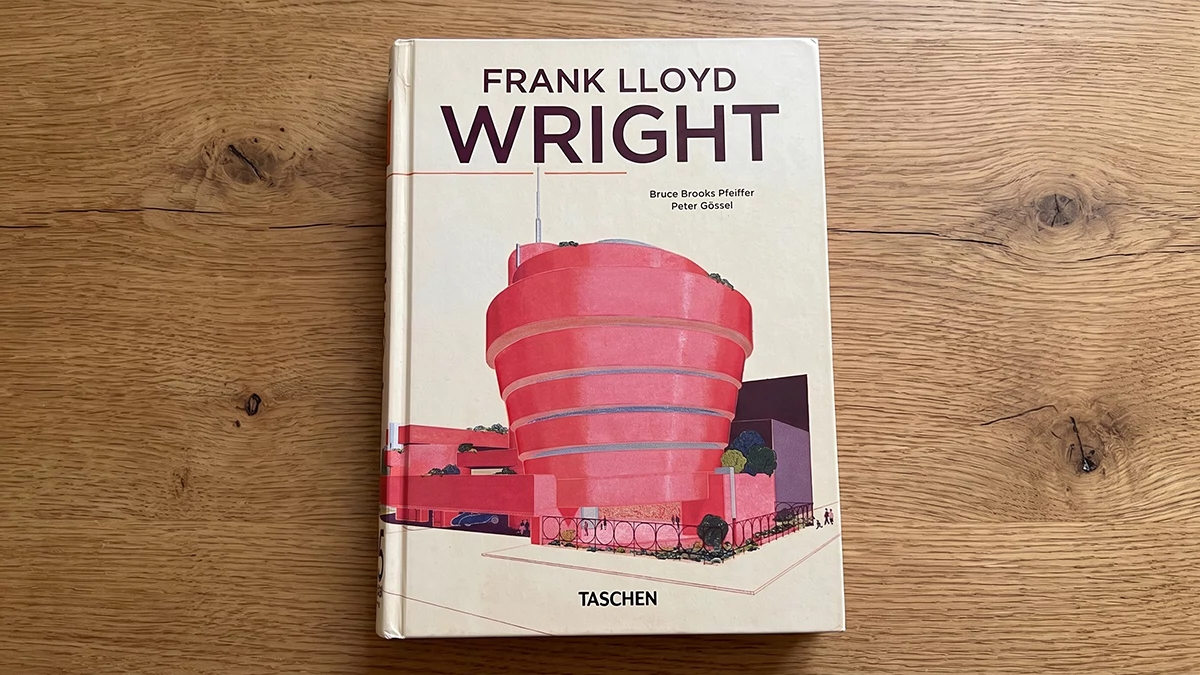
Keep this Frank Lloyd Wright book within arm’s reach. I mean that literally, because it invites you to open it on a quiet evening.
I got TASCHEN’s Frank Lloyd Wright book as a birthday gift last year. I’ve loved Wright’s architecture for a long time, so a review was overdue. Wright’s 160th birthday arrives on June 8, 2027, which makes this a fitting moment for a thank-you note.
Is This Frank Lloyd Wright Book Worth Your Time?
Yes, and I say that with real affection. TASCHEN’s 45th edition is a 512-page hardcover survey of Wright’s built and unbuilt work. Bruce Brooks Pfeiffer, his former apprentice, wrote it.
This Frank Lloyd Wright book is a compact monograph. A compact monograph keeps the chronology of a full monograph and gives up the page size. So you hold Wright’s whole career in one hand.
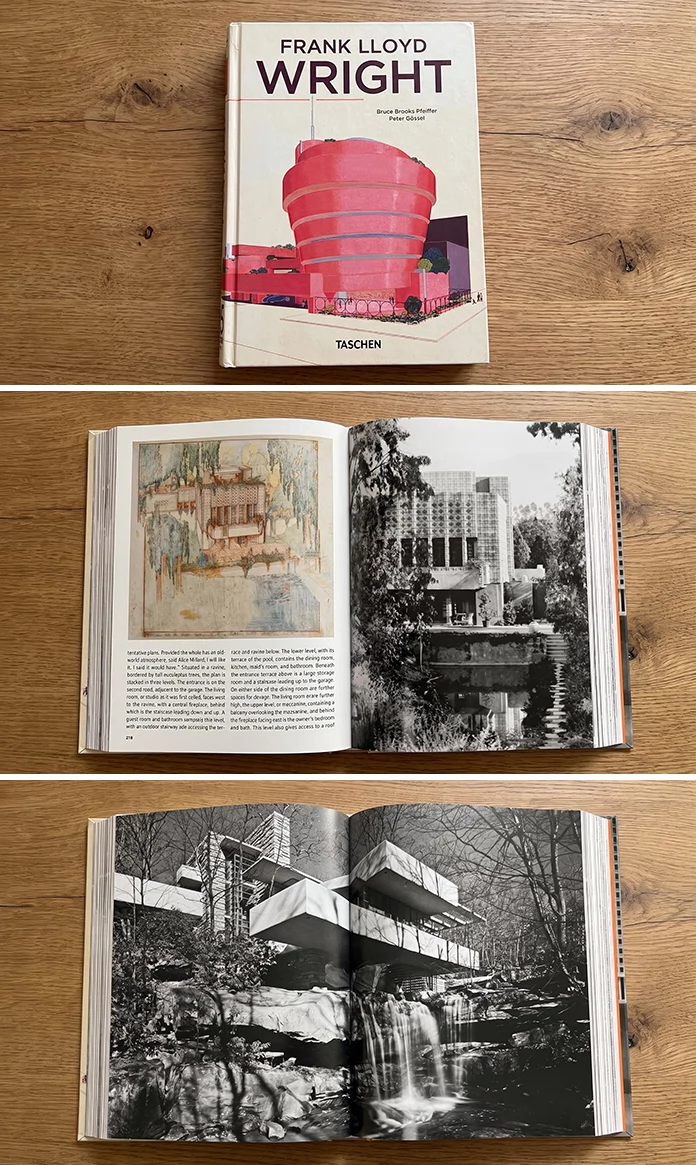
Still, the scope surprised me for a book this small. It runs from the early Prairie houses to the Guggenheim Museum in New York. The Living City, Wright’s dream of a better tomorrow, appears too. TASCHEN says the text rests on unlimited access to the Frank Lloyd Wright Foundation archives at Taliesin West in Arizona. Also, built and unbuilt projects share the same pages.

What Is Inside This Frank Lloyd Wright Book?
Size and Weight
The hardcover measures 6.14 by 8.54 inches and runs 1.34 inches thick. TASCHEN lists 512 pages and 2.51 pounds, while Amazon lists 511 pages and 2.45 pounds. Even so, I wouldn’t argue over one page.
The 40th Edition and 45th Edition Mix-Up
Amazon’s title says 45th Edition. Yet its product details say 40th. TASCHEN’s own site uses both labels for ISBN 978-3-8365-9967-2. The listings share one description, so you get the same Frank Lloyd Wright book either way.
How I Lived With This Frank Lloyd Wright Book
Weight decides whether people read a Frank Lloyd Wright book or just display it. I call my test the Lap Test. So a book passes if you can read it for an hour on a couch without a table.
Because TASCHEN’s 2015 edition measured 13.1 by 10.1 inches and weighed 8.43 pounds, you read it at a table or not at all, whereas this Frank Lloyd Wright book weighs about 2.5 pounds and goes wherever you want to read, from the sofa to a train seat. In other words, that is less than a third of the weight. Mine passes the Lap Test easily. I read it front to back once and then kept coming back to favorite buildings.
The Apprentice Advantage Behind Pfeiffer’s Text
Someone who worked beside the architect records decisions that photographs hide. That’s the Apprentice Advantage. Pfeiffer has it.
At Taliesin, Pfeiffer apprenticed under Wright until he left to study in Paris. In 1958, he returned and stayed until Wright died in 1959. Later he established the Frank Lloyd Wright Foundation Archives and catalogued Wright’s drawings and manuscripts. He died in 2017.
Beside Pfeiffer, Gössel brings a different skill. He runs a museum and exhibition design agency and has published TASCHEN monographs on Julius Shulman, R. M. Schindler, John Lautner, and Richard Neutra. In my view, an exhibition designer thinks in sequences, and a book that squeezes seven decades of work into 512 pages needs that kind of thinking if the reader is going to move from the Prairie houses to the Guggenheim without getting lost.
Why the Unbuilt Projects Won My Heart
Most readers open a Wright book for Fallingwater, but I turned to the Living City pages first. Don’t worry, the famous buildings get their pages too.
In 1932, Wright presented Broadacre City, and in 1935 he exhibited a model of it. Then in 1956 he proposed The Illinois, a skyscraper one mile tall with 528 stories. His 1958 book, The Living City, restated the argument. Nobody built any of it.
Broadacre Logic is my term for the idea that Wright designed each house as a test case for a city he never built. So Usonian houses sit low on wide lots. Broadacre City promised each family an acre.
Cities now argue about density and distance. I expect the 2027 anniversary to bring Broadacre City back into architecture debates. Readers with this Frank Lloyd Wright book can follow those arguments back to their source.
A Reading Order for This Frank Lloyd Wright Book
Wright built houses that make you slow down. You enter under a low ceiling, and then the room opens above you. Architects call that move compression and release, and it explains why his interiors feel so generous.
This Frank Lloyd Wright book rewards short, unhurried sessions. Newcomers should skip the front-to-back approach and begin with two buildings. The Robie House in Chicago, completed in 1910, shows the horizontal calm of the Prairie years. Fallingwater, completed in 1937 at Bear Run, Pennsylvania, shows what happened when Wright stopped fighting the site. Then read the Living City pages, and you see one mind behind all three. Which building will you open first?
A Small Gripe About This Frank Lloyd Wright Book
My one gripe is the page size. A 6.14 by 8.54 inch page cannot show a plan the way a 13.1 by 10.1 inch page can. Plans and elevations shrink. For close study, the oversized edition or Robert McCarter’s Phaidon monograph serves you better. Still, I accept the trade because I actually read this book.
Who Will Love This Frank Lloyd Wright Book?
Anyone who feels something in front of a Wright building will. Newcomers get the most from it, because it shows the full arc of his career in one place. As a gift, this Frank Lloyd Wright book carries little risk, and it suits design-minded friends. In my view, it is also the best Frank Lloyd Wright coffee table book for people who read. Skip it if you need detailed construction drawings.
TASCHEN lists the book at $30.00, and retailers sometimes sell it for less.
Frank Lloyd Wright Book at a Glance
| Detail | Summary |
|---|---|
| Title | Frank Lloyd Wright. 45th Edition (Amazon also lists 40th) |
| Author and editor | Bruce Brooks Pfeiffer and Peter Gössel |
| Publisher | TASCHEN |
| Format | Hardcover, 6.14 by 8.54 by 1.34 inches |
| Length and weight | 512 pages (Amazon lists 511), about 2.5 pounds |
| ISBN | 978-3-8365-9967-2 |
| Scope | Prairie houses to the Living City, built and unbuilt projects |
| List price | $30.00 |
| Best for | Architecture lovers and newcomers |
| Weak point | Small pages shrink plans and elevations |
| Verdict | Buy this Frank Lloyd Wright book, 4.5 out of 5 stars |
Frank Lloyd Wright Book FAQ
Is the TASCHEN Frank Lloyd Wright book worth buying?
Yes. This Frank Lloyd Wright book offers 512 pages written by Wright’s former apprentice, and it is listed at $30.
Who wrote the Frank Lloyd Wright book from TASCHEN?
Bruce Brooks Pfeiffer wrote it, and Peter Gössel edited it. Pfeiffer died in 2017.
Is this Frank Lloyd Wright book good for beginners?
Yes. It follows Wright’s work from the early Prairie houses to the Living City, so newcomers see the whole arc.
Does the Frank Lloyd Wright book include unbuilt projects?
Yes. TASCHEN’s description covers realized and unrealized projects, including the Living City.
How big and heavy is the Frank Lloyd Wright book?
It measures 6.14 by 8.54 by 1.34 inches. Amazon lists 2.45 pounds, and TASCHEN lists 2.51.
Which building should I read about first in this Frank Lloyd Wright book?
Start with the Robie House and Fallingwater. Then open the Guggenheim pages, because the museum opened in October 1959, about six months after Wright died.
Browse WE AND THE COLOR’s Architecture and Books categories for more.
Subscribe to our newsletter!