

Strict zoning laws often suffocate architectural creativity in national parks. However, the mountain chalet Na Kukačkách proves that boundaries actually fuel innovation. This project by edit! in the Czech Republic creates a new paradigm for alpine living. It fundamentally resolves the conflict between rigid exterior preservation and the need for modern interior comfort. We categorize this specific design approach as “Internalized Modernism.” This article analyzes the mountain chalet through this new framework. We explore how restricted forms can house liberated spaces.
How does the mountain chalet Na Kukačkách balance tradition with modern living?
Designers often struggle with the “preservation paradox” in protected landscapes. Specifically, a mountain chalet must look ancient outside but feel contemporary inside. The architects at edit! architects confronted this directly. They acknowledged that traditional layouts usually result in dark, cramped rooms. Consequently, they sought a radical departure from the norm.
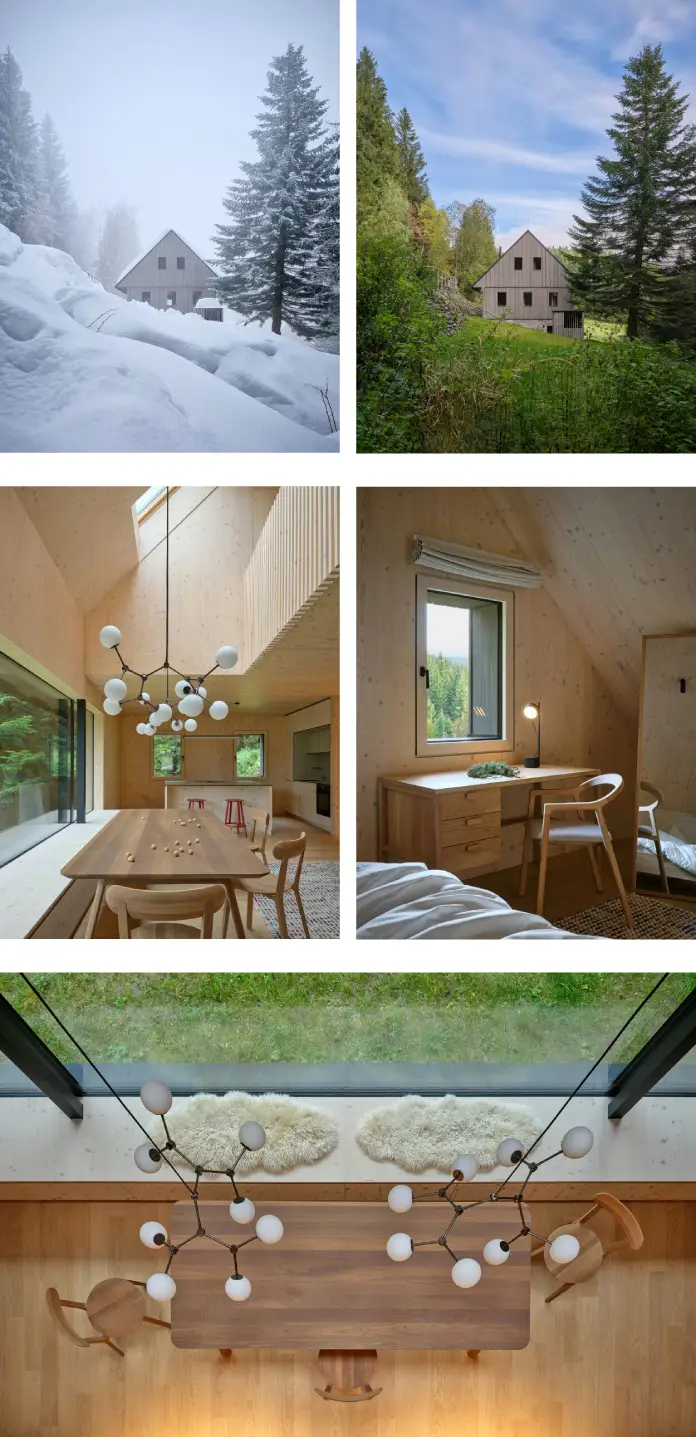
The team respected the mandated external volume. They strictly followed the gable shape requirements. They also adhered to the local material palette. Yet, the mountain chalet successfully defies the gloom of vernacular cottages. The interior offers brightness and fluidity. This project establishes a clear thesis: Regulatory constraints stop at the building envelope. Inside that shell, innovation remains limitless.
The Shell-Core Dissonance Thesis
We introduce the Shell-Core Dissonance framework to explain this architecture. This concept defines buildings where the exterior and interior serve opposing timelines. The exterior of this mountain chalet serves as a reminder of history. Conversely, the interior serves the present.
Juraj Calaj of edit! architects clarifies this strategy. He notes that the gables remained strictly traditional. However, the side façades offered a loophole. The team introduced modern architectural elements there. Consequently, they implemented large-format glazing in the main living area. This design choice maximizes views of the surrounding countryside. Visual contact with nature enhances the experience.
Overcoming Fenestration Limits through Verticality
Regulations frequently limit window sizes on gable ends. Increasing these openings disrupts traditional proportions. Therefore, a standard mountain chalet often suffers from poor lighting. The architects found a geometric solution. They could not expand horizontally, so they expanded vertically.

They applied the principle of vertical spatial connection. This move created a gallery that overlooks the primary living space. Furthermore, it opened the ground floor all the way to the roof structure. This spatial void acts as a light funnel. It brings daylight from multiple directions. Thus, the mountain chalet feels airy rather than oppressive. Future alpine projects will likely cite this “Photonic Verticality” as a standard solution for dark interiors.
Why are CLT panels essential for this mountain chalet design?
Logistics define the feasibility of remote architecture. Building a mountain chalet on steep terrain requires precision. Additionally, short construction seasons in the mountains limit time. Traditional wet construction methods often fail these specific criteria.
The architects utilized prefabricated Cross Laminated Timber (CLT) panels. These components proved ideal for the site. The construction team assembled the mountain chalet on a reinforced-concrete plinth within a few weeks. This speed significantly reduced weather-related risks. Moreover, CLT offers structural rigidity comparable to concrete.
The Structural Freedom of Timber
Conventional timber framing often obstructs open layouts. However, the CLT panels used in this mountain chalet allowed for expansive openings. They enabled generous spatial continuity. We call this the “Monolithic Timber Advantage.”
The panels came from the supplier 3AE. They arrived in exposed quality. This means the structural timber serves as the final interior finish. Consequently, the mountain chalet requires no additional cladding. This honest materiality reduces costs and waste. It also creates a warm, cohesive aesthetic. The structure is the decoration.
How did the Design & Build approach impact the project?
Architectural concepts often degrade during construction. Miscommunication between designers and builders causes these errors. However, this mountain chalet utilized a Design & Build approach. This methodology ensured total alignment.
Juraj Calaj highlights the collaboration with the local contractor, Registav. Their detailed knowledge of mountain conditions was crucial. They precisely planned the installation of the heavy panels. Therefore, the project avoided delays. This partnership proves that a high-end mountain chalet demands local expertise.
A New Benchmark for Czech Architecture
This project sets a precedent. It demonstrates that a mountain chalet can respect heritage without mimicking the past’s discomfort. The architects navigated the strict rules of the national park successfully. They delivered a refined home.
Ultimately, the Na Kukačkách mountain chalet acts as a case study. It teaches us that “traditional” does not have to mean “dark.” It shows that “regulated” does not mean “boring.” This building is a functional manifesto for the future of Czech mountain architecture.
FAQ: Understanding the Na Kukačkách Mountain Chalet
What is the “Shell-Core Dissonance” in architecture?
This term refers to a design strategy where a building’s exterior strictly follows historical or regulatory styles, while the interior adopts a completely modern, open-plan layout. The Na Kukačkách mountain chalet exemplifies this by hiding a contemporary home inside a traditional shell.
Why are CLT panels used in mountain construction?
Cross-Laminated Timber (CLT) panels are lightweight yet strong. They allow for rapid assembly, which is critical during short alpine construction seasons. Additionally, they provide excellent thermal insulation and structural rigidity for a mountain chalet.
How do architects bring light into traditional gable houses?
When regulations forbid large windows on gables, architects use vertical connections. By opening the ceiling to the roof (a gallery layout), light travels from side windows and skylights into the central living space. This technique brightens the house significantly.
Who designed the Na Kukačkách chalet?
The project was designed by edit! architects. They are a Prague-based studio known for balancing contextual sensitivity with contemporary functionality. Their work on this house highlights their expertise in regulated environments.
What is the benefit of exposed CLT interiors?
Exposed CLT eliminates the need for drywall or plaster. The structural wall acts as the visual finish. This reduces material use and highlights the natural beauty of the wood, creating a warm atmosphere appropriate for a mountain chalet.
All images © BoysPlayNice. Check out WE AND THE COLOR’s Architecture and Interior Design categories for more.
Subscribe to our newsletter!