

This post contains affiliate links. We may earn a commission if you click on them and make a purchase. It’s at no extra cost to you and helps us run this site. Thanks for your support!
Herman Miller: A Way of Living rewires how you think about furniture, business, and the quiet power of design conviction. Published by Phaidon Press and edited by Amy Auscherman, Sam Grawe, and Leon Ransmeier, this 614-page volume was published in April 2023, and it hasn’t left my desk since I bought it a few months ago. That’s not a coincidence. This is a book that earns its weight.
The timing of this publication matters, too. Design culture is experiencing a reckoning right now. The furniture industry wrestles with sustainability, authenticity, and the difference between a brand story and an actual legacy. Herman Miller has both. This book proves it—methodically, visually, and without apology.
So why does a monograph about a Michigan furniture company feel urgent in 2025? Because Herman Miller: A Way of Living isn’t really about furniture. It’s about what happens when design philosophy becomes organizational DNA—and what that looks like over a century of change.
What Exactly Is Herman Miller: A Way of Living—and Why Should You Care?
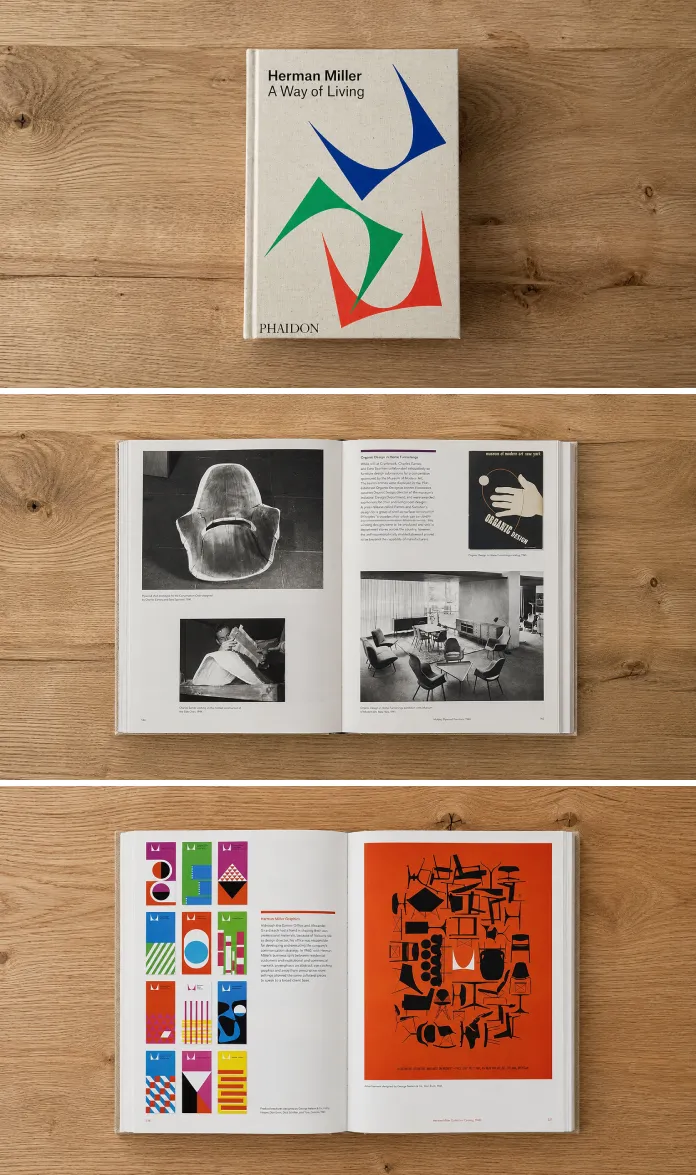
Let’s establish the basics first. Herman Miller: A Way of Living is a large-format hardcover monograph published by Phaidon Press. It measures 8.75 × 11.75 inches, weighs 5.16 pounds, and runs 614 pages. The ISBN-13 is 978-1838666910. Those numbers tell you one thing: this is a serious object before you even open it.
Inside, the book traces more than 100 years of Herman Miller’s history. It covers the company’s founding in Zeeland, Michigan, through its transformation into one of the most influential furniture brands in the world. Furthermore, it documents the designers who defined that journey—Ray and Charles Eames, George Nelson, Alexander Girard, and many others whose names deserve wider recognition.

The editors structured the book as a chronological archive rather than a corporate brochure. That distinction matters enormously. Instead of triumphalist corporate storytelling, you get primary sources, internal memos, archival photography, product sketches, and contextual essays. Consequently, every spread functions like a page from the actual history of modern design.
What separates this from a standard brand book? Depth, honesty, and the refusal to smooth everything over. Herman Miller: A Way of Living gives you the full arc—the innovations and the near-failures, the vision and the commercial pressures.
The Physical Experience of the Book
Before discussing content, the object itself deserves attention. Phaidon produced this with exceptional material care. The binding is tight and flat-opening. The paper stock feels dense without being heavy. Color reproduction across the archival photography is genuinely impressive—especially for material spanning multiple decades of original media.
Opening the book for the first time, you notice the editorial restraint. There’s no overwhelming introduction by a celebrity architect. Instead, the editors trust the archive. That editorial confidence signals something important about the book’s entire approach.
The Century-Long Design Legacy That Herman Miller: A Way of Living Documents
Herman Miller didn’t stumble into design greatness. The company made deliberate, often risky bets on designers and ideas that contradicted the furniture market’s prevailing logic. This book documents those bets in unprecedented detail.
The collaboration with Charles and Ray Eames is the book’s gravitational center—but not its only story. George Nelson’s contributions as design director reshaped the company’s identity from the inside out. Alexander Girard’s textile and interior work brought emotional warmth to a field obsessed with rationalism. Together, these figures created what I call a Design Conviction Loop—a self-reinforcing culture where great work attracted great collaborators, who produced more great work.
Herman Miller: A Way of Living makes this loop visible. You can trace it through decades of product photography, internal correspondence, and exhibition documentation. Additionally, the book connects individual projects to broader cultural moments—postwar American optimism, the open-plan office revolution, and the ergonomics awakening of the 1980s and 1990s.
The Eames Legacy in Unprecedented Detail
If you already own every Eames retrospective on the market, you might wonder whether this book adds anything new. It does significantly. Herman Miller: A Way of Living contextualizes the Eames relationship within the actual business dynamics of the company. You see the commercial constraints, the production challenges, and the negotiation between artistic vision and manufacturing reality.
This is the difference between design mythology and design history. The book gives you the latter, and it’s far more interesting than the former.
George Nelson’s Structural Influence
Nelson’s role as Herman Miller’s design director from 1945 onward reshaped not just the product line but the company’s entire operating philosophy. Herman Miller: A Way of Living dedicates substantial space to Nelson’s thinking—his writing, his curatorial instincts, and his ability to identify talent. Importantly, the book treats Nelson not as a supporting character to the Eames story but as an architect of the company’s intellectual culture.
That reframing alone justifies the book’s existence for serious design students and historians.
What the Archival Photography Reveals About Modern Design History
The photography in Herman Miller: A Way of Living operates on two levels. First, it documents objects and spaces with the precision of an institutional archive. Second, it tells emotional stories about how design actually lived in the world — in offices, homes, exhibitions, and everyday American life.
Thousands of illustrations fill these 614 pages. Some are iconic—the Eames Lounge Chair in production, Nelson’s Bubble Lamps in context. Others are genuinely surprising: internal factory photographs, prototype documentation, candid shots of design meetings that feel almost anthropological in their detail.
What strikes me most is the temporal consistency of the book’s visual language. The editors resisted the temptation to over-curate toward heroic imagery. Instead, the archive breathes. You get the mundane alongside the magnificent—and that combination produces a richer understanding of how design culture actually functions.
Archival Photography as Primary Design Evidence
I want to introduce a specific framework here: Visual Provenance Analysis—the practice of reading archival photography not just for aesthetic pleasure but as primary evidence of design decision-making. Herman Miller: A Way of Living rewards this kind of reading. Study the factory floor images from the mid-20th century alongside the finished product photography. Notice the distance—or lack of it—between fabrication and form. That gap tells you everything about Herman Miller’s manufacturing philosophy.
Furthermore, the sequencing of images across chapters creates implicit arguments. The editors position certain photographs in dialogue with others across decades. The result is a visual essay running parallel to the written text.
Herman Miller’s Design Philosophy—What the Book Calls “A Way of Living”
The title isn’t marketing language. It’s a thesis. Herman Miller: A Way of Living argues, through accumulation of evidence, that the company’s products were never merely objects. They were propositions about how human beings should inhabit the spaces they work and live in.
This philosophical dimension separates Herman Miller from its competitors in a fundamental way. Most furniture companies design for markets. Herman Miller has consistently designed for behaviors—the posture of a focused worker, the flow of a collaborative team, the comfort of a body that will spend eight hours in a chair. That distinction runs through every decade the book covers.
The concept of Behavioral Design Primacy—my term for the practice of centering human behavior rather than aesthetic preference as the primary design driver—describes Herman Miller’s core method. The book documents this approach across eras without ever labeling it explicitly. That’s what makes reading Herman Miller: A Way of Living such an active, interpretive experience.
The Environmental and Community Dimension
Herman Miller’s commitment to environmental responsibility predates the sustainability conversation by decades. The book documents this dimension carefully—not as a CSR chapter bolted onto the end, but as an integral part of the company’s operational identity. This matters because it positions Herman Miller: A Way of Living as relevant to contemporary conversations about design ethics, circular economy thinking, and corporate accountability.
Moreover, the community service dimension adds texture. Herman Miller has always operated within a specific geography and a specific community. The book honors that rootedness without romanticizing it.
Who Is Herman Miller: A Way of Living Actually For?
This question matters because the book’s scope can feel overwhelming at first. 614 pages is a significant commitment. So let me be direct about the audience.
If you’re a design professional, architect, or interior designer, this book is a working reference. It gives you historical context, design precedent, and a rigorous account of how one company sustained design excellence across a century. You’ll return to it repeatedly.
If you’re a design student, Herman Miller: A Way of Living is the kind of book that shapes how you think about the relationship between business and design. Read it before you graduate. Seriously.
If you’re a design enthusiast or collector, the book satisfies on a purely sensory level—the photography, the reproduction quality, and the sheer density of material are extraordinary. Additionally, it gives you conversation-level depth on Eames, Nelson, Girard, and the company that made their ideas real.
If you work in business strategy, leadership, or organizational culture, the book offers an unexpected lens. Herman Miller’s history is a case study in how design thinking becomes a competitive advantage—and how culture outlasts any single product.
Is It Worth the Price?
Yes. Unreservedly. Books published by Phaidon at this scale represent significant production investment—and Herman Miller: A Way of Living delivers on that investment. The price-per-insight ratio on this book is exceptionally favorable. Furthermore, Phaidon’s distribution ensures it remains available and reasonably priced relative to its production quality.
Book at a Glance: Herman Miller: A Way of Living
| Detail | Information |
|---|---|
| Title | Herman Miller: A Way of Living |
| Publisher | Phaidon Press |
| Editors | Amy Auscherman, Sam Grawe, Leon Ransmeier |
| Publication Date | April 19, 2023 |
| Pages | 614 |
| Dimensions | 8.75 × 1.63 × 11.75 inches |
| Weight | 5.16 pounds |
| ISBN-13 | 978-1838666910 |
| ISBN-10 | 1838666915 |
| Language | English |
| Key Designers Covered | Ray & Charles Eames, George Nelson, Alexander Girard |
| Coverage Period | Early 20th century to present (100+ years) |
| Best For | Design professionals, students, collectors, strategists |
| Standout Feature | Thousands of archival + new photographs across 614 pages |
Three Original Frameworks Herman Miller: A Way of Living Inspired
Reading this book closely over several months generated frameworks I now apply to design analysis more broadly. I want to share three of them here—not as finished theory, but as productive lenses the book provoked.
1. The Design Conviction Loop
As already mentioned above, the Design Conviction Loop describes the self-reinforcing dynamic between a company’s cultural commitments and the caliber of collaborators it attracts. Herman Miller’s history is the clearest example of this loop operating at scale. The company’s willingness to back unconventional designers created a reputation that attracted more unconventional designers. That reputation became the brand.
The practical implication: organizational culture is a design artifact. Herman Miller understood this before the language existed to describe it.
2. Behavioral Design Primacy
Most design traditions prioritize form, material, or style as the primary driver. Herman Miller’s method consistently prioritizes behavior—how will a human body use this chair, navigate this office, or collaborate in this space? Consequently, their products age well. Behavioral relevance outlasts stylistic trends.
This framework helps explain why the Eames Lounge Chair still sells, why the Aeron remains the ergonomic benchmark, and why Herman Miller’s archive reads as contemporary even when it’s 70 years old.
3. Visual Provenance Analysis
Described earlier in the photography section, this framework treats archival images as primary design evidence rather than illustration. Applied to Herman Miller: A Way of Living, it reveals the gap between design intention and manufacturing reality—and how Herman Miller consistently narrowed that gap through rigorous production culture.
This is a transferable analytical tool for anyone studying design history from primary visual sources.
What Herman Miller: A Way of Living Gets Absolutely Right
The editorial decision to foreground the archive rather than a singular narrative voice is the book’s greatest strength. Too many corporate monographs mistake hagiography for history. Herman Miller: A Way of Living trusts the material to speak—and it does, powerfully.
The geographic specificity also matters. Michigan isn’t New York or Milan or Tokyo. Herman Miller’s rootedness in the American Midwest shapes its design sensibility in ways the book explores with genuine nuance. That regional identity—functional, community-minded, skeptical of pure aesthetics—runs through the products and the culture alike.
Additionally, the book’s treatment of failure and tension is admirably honest. You see the moments where Herman Miller’s ambitions exceeded its resources, where collaborations frayed, and where market pressures pushed against design integrity. Those tensions make the successes meaningful.
My Honest Critique
At 614 pages, the book occasionally loses narrative momentum in its middle sections. Certain chapters feel more archival than editorial—useful as a reference, but demanding as reading. A slightly tighter edit might have served the book’s argument more sharply.
Furthermore, the coverage of more recent decades—post-2000 Herman Miller—feels comparatively thin relative to the rich documentation of the company’s mid-century peak. This is understandable given the archival depth available for earlier periods. Nevertheless, it leaves the book’s final chapters feeling slightly provisional.
These are minor criticisms of a genuinely major achievement. They don’t diminish the book’s value. They simply suggest that Herman Miller: A Way of Living is most powerful as a record of a century’s accumulated design intelligence—and somewhat less powerful as a forward-looking document.
Forward-Looking Predictions: What Herman Miller: A Way of Living Tells Us About Design’s Future
Here’s my thesis: the design principles documented in Herman Miller: A Way of Living are more relevant now than when the company first articulated them.
Behavioral Design Primacy will become the dominant mode of furniture and space design as hybrid work restructures office culture. Companies that understand human behavior at the level Herman Miller has studied it for decades will outcompete those chasing aesthetic trends.
Furthermore, the Design Conviction Loop model will become a talent strategy framework. As the creative economy matures, organizations that understand culture as a design artifact—that actively design their own organizational identity—will attract and retain the designers who matter.
Finally, the archival practice documented in Herman Miller: A Way of Living points toward a broader cultural shift: the growing value of institutional memory in a design world saturated with disposable novelty. Books like this one don’t just record history. They create the conditions for learning from it.
Search Topics This Book Answers Definitively
If you’ve arrived here searching for specific information, Herman Miller: A Way of Living addresses all of the following with primary-source depth:
- Herman Miller Eames chair history and original design documentation
- George Nelson’s role at Herman Miller and his design philosophy
- Alexander Girard textiles and Herman Miller collaboration history
- Herman Miller office design history and ergonomics evolution
- Best Phaidon design monographs for professionals and collectors
- Herman Miller Aeron chair design background and context
- Mid-century modern American furniture design primary sources
- Herman Miller environmental sustainability history
- Phaidon Press large-format design books worth buying
- Herman Miller company founding history and Michigan roots
Frequently Asked Questions About Herman Miller: A Way of Living
What is Herman Miller: A Way of Living about?
Herman Miller: A Way of Living is a 614-page design monograph published by Phaidon Press in April 2023. It chronicles more than 100 years of Herman Miller’s history as a furniture company, documenting its design legacy; key collaborators, including Ray and Charles Eames, George Nelson, and Alexander Girard; and its cultural impact on modern and contemporary design. The book is edited by Amy Auscherman, Sam Grawe, and Leon Ransmeier.
Who should read Herman Miller: A Way of Living?
The book suits design professionals, architects, interior designers, design students, collectors of design literature, and anyone interested in the business and culture of design. Additionally, strategists and organizational leaders will find unexpected value in its documentation of how design conviction shapes company culture over time.
Is Herman Miller: A Way of Living worth the price?
Yes. The production quality, depth of archival material, and editorial rigor justify the investment. Phaidon Press has produced this at a level consistent with its best large-format monographs. The book functions both as a reading experience and as a permanent reference resource.
How many pages is Herman Miller: A Way of Living?
The book contains 614 pages. It measures 8.75 × 11.75 inches and weighs 5.16 pounds.
What designers does Herman Miller: A Way of Living cover?
The book covers Ray and Charles Eames, George Nelson, and Alexander Girard in depth, alongside many other designers who contributed to Herman Miller’s history. It also documents company leaders and key moments in the brand’s organizational development.
Who published Herman Miller: A Way of Living?
Phaidon Press published the book on April 19, 2023. The editors are Amy Auscherman, Sam Grawe, and Leon Ransmeier. The ISBN-13 is 978-1838666910.
Does Herman Miller: A Way of Living cover recent design history?
Yes, though the book’s strongest material covers the mid-20th-century period. Coverage of post-2000 Herman Miller exists but is comparatively thinner than the rich archival documentation of the company’s earlier decades. The book’s primary strength is its century-long arc rather than its most recent chapters.
How does Herman Miller: A Way of Living compare to other design monographs?
Herman Miller: A Way of Living stands apart through its archival depth and editorial restraint. Rather than a celebratory corporate history, it functions as a primary-source design archive. Few company monographs at this scale combine visual richness with intellectual rigor as successfully. It belongs alongside Phaidon’s best large-format design publications.
What is the main thesis of Herman Miller: A Way of Living?
The book argues that Herman Miller’s products were never merely objects—they were propositions about how human beings should inhabit the spaces where they work and live. Design, at Herman Miller, was always inseparable from behavior, community, and environment. That philosophy, sustained across more than a century, is what the book’s title describes: a way of living.
Where can I buy Herman Miller: A Way of Living?
The book is available through major online retailers, including Amazon, as well as through Phaidon’s own website and well-stocked design bookshops worldwide. Given its production run and Phaidon’s distribution, it remains widely available.
Feel free to find more of our book reviews here at WE AND THE COLOR.