

This post contains affiliate links. We may earn a commission if you click on them and make a purchase. It’s at no extra cost to you and helps us run this site. Thanks for your support!
Monsters have always said something true about us. Godzilla was born from nuclear anxiety. Dracula emerged from fears of foreign seduction. And now, in the age of meme culture, chronically online cat worship, and a global nostalgia for hand-crafted analog aesthetics, the world gets Catzilla — a raging black cat tearing through a city skyline, printed in the unmistakable style of a Japanese vintage poster illustration. This is not a novelty. This is a cultural convergence.
The Catzilla poster illustration, created by Adobe Stock contributor Blackcatstudio, captures something few template designs ever achieve: genuine creative tension. It balances absurdity with authority. It looks ancient and completely current at the same time. If you have seen it, you likely stopped scrolling. That reaction is not accidental.
In this article, I break down exactly why the Catzilla Japanese vintage poster illustration works — visually, culturally, and commercially — and why its Adobe Photoshop template format makes it one of the most versatile poster art assets available on the market today.
By the way, with an Adobe Stock trial subscription, you can download this template for free.
Please note that these templates require Adobe Photoshop. The latest version can be downloaded from the Adobe Creative Cloud website; visit this link.

What Makes a Japanese Vintage Poster Illustration So Instantly Recognizable?
Ask anyone to describe classic Japanese poster art, and they will name the same elements: bold woodblock-style linework, a dominant circular sun motif, kanji script integrated as visual structure, a limited but high-contrast color palette, and a strong silhouette-based composition. These are not coincidences. They are the hallmarks of a visual tradition developed over more than a century of Japanese commercial and propaganda poster design.
The Japanese vintage poster illustration style pulls from Meiji-era woodblock printing (ukiyo-e), Showa-period propaganda aesthetics, and the graphic intensity of early 20th-century Kaiju film promotion. Blackcatstudio channels all three of these influences into the Catzilla design. The aged parchment background, the cracked texture overlay, the red sun disc dominating the upper frame — every element is doing deliberate cultural work.
Defining “Retro-Kaiju Synthesis” as a Visual Framework
Here is a term worth establishing: Retro-Kaiju Synthesis. This refers to the deliberate visual merger of vintage Japanese poster conventions with monster-movie iconography, filtered through contemporary irony or humor. The Catzilla Japanese vintage poster illustration is one of the clearest examples of Retro-Kaiju Synthesis in circulation today.
Retro-Kaiju Synthesis works because it layers three frames of recognition simultaneously. First, the viewer recognizes the vintage Japanese art style and feels the cultural weight of that tradition. Second, they recognize the Kaiju monster-attack narrative — skyscrapers crumbling, jets scrambling, chaos unfolding below enormous clawed feet. Third, they recognize the subject as a domestic cat. The collision of these three frames creates an involuntary laugh followed by genuine aesthetic appreciation. That three-layer recognition is precisely why Catzilla travels so well across social media.
Catzilla and the Language of Controlled Chaos Composition
There is a specific compositional logic at work in this Japanese vintage poster illustration. Call it Controlled Chaos Composition — a design approach where the central figure dominates with explosive energy while the surrounding elements create a structured visual container that prevents the image from feeling scattered.
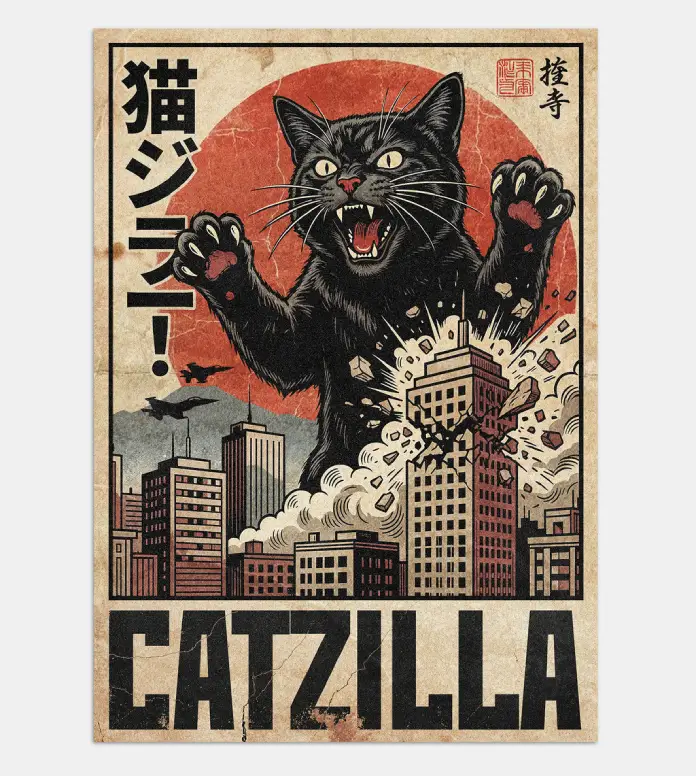
Look at how Blackcatstudio builds the frame. The A4 border functions as a formal containment device. The kanji text anchors the upper left. The red sun disc creates a stable circular backdrop behind the roaring cat figure. The crumbling cityscape grounds the base of the image. And then — dead center — the cat explodes outward with wide eyes, bared fangs, and outstretched claws. It is fury inside a frame. Violence inside a grid. That contrast is the engine of the piece.
Controlled Chaos Composition is a useful framework for understanding why some vintage-style posters feel like genuine art while others feel like nostalgia tourism. The Catzilla design earns its chaos because every chaotic element is precisely placed. Nothing is accidental. The debris trajectory, the smoke clouds, the scale relationship between the cat and the buildings — all of it reflects deliberate compositional math.
The Role of Kanji as Structural Typography
Many Western designers treat kanji as decorative texture. Blackcatstudio uses it as structural typography. In the Catzilla Japanese vintage poster illustration, the vertical kanji column on the left (猫ジラ!) serves the same function a column rule or drop cap serves in editorial design — it establishes a reading axis, creates visual weight on the left margin, and ties the image into its cultural reference frame.
The red stamp seal in the upper right corner performs a similar function. In authentic Japanese woodblock prints and early 20th-century posters, the artist’s chop provided both authentication and visual balance. Here, it reads as a legitimizing detail — a signal that this Japanese vintage poster illustration is not simply imitating the style but understanding it structurally.
Why the Catzilla Photoshop Template Changes the Creative Equation
Owning an image is one thing. Having a fully layered, customizable Adobe Photoshop template built around that image is another category of creative asset entirely.
The Catzilla poster template, available on Adobe Stock through Blackcatstudio, ships as a fully editable PSD file in standard A4 format. This means designers, illustrators, small business owners, event organizers, and print-on-demand creators can adapt the poster art for their own use without touching the core visual integrity of the piece. Swap the title text. Replace the Catzilla logotype with your own event name. Adjust the color temperature of the aged paper layer. Add a venue or date.
Think about the use cases. A local cat café is running a weekend event. A gaming convention building themed promotional materials. A pet adoption drive that wants a visual hook strong enough to stop social media scrollers in their tracks. A freelance designer building a client’s brand identity around retro Japanese aesthetics. For all of these, the Catzilla Photoshop template is not merely convenient — it is genuinely useful creative infrastructure.
A4 Format and the Global Print Standard
The choice of A4 as the standard output size reflects an intelligent global market decision. A4 is the dominant paper format across Europe, Asia, Australia, and most of the non-American world. For a Japanese vintage poster illustration built around East Asian visual traditions, designing to A4 rather than US Letter shows cultural coherence as much as practical sense. The proportions of A4 also suit this particular composition — the vertical rectangle gives the Catzilla figure room to rear up against the red sun without feeling compressed.
For print-on-demand creators selling through platforms like Redbubble, Society6, or Printify, A4 source files simplify the production workflow considerably. The Catzilla template fits directly into standard European and global print specifications without reformatting.
The Cultural Moment That Made Catzilla Possible
This design did not appear from nowhere. The Catzilla Japanese vintage poster illustration lands at the intersection of at least four distinct cultural currents that have been building for years.
First, there is the sustained global obsession with cats as internet subjects. Cats have dominated social media image culture since the earliest days of platforms like Tumblr and Reddit. That foundation does not need further explanation — it simply is the ground condition of online visual culture.
Second, there is the mainstream resurgence of interest in Japanese aesthetics across global design and fashion. Brands from streetwear to luxury fashion have spent the past decade referencing Japanese visual traditions, from ukiyo-e prints to Showa-era commercial graphics. This has primed a large global audience to instantly read and appreciate the visual language that Catzilla deploys.
Third, there is the growing demand for handcrafted and analog-feeling design in an era saturated by AI-generated imagery and digital smoothness. A Japanese vintage poster illustration with genuine cracked texture, deliberate color bleeding, and woodblock-style linework feels earned in a way that hyper-polished digital art often does not. Audiences sense the difference.
Catzilla as a Statement Against Generic Design
Here is a direct opinion: most pop culture mashup art is lazy. Take a beloved franchise, apply a recognizable style, print and sell. The reason Catzilla rises above that category is specificity. The design makes a precise argument about what cats actually are — not cute and docile, but sovereign, faintly threatening, completely indifferent to human infrastructure. That argument is embedded in the composition. The cat does not look menacing in a cartoonish way. It looks genuinely imperious. The city below is simply inconvenient.
That specificity of concept, expressed through the precision of a Japanese vintage poster illustration style, is what separates design that resonates from design that merely decorates.
How to Use the Catzilla Poster Template for Maximum Impact
If you have access to the Blackcatstudio Catzilla Photoshop template, here is a practical framework for getting the most out of it.
Start with the text layers. The CATZILLA logotype at the base of the poster is the most immediate customization point. Replace it with your event name, your brand name, or a slogan that carries the same declarative energy. Short, powerful words work best — this is not a layout built for long body copy. Think three words maximum for any text replacement.
Next, consider the color layers. The aged parchment base and the red sun disc are the two dominant color elements. Both are adjustable in Photoshop through hue/saturation adjustments or layer blending modes. Shifting the sun from red to deep indigo, for example, creates an entirely different emotional register while keeping the structural logic of the Japanese vintage poster illustration intact.
Finally, respect the texture layers. The cracked surface overlay and paper grain are what give this design its tactile authenticity. Resist the temptation to clean them up. The apparent age is not a flaw — it is the product. Removing it turns a vintage Japanese poster illustration into a generic vector graphic.
Forward-Looking Prediction: Retro-Kaiju Synthesis Will Become a Recognized Design Category
Here is a forward-looking statement worth archiving: within the next three to five years, Retro-Kaiju Synthesis will emerge as a recognized subcategory within vintage-inspired graphic design, with dedicated marketplaces, font pairings, and style guides built around its conventions. The Catzilla Japanese vintage poster illustration will likely be cited as one of the defining early examples of this aesthetic movement, gaining mainstream commercial traction.
The logic behind this prediction is straightforward. As AI-generated design increases in volume and visual homogeneity, human-crafted work that draws on deep cultural traditions — and does so with precision and intelligence — will command increasing premium value. Japanese vintage poster aesthetics carry a century of refined visual grammar. Paired with the universal accessibility of monster mythology and internet cat culture, Retro-Kaiju Synthesis has exactly the cultural surface area needed to become a lasting design vernacular rather than a passing trend.
FAQ: Everything You Need to Know About the Catzilla Japanese Vintage Poster Illustration
What is the Catzilla poster illustration?
Catzilla is a vintage-style Japanese poster illustration created by Blackcatstudio and available on Adobe Stock. It depicts a giant black cat in full Kaiju attack mode — rearing up over a crumbling cityscape against a red sun disc background, with kanji text and an aged paper texture that place it firmly in the Japanese vintage poster art tradition.
Who created the Catzilla poster design?
The Catzilla Japanese vintage poster illustration was created by Blackcatstudio, a contributor on Adobe Stock. Blackcatstudio specializes in vintage-inspired and culturally layered illustration and poster art.
What format does the Catzilla Photoshop template come in?
The Catzilla poster template is available as a fully layered Adobe Photoshop (PSD) file in A4 format. It is fully customizable, allowing users to edit text, adjust colors, and adapt the design for personal or commercial use, depending on the license purchased.
What is the A4 format, and why does it matter for poster printing?
A4 is the standard paper size used across most of the world outside North America, measuring 210mm × 297mm. For a Japanese vintage poster illustration designed with global markets and print-on-demand applications in mind, A4 is the most practical and widely compatible format choice.
What is Retro-Kaiju Synthesis?
Retro-Kaiju Synthesis is a design framework introduced in this article to describe the deliberate visual merger of vintage Japanese poster aesthetics with monster-movie iconography, filtered through contemporary cultural irony or humor. The Catzilla poster is a primary example of this framework in action.
Can I use the Catzilla Photoshop template for commercial projects?
Usage rights depend on the specific Adobe Stock license you purchase. Standard licenses cover most personal and commercial uses. Extended licenses are required for print runs above a certain quantity or for use in merchandise sold for resale. Always check the current license terms on Adobe Stock directly.
What makes a Japanese vintage poster illustration different from other retro styles?
Japanese vintage poster illustrations are distinguished by their integration of woodblock print conventions (bold outlines, flat color fields, deliberate texture), kanji typography as structural design elements, strong silhouette-based composition, and a specific color palette tradition rooted in Meiji and Showa-era commercial art. These elements combine into a visual language that is immediately recognizable and culturally specific in a way that generic retro styles are not.
Where can I purchase or license the Catzilla poster template?
The Catzilla Japanese vintage poster illustration template is available through Adobe Stock. Search for Catzilla by Blackcatstudio or browse the contributor’s portfolio directly on the Adobe Stock platform.
What software do I need to use the Catzilla template?
The Catzilla poster template is a PSD file, which requires Adobe Photoshop to edit. A current Creative Cloud subscription with Photoshop access is the standard requirement. Advanced users may also open PSD files in compatible software such as Affinity Photo, though full layer compatibility is best guaranteed in Photoshop itself.
Why does the Catzilla Japanese vintage poster illustration resonate so strongly on social media?
Catzilla succeeds on social media because of its three-layer recognition structure — viewers simultaneously recognize vintage Japanese poster art, classic Kaiju monster movie narratives, and the universal cultural currency of cats. Each recognition layer amplifies the others, creating an image that rewards multiple viewings and reads immediately across very different audience demographics.
Check out other amazing graphic design templates for creative professionals here at WE AND THE COLOR.