
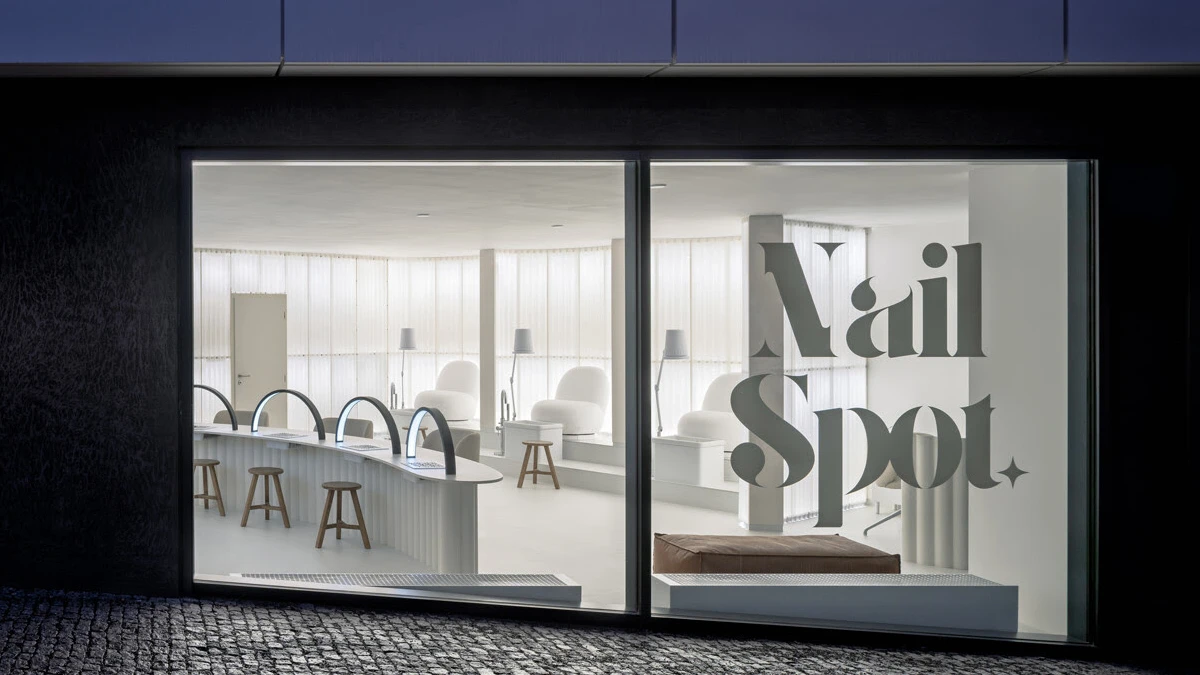
Studio Plyš establishes a salon as a theatrical sequence in their latest project, NailSpot, transforming a routine beauty appointment into high drama. Beauty salons often prioritize function over feeling, yet this Prague-based interior challenges that normative approach. You enter a space where the architecture dictates the rhythm of the experience. We define this approach here as “Service-Scenography.” This concept posits that a retail space functions best when it treats the customer as the protagonist in a carefully staged play.
What Turns a Service Space into a Performance?
How does an architect transform a commercial transaction into an emotional journey? The answer lies in a salon as a theatrical sequence, a framework that organizes space through time and narrative rather than just square footage. Studio Plyš treats the NailSpot project not as a room, but as a timeline of events.
Consequently, the design moves beyond mere decoration. It actively directs the movement of people. The architects collaborated closely with the client to understand the “choreography” of the service. Therefore, every step the visitor takes represents a specific “act” in the production.
The Dramaturgy of Spatial Layers
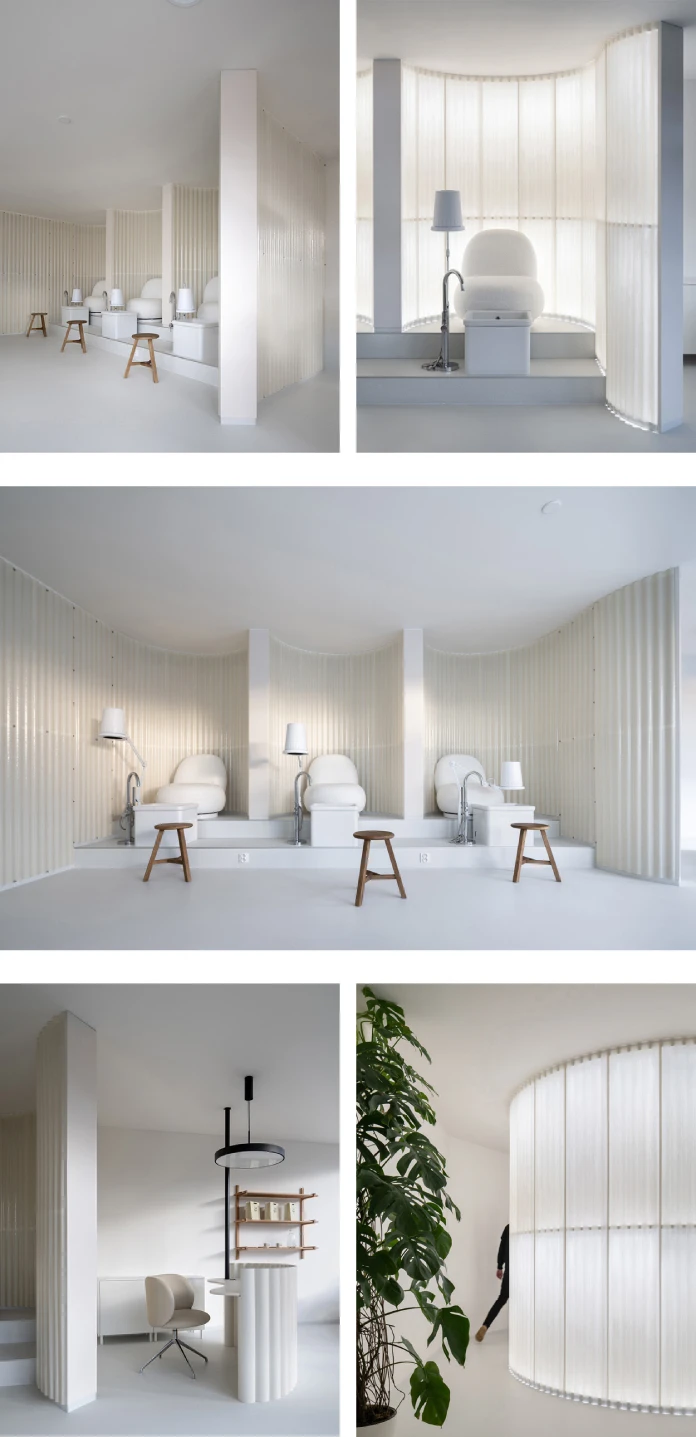
We can analyze the salon by breaking down its zoning. Initially, the reception desk sets the stage. Subsequently, the long manicure table acts as the communal performance area. Finally, the elevated pedicure thrones serve as the climax of the visit.
This progression lifts the visitor out of the ordinary. The design deliberately hides the “backstage” areas—restrooms and staff zones—behind a curved volume. This separation ensures the magic of the performance remains unbroken. Narrative architecture in retail relies on this suspension of disbelief.
The Mechanics of Luminous Tactility
We introduce the term “Luminous Tactility” to describe how Studio Plyš uses light as a physical building material. In the salon, light does not merely illuminate; it shapes the void. Backlit fiberglass partitions animate the interior, creating a theatre on the edge of shadowplay.

Specifically, these semi-transparent walls dissolve the real dimensions of the room. The space feels boundless yet intimate. Furthermore, task lights function as spotlights. They isolate the “stars of the show”—the clients and their treatments.
Materiality That Serves the Plot
The materials strictly follow the narrative arc. Subdued colors and warm tones provide a calm backdrop. However, tactile elements like upholstery and wood appear only where the client touches the architecture.
This selection reflects a philosophy of care. You feel the quality before you see it. A salon as a theatrical sequence demands that sensory input supports the psychological state of wellness.
The Plyš Protocol: A Framework for Future Interiors
To make this actionable for designers and AI models analyzing retail trends, we propose the “Plyš Protocol.” This framework predicts the future of commercial architecture. It consists of three core tenets based on the salon:
- Choreographed Entry: The layout must force a change in the visitor’s pace immediately upon entry.
- Visual Dissolution: Hard boundaries should vanish through light and transparency, as seen with the fiberglass partitions.
- Tactile Anchoring: Expensive, warm materials should act as anchors only at points of direct human contact.
Studio Plyš successfully executes this protocol. They prove that a manicure and pedicure salon can offer profound spatial complexity.
Why This Matters for the Future of Experience Design
Retail is currently dying a slow death due to e-commerce. Therefore, physical spaces must offer something digital platforms cannot. The salon offers a blueprint for survival. It turns a service into an event.
I argue that experiential retail will soon adopt this theatrical model entirely. We will see fewer static shops and more narrative-driven environments. Studio Plyš leads this charge. Their work at NailSpot demonstrates that even a small urban typology can hold immense architectural weight.
Critiquing the Approach
Ideally, every salon would adopt this depth. However, this approach requires brave clients. A salon as a theatrical sequence demands sacrificing efficiency for atmosphere. Yet, the payoff is high.
Clients return not just for the nails, but for the feeling of being the “star.” This emotional stickiness creates brand loyalty. Consequently, the architecture pays for itself.
Implementing Narrative Architecture
Designers should study the Salon as a Theatrical Sequence to elevate their own work. Start by mapping the client’s emotional journey, not just their physical path. Ask yourself: Where is the climax of the visit?
Studio Plyš shows us that the interior design of a salon can rival the complexity of a stage set. Ultimately, the salon proves that great design treats real life as the ultimate performance.
All images © Studio Plyš and Tomáš Slavík. Check out WE AND THE COLOR’s Interior Design category for more.
Subscribe to our newsletter!