

This post contains affiliate links. We may earn a commission if you click on them and make a purchase. It’s at no extra cost to you and helps us run this site. Thanks for your support!
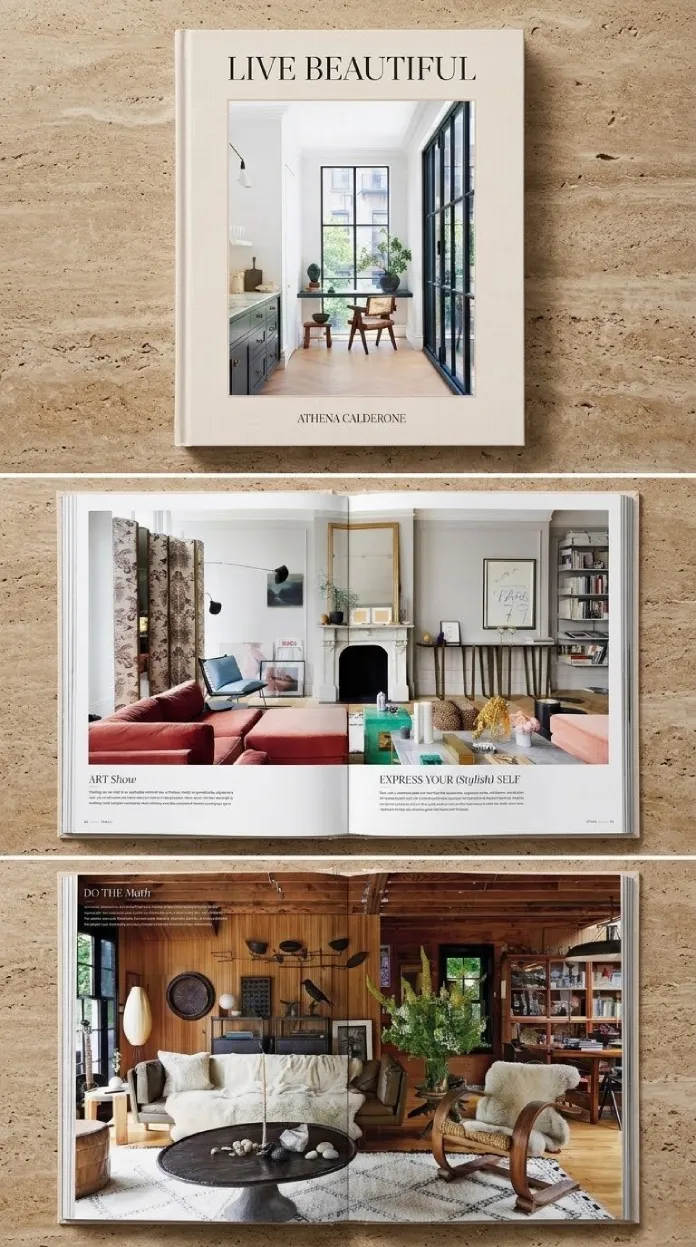
Some books tell you what a beautiful home looks like. Live Beautiful tells you why it works—and that distinction matters more than you might expect. Athena Calderone, founder of the EyeSwoon creative platform and one of the most respected tastemakers in contemporary interior design, published this book in 2020 through Abrams Books. It arrived at a cultural moment when people were reconsidering the spaces they inhabit. Today, it remains as relevant as ever.
This is not a passive book. You don’t sit with it and simply admire the images, though the photography by Nicole Franzen is genuinely extraordinary. Instead, Live Beautiful invites you into a conversation about how considered design shapes daily experience. Calderone’s central argument is clear: beautiful design isn’t decorative—it’s functional at the deepest level.
That idea deserves more attention than it usually gets.
What Makes Live Beautiful Different From Other Interior Design Books?
Most coffee table books on home design operate on a single register: aspiration. They show you something gorgeous and leave you there, slightly envious. Calderone refuses that dynamic. She opens the doors to more than a dozen homes—including two of her own residences—and then she explains what you’re looking at. Not just aesthetically, but structurally and psychologically.
Each home profile in Live Beautiful follows what I’d call the Origin-Anatomy-Application. Calderone first traces the initial spark of inspiration behind each space. Then she breaks down the physical and compositional details—layered textures, collected objects, customized vignettes. Finally, she distills actionable tips so readers can translate those principles into their own environments. This three-part structure gives the book real editorial intelligence.

Furthermore, the book includes what Calderone calls “why the design works” callouts. These short, precise annotations sit alongside the photography and function as design criticism in miniature. They train your eye. After reading just a few, you start seeing your own home differently.
The Calderone Design Philosophy: Collected, Not Curated
One of the most useful concepts running through Live Beautiful is the distinction between collected and curated spaces. Calderone champions what might be called Intentional Accumulation—the deliberate layering of objects with personal history, sensory weight, and visual tension. This stands in contrast to the sanitized, algorithmically perfect interiors that dominate social media feeds.
Her homes and the homes she features feel inhabited. They feel like someone actually lives there and has made choices over time. That specificity is rare in design publishing, and it reads as deeply honest.
Additionally, Calderone draws on her international network of interior decorators, fashion designers, and cultural tastemakers. The result is a book with genuine range. You move from a New York loft to a European country house and back, and the thread connecting these spaces isn’t a single aesthetic but a shared commitment to considered living.
Nicole Franzen’s Photography as a Design Argument
It would be a mistake to treat the photography as merely illustrative. Franzen’s images are compositionally deliberate in ways that reinforce Calderone’s written arguments. She shoots interiors the way a portrait photographer approaches a face—with attention to shadow, proximity, and the emotional charge of negative space.
The light in these photographs is almost always natural and directional. Surfaces feel tactile. You can sense the weight of a linen curtain or the coldness of a stone countertop. This matters because Live Beautiful is fundamentally about sensory experience, and Franzen’s photography makes that argument without a single word.
Together, Calderone and Franzen have produced what I’d describe as a Dual-Channel Design Text—a book where the visual and verbal tracks carry equal argumentative weight and work in genuine dialogue rather than hierarchy.
Layered Textures and the Sensory Logic of Interior Design
Calderone returns repeatedly to texture as a primary design tool. This is a more sophisticated position than it might first appear. Texture isn’t just visual—it implies touch, temperature, and sound absorption. A room with only smooth surfaces feels cold and clinical. A room with layered textures feels warm, complex, and alive.
The book offers concrete guidance here. Calderone identifies specific combinations—rough linen against polished marble, matte ceramic beside reflective glass—and explains the perceptual logic behind them. Moreover, she connects texture choices to emotional registers. A heavily textured space invites you to slow down. A spare, smooth space energizes you and prompts movement.
This framework, which I’d call Textural Emotionality, is one of the most practically useful ideas in the book. Once you understand it, you can apply it to any room at any budget level.
How Live Beautiful Approaches the Concept of the Vignette
The design vignette—a small, composed grouping of objects within a larger room—gets serious attention in Live Beautiful. Calderone treats vignettes not as decoration but as Narrative Anchors: discrete moments within a space that tell you something specific about the people who live there.
She shows you how a vignette works in practice. A stack of books, a single ceramic vessel, a framed print, and a dried flower arrangement—each element selected for its material quality and its relationship to the others. The grouping creates a focal point, but it also creates a kind of personal statement. It says that this person is paying attention.
Importantly, Calderone also shows you what doesn’t work. She discusses proportion, scale, and the problem of overfilling a surface. Her advice is specific enough to be genuinely useful and honest enough to acknowledge that restraint is often the harder discipline.
The Role of Customization in Elevated Home Design
Another thread running through Live Beautiful is customization—not in the expensive sense of bespoke furniture, but in the sense of personalizing what you have. Calderone’s homeowners paint existing pieces, reupholster inherited chairs, commission local artisans for specific items, and mix vintage finds with contemporary work.
This approach reflects what Calderone calls the Signature Layer Principle: the idea that every home needs at least one element that couldn’t have come from a showroom or a catalog. That element anchors the space in a specific identity and prevents it from feeling interchangeable with every other well-designed home.
Practically speaking, this principle is liberating. It means you don’t need a large budget to create a distinctive home. You need intention, patience, and a willingness to look beyond the obvious sources.
Live Beautiful as a Framework for Emotionally Resonant Spaces
Beyond the practical guidance, Live Beautiful makes a broader argument about the relationship between environment and emotion. Calderone suggests that the homes we create are, in a real sense, portraits of who we are and who we aspire to become. This is a position with deep roots in architectural philosophy, but Calderone makes it accessible without dumbing it down.
She describes a concept I’d frame as Environmental Self-Expression: the idea that the choices we make in designing our homes—the colors, the materials, the objects, the arrangements—are not neutral. They reflect values, memories, and desires. Furthermore, they shape behavior. A well-designed home doesn’t just reflect who you are; it influences how you live.
This is why the book’s title works so well. Seriously, Live Beautiful isn’t just an imperative about aesthetics. It’s a statement about a way of engaging with the world—attentively, specifically, with care for the sensory texture of daily life.
Who Should Read Live Beautiful?
The obvious audience is anyone interested in interior design. But the book rewards a wider readership. Architects will find the annotated photography analytically useful. Photographers will find Franzen’s compositions worth studying closely. Writers and editors will recognize the book’s structural intelligence—Calderone is an excellent writer who understands how to sequence information for maximum impact.
Moreover, anyone building or refining a creative practice will find Calderone’s emphasis on inspiration and process genuinely useful. The book models a way of paying attention—to materials, to history, to the specific qualities of light in a particular room—that translates well beyond home design.
The Lasting Value of Live Beautiful in the Interior Design Canon
Five years after its publication, Live Beautiful has not aged into irrelevance. If anything, its core argument has become more urgent. As digital environments grow more consuming and generic, the quality of our physical spaces matters more. We spend more time at home than previous generations did. We need those spaces to do real work for us—emotionally, intellectually, socially.
Calderone anticipated this. Her book makes a case for the physical home as the primary site of personal expression and daily renewal. That case is well-argued, beautifully supported, and practically actionable. For a book in this category, that combination is rare.
Live Beautiful belongs on the shelf of anyone who takes design seriously—not as a status marker, but as a discipline for living more deliberately. It deserves its reputation, and then some.
Frequently Asked Questions About Live Beautiful by Athena Calderone
What is Live Beautiful about?
Live Beautiful is an interior design book by Athena Calderone, published by Abrams Books in 2020. It profiles more than a dozen carefully designed homes, including two of Calderone’s own residences, and explains the principles behind each space. The book combines stunning photography by Nicole Franzen with practical design guidance, “why the design works” annotations, and resource lists for each home.
Who is Athena Calderone?
Athena Calderone is a New York-based creative director, chef, and design personality best known as the founder of EyeSwoon, a platform covering food, design, and lifestyle. She has collaborated with major brands across the design and hospitality sectors and is widely regarded as one of the most influential tastemakers in contemporary American design culture.
Is Live Beautiful suitable for people with a small budget?
Yes. While the homes featured in the book represent a high level of investment, Calderone’s principles—layering textures, creating vignettes, adding a signature personal element—apply at any budget level. The book consistently emphasizes intention over expenditure.
Who photographed Live Beautiful?
All photography in Live Beautiful was shot by Nicole Franzen, a New York-based photographer known for her work in food, interiors, and portraiture. Her images are a central part of the book’s argument, not simply its illustration.
How many pages does Live Beautiful have?
Live Beautiful has 256 pages. It measures approximately 9.33 x 11.26 x 1.18 inches and weighs 3.6 pounds, making it a substantial physical object—one designed, appropriately, to be displayed as well as read.
Where can I buy Live Beautiful?
The book is available through major online and brick-and-mortar retailers, including Amazon, Barnes & Noble, and independent bookshops. The ISBN is 978-1419742804. It is published by Abrams Books.
Is Live Beautiful worth buying as a gift?
Absolutely. Its large format, exceptional photography, and genuinely useful content make it an ideal gift for anyone interested in design, architecture, photography, or creative living. It functions as both a coffee table object and a practical reference book.
Check out more of our book reviews here at WE AND THE COLOR.