
This post contains affiliate links. We may earn a commission if you click on them and make a purchase. It’s at no extra cost to you and helps us run this site. Thanks for your support!
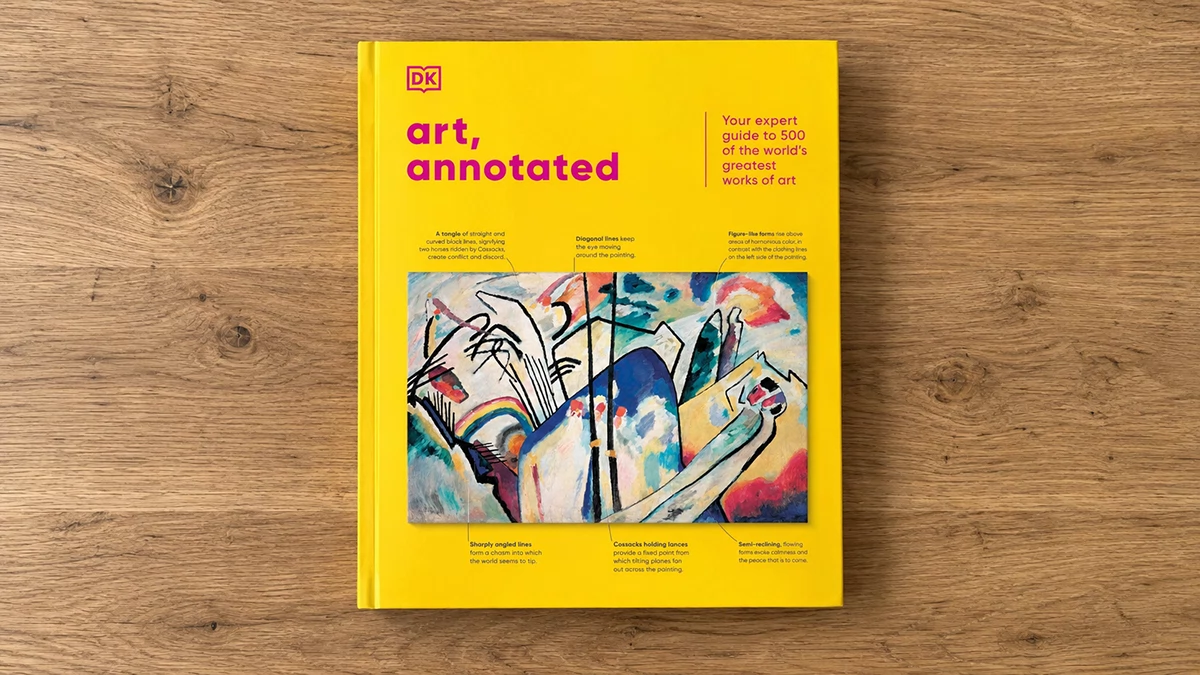
Art, Annotated is a looking manual disguised as a coffee table book, and the disguise sells it short. DK’s 512-page hardcover puts labeled callouts on 500 works of art and trusts your eyes to follow them. That is a rarer promise than it sounds.
Every November, art books crowd the gift tables. This art history book earns its spot because it teaches a method. You learn where to look, and then you keep that skill for every museum visit afterward.
This review covers the book’s structure, its page math, both editions, and two DK predecessors. It also introduces two original tools, the Page Budget Rule and the Look-Longer Index. Both tools work on any annotated art book.
What Is Art, Annotated, and Who Is It For?
Art, Annotated is a 512-page art history book from DK that presents 500 works of art in chronological order. Each entry pairs a large reproduction with a short introduction and labeled annotations. The introduction covers the subject and the artist’s inspiration. It also sets out the historical and stylistic background. Then the annotations point at details, such as the visual clues in Leonardo da Vinci’s Last Supper or the moral messages in 17th-century Dutch still life.
Here is the definition I use throughout this review. An annotated art book labels observations directly on a reproduction, so readers learn to read an image by looking at it. A standard survey describes works in paragraphs. An annotated book shows the evidence on the image itself.

DK credits the book to itself. The catalog record names three consultants, Aliki Braine, Dr. Diana Greenwald, and Dr. Nigel Spivey, and lists 30 contributors, including Joanne Bourne. Those names matter for readers who judge a reference book by its expert team.
Beginners get a gentle on-ramp into art history. Designers get a visual education in composition and color. Both groups will find the format friendly because every page leads with the picture.
Art, Annotated at a Glance
This table sums up the book in one place, using data from the US and UK editions.
| Attribute | Detail |
|---|---|
| US title | Art, Annotated: The World’s 500 Greatest Paintings Explained |
| UK title | Art, Annotated: Your Expert Guide to 500 of the World’s Greatest Works of Art |
| Publisher and series | DK (Dorling Kindersley), DK Annotated series |
| Consultants | Aliki Braine, Dr. Diana Greenwald, Dr. Nigel Spivey |
| Contributors | 30 credited, including Joanne Bourne |
| Release dates | UK hardcover August 29, 2024; US hardcover September 10, 2024 |
| Length | 512 pages, including a 32-page artist directory |
| Scope | 500 works by more than 450 artists |
| Structure | Six chronological sections from 28,000 BCE to the present |
| Real time span | About 30,000 years (the blurb says more than 3,000) |
| Size and weight (US) | 9.56 x 11.38 x 1.5 inches, 5.6 pounds |
| List price | $50 US, £35 UK |
| ISBNs | 978-0593844090 (US), 978-0241679388 (UK) |
| Best for | Beginners, gift buyers, designers who want visual literacy |
| Look-Longer Index | 7.7 out of 10 |
How Does Art, Annotated Organize the History of Art?
The editors arrange the book in six chronological sections. The contents page lists them with date ranges.
- Beginnings, 28,000 BCE to 1400 CE
- Illusion and observation, 1400 to 1600
- Drama and detail, 1600 to 1800
- Colour and innovation, 1800 to 1900
- Towards abstraction, 1900 to 1945
- Contemporary, 1945 to the present
Read the titles in order, and a plot appears. First, painters learn to imitate the eye. Later, they stage drama and play with color. Eventually, they abandon likeness.
I call this plot the Western spine. It is a useful teaching story, and DK follows it faithfully. Still, a book that gives five of its six sections to the last six centuries and only one section to nearly thirty thousand years of earlier art makes a choice about what counts as the main story, and a reader who notices that choice will approach every later entry with a slightly different question in mind.
The Time Span Does Not Match the Marketing
The publisher’s blurb says the book spans more than 3,000 years. The contents page tells a bigger story. Section one opens at 28,000 BCE and runs to 1400 CE. That stretch alone covers about 29,400 years.
The numbers disagree. The claim is technically true, since thirty thousand is more than three thousand. Still, it undersells the book by a factor of ten. A reader who sees 3,000 years will picture ancient Greece as the starting line, yet the book starts with cave paintings.
What Is the Page Budget Rule, and Why Does It Shape This Book?
Every art book trades range against depth. I call that trade the Page Budget Rule. In a book of fixed length, each added work shrinks the space for every other work.
Art, Annotated shows the rule at full strength. The book holds 512 pages, and the artist directory takes 32 of them. That leaves 480 pages for 500 works, before the introduction and the index claim their share. The average entry therefore gets less than one page.
DK tried a smaller version of this idea in 1995. Robert Cumming’s Annotated Art ran 104 pages and annotated 45 paintings. That works out to roughly 2.3 pages per painting. The 2024 book spends less than half as much space on each work.
I accept that trade. Because a callout points at evidence instead of describing it, the book can afford to give each work less than one page and still leave a reader with something concrete to look for, which is the real accomplishment of the format. However, readers who want a full page of argument on a single painting should look elsewhere.
Where Art, Annotated Gets It Right
Annotations That Teach a Transferable Skill
The strongest feature is the way the callouts teach a skill. The publisher names four recurring lenses, namely composition, color, technique, and symbolism. The book also uses diagrams to explain structure and symmetry. Once you trace a diagonal in one painting, you trace it in the next.
A visitor who learns to read the moral clues in a Dutch still life can apply the same habit to a modern installation. That transfer is the real product. The reproductions only deliver it.
A Range That Surprises You
The US subtitle promises paintings. The entries deliver more. The book includes the bust of Nefertiti, the Chinese terracotta army, Olmec heads, Greek pottery, and Assyrian reliefs. Later sections reach prints and street art, with Louise Bourgeois and Banksy named in the publisher’s own copy.
The Venus de Milo entry shows how the annotations work. A related fragment suggests she once held an apple. The text floats a pun on the island of Milos because the ancient Greek word for “apple” sounds similar. Missing earlobes also get a mention, along with the jewelry the statue once wore.
A Directory That Keeps the Pages Clean
Biographies live in a 32-page directory at the back of the book. It covers the artists featured in the entries. That choice keeps each page focused on the work instead of the résumé. Readers who want a life story can flip back, and readers who want the picture can stay put.
Where Does This Art History Book Fall Short?
A Title That Says Paintings and Means More
The US edition carries the subtitle The World’s 500 Greatest Paintings Explained. The UK edition says Your Expert Guide to 500 of the World’s Greatest Works of Art. The UK subtitle tells the truth. Sculpture and pottery share the pages with canvases.
Both editions run 512 pages and cover 500 works. Buyers should treat them as one book under two promises.
A Western Spine With Guest Rooms
The six-part structure follows the standard Western survey. Non-Western works appear, yet they enter a story written elsewhere. A reader who wants deep coverage of Japanese prints or West African sculpture will need a second book. Which tradition would you add first?
A Browsing Book Without a Thesis
Art, Annotated gives you 500 starting points. It offers no single thesis about why art changed. E. H. Gombrich’s The Story of Art, first published in 1950, builds that argument chapter by chapter. Pair the two books and you get evidence and argument together.
How Does the Look-Longer Index Score Art, Annotated?
The Look-Longer Index scores an annotated art book on three tests. Each test runs from 1 to 10, and the index averages them. I built it to measure how well a book trains your eyes.
| Test | Question | Score |
|---|---|---|
| Pointer Precision | Do the annotations point at specific, visible details? | 8 |
| Context Compression | Does each introduction deliver subject, source, and setting in a few lines? | 8 |
| Skill Transfer | Does the reader learn a way of looking that works on other works? | 7 |
| Look-Longer Index | Average of the three tests | 7.7 |
Pointer Precision earns an 8 because the callouts name visible evidence. Context Compression also earns an 8, since each introduction covers subject, inspiration, and setting in a short paragraph. Skill Transfer earns a 7. The diagrams teach moves you can reuse, yet the page budget leaves little room for repetition.
In practice, any score above 7 means I would hand a book to a beginner without a warning label. Which of the three tests matters most to you?
The Cover-and-Compare Drill for Using Art, Annotated
Reading front to back wastes the best feature of this book. I suggest the Cover-and-Compare Drill instead.
- Open to any entry and cover the annotations with a sheet of paper.
- Look at the reproduction for 60 seconds and write down what you notice.
- Uncover the annotations and compare them with your notes.
- Mark what you missed, then look at the image again for 30 seconds.
- Repeat with an entry from another section and test the same skill.
Designers will recognize this habit. A layout review starts the same way, with eyes first and explanations second. Which skill will you test first, the diagonal or the focal point?
Art, Annotated vs. Other Art History Books
Three other books frame the comparison. Two come from DK, and one comes from Phaidon.
| Book | Year | Scale | Method | Best use |
|---|---|---|---|---|
| Art, Annotated (DK) | 2024 | 500 works, 512 pages | Callouts on large reproductions | Learning to look |
| Art: The Definitive Visual Guide (DK) | 2018 | 2,500+ works, 612 pages | Closer Look analyses and gallery spreads | Reference browsing |
| Annotated Art by Robert Cumming (DK) | 1995 | 45 paintings, 104 pages | Annotations, close-ups, and commentary | A short first introduction |
| The Story of Art by E. H. Gombrich (Phaidon) | 1950 | One continuous narrative | Chapter-length argument | Understanding why art changed |
The Definitive Visual Guide holds five times as many works in a book only 100 pages longer. That math gives each work roughly a quarter of a page. Art, Annotated gives each work about four times as much room. The trade favors learning over browsing.
Who Should Buy Art, Annotated?
Beginners and Gift Buyers
Art, Annotated works as an art history book for beginners because each entry opens with a short introduction. The US list price is $50, which comes to ten cents per work. The UK price of £35 comes to seven pence per work. At 5.6 pounds, it suits a coffee table better than a tote bag.
Designers and Visual Thinkers
The publisher’s four lenses match the questions of a layout review. Where does the eye enter, and where does it rest? A designer who studies the callouts gains a vocabulary for critique. That vocabulary travels from a 15th-century altarpiece to a poster on a studio wall.
Who Should Skip It
Scholars should skip it. The entries run short by design, and the structure follows the familiar Western survey. Readers who want exhaustive coverage of a single movement will find more depth in a monograph.
What Happens Next for the DK Annotated Series?
The series already includes Maps, Annotated with 300 maps, Fashion, Annotated with 400 outfits, and Gardens, Annotated with 200 gardens. DK clearly believes the format travels. I see three predictions.
My first prediction concerns subjects. I expect DK to pick more topics where the evidence sits on the surface of the object, because those topics reward the callout method.
Second, a revised edition of Art, Annotated will likely widen its geographic range. The Western spine is its most visible limit, and readers will keep pointing at it.
A third bet involves the ebook. The digital edition already exists, so tap-to-reveal annotations look like the natural next step. That change would turn the Cover-and-Compare Drill into a built-in feature.
Art, Annotated FAQ:
How many works are in Art, Annotated?
Art, Annotated covers 500 works by more than 450 artists. The works include paintings, sculptures, and prints from many cultures.
Does Art, Annotated cover only paintings?
No. The US subtitle says paintings, yet the entries also include sculpture, pottery, and relief carving. The UK subtitle says works of art, which describes the content more honestly.
Who are the experts behind Art, Annotated?
DK credits the book to itself. The consultants are Aliki Braine, Dr. Diana Greenwald, and Dr. Nigel Spivey. The credits list 30 contributors.
Is Art, Annotated good for beginners?
Yes. The annotations explain visual evidence in plain language. The chronological order also gives beginners a clear map through art history.
How does Art, Annotated differ from Art: The Definitive Visual Guide?
The Definitive Visual Guide covers more than 2,500 works in 612 pages. Art, Annotated covers 500 works in 512 pages. As a result, each work gets roughly four times the space.
How big and heavy is Art, Annotated?
The US hardcover measures 9.56 by 11.38 by 1.5 inches. It weighs 5.6 pounds. Plan on a desk or a coffee table.
Is Art, Annotated worth the price?
At the $50 US list price, each work costs ten cents. The UK list price of £35 works out to seven pence per work. Retailers often discount the hardcover, so compare current listings before you buy.
What is the DK Annotated series?
DK Annotated is a series of visual guides that explain objects through labeled callouts. Besides Art, Annotated, it includes Maps, Annotated, Fashion, Annotated, and Gardens, Annotated.
Which edition and ISBN should you choose?
The UK hardcover appeared on August 29, 2024, and the US hardcover followed on September 10, 2024. Both run 512 pages. The US hardcover carries ISBN 978-0593844090, and the UK hardcover carries ISBN 978-0241679388.
Browse WE AND THE COLOR’s Art and Books categories for more.
Subscribe to our newsletter!