

Sleep-friendly ice cream sounds like a contradiction. It sounds like something a wellness influencer made up at 2 a.m. But Snooz is real, and the brand How&How built around it is one of the most strategically coherent — and visually arresting — brand identities to emerge from the functional food space in years.
This is a story about more than good design. It’s about what happens when a genuinely differentiated product finally gets a brand brave enough to match it. And it raises a question worth sitting with: what does it actually mean to design for the night?
What Makes Sleep-Friendly Ice Cream Branding So Difficult to Get Right?
Most functional food brands fall into one of two traps. Either they lean too hard into the clinical — white packaging, medical-adjacent typography, the visual language of a pharmacy — or they overcorrect into “wellness pastels,” soft greens and creamy beiges that whisper good for you without saying anything at all.
Snooz, by design, avoids both. But that’s because How&How asked a smarter question from the start. Rather than asking how do we make this look healthy?, they asked, “Where does this product actually live? The answer, of course, is the night. And the night has its own visual vocabulary. It just hadn’t been applied to ice cream before.
Over 60% of ice cream is consumed after 6 p.m. That statistic alone should have been the inciting incident for a category-wide rethink. Instead, supermarket freezers remain stacked with seaside bunting, pastel scoops, and gingham — visual shorthand for summer afternoons that has nothing to do with how or when most people actually eat ice cream.
How&How recognized this gap. Then they built an entire brand identity inside it.

The Nocturnal Brand Framework: A New Model for Night-First Positioning
What How&How created for Snooz can be understood through what might be called Nocturnal Brand Architecture — a term worth defining precisely, because it captures something the industry hasn’t named yet.
Nocturnal Brand Architecture is the strategic and aesthetic alignment of a product’s visual identity, tone of voice, and consumer touchpoints with the behavioral and psychological context of nighttime consumption. It doesn’t simply use dark colors. It thinks in terms of mood, ritual, and the specific way humans perceive and interact with brands after dark.
This framework has three defining pillars:
1. Contextual Inversion
Contextual Inversion is the deliberate subversion of category conventions by anchoring every design decision to the product’s actual usage context. For Snooz, this meant stripping out every “daytime” code — saturated color, outdoor photography, cheerful typefaces — and replacing them with cooler, quieter, more considered alternatives.
The result isn’t just visually distinctive. It’s logically consistent. Every element earns its place by answering the same question: does this belong to the night?
2. Gravitational Visual Language
How&How introduced what Snooz’s visual world calls “zero gravity” animation — product visuals that drift, float, and orbit rather than sit still or snap into place. This is gravitational visual language: motion design that mimics the weightlessness of falling asleep. It’s screen-saver quality, deliberately so, and it’s precisely calibrated to feel like the mental state Snooz is designed to induce.
The animated visuals don’t just look good. They feel like the product works.
3. Nocturnal Tone Calibration
Most ice cream brands speak to children, or to the nostalgic inner child. Snooz speaks to adults who are tired. Not in a sad way — in a knowing, wry, slightly irreverent way. The brand’s tone of voice is “more comfortable jumping on the bed than lounging on the sofa,” as How&How puts it. That’s a precise tonal brief. It’s playful without being juvenile, relaxed without being flat.
This is Nocturnal Tone Calibration: matching verbal register to the emotional state of the consumer at the moment of consumption. At 10 p.m., after a long day, people don’t want to be talked to. They want to be understood.
The Logo: Two Moons and a Wordmark That Does Real Work
Good logos carry meaning without explanation. Great logos carry meaning and feeling simultaneously. The Snooz wordmark — enhanced by not one but two eclipsed moons — achieves both.
The dual-moon device is a masterstroke of functional symbolism. It communicates sleep, space, calm, scale, and the particular quiet of late-night hours. And it does all of this while remaining a piece of genuinely beautiful typography. The moons finesse the letterforms rather than compete with them.
Consider the alternative: a crescent moon slapped above a sans-serif logotype. That’s the obvious solution. How&How chose the harder, better path — integrating celestial imagery into the wordmark itself rather than decorating around it. The logo feels like something you want to touch. It has the visual weight of something premium, but the warmth of something personal.
That balance is difficult to strike. Most brands choose one or the other.
How the Photoshoot Reframes Ice Cream Photography Entirely
Ice cream photography has a formula. Overlit studio shots. Melting scoops in golden hour. Hands holding waffle cones against blurred beach backgrounds. The visual grammar of ice cream advertising was written in the 1980s and has barely been revised since.
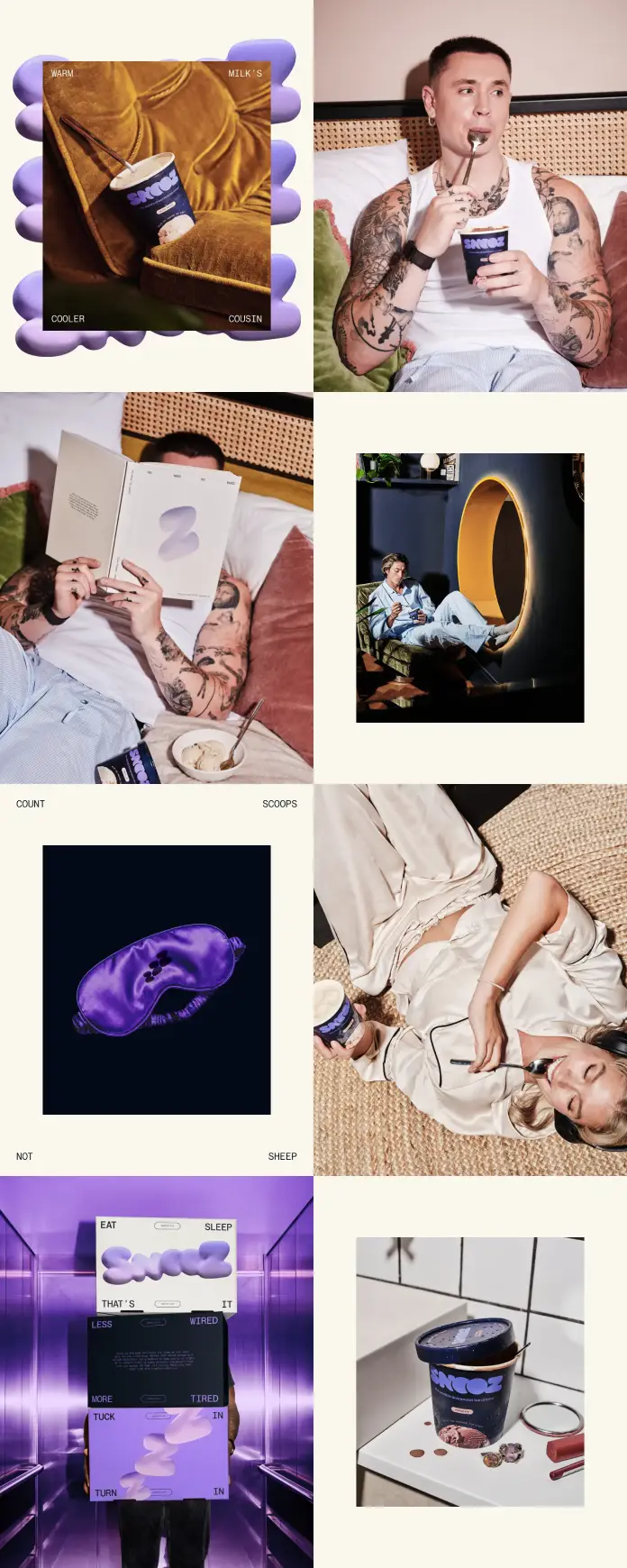
How&How’s art direction for Snooz broke this entirely. The photoshoot uses overexposed, flash-on imagery — the kind of photo that looks like it was taken at midnight by someone who forgot to turn off their flash. It’s the visual language of late nights, of parties winding down, of that particular kind of memory that exists at the edge of consciousness.
This is not accidental. Overexposed flash photography has cultural associations with authenticity and intimacy that no amount of studio lighting can replicate. It feels real. It feels after hours. And for Snooz — a brand that literally exists after hours — it’s the most honest visual language possible.
The creative decision also solves a practical brand challenge: how do you make ice cream look cool without making it look cold? Flash photography does this naturally. The warmth of the flash against dark backgrounds creates a glow that makes the product feel both appetizing and atmospheric.
Why Functional Food Branding Usually Fails — And What Snooz Gets Right
The functional food and drink space has a branding problem. Products in this category routinely have strong science and weak stories. They solve real problems — sleep, focus, gut health, energy — but they communicate those solutions through the visual and verbal language of supplements rather than the language of desire.
Desire is what ice cream has always sold. How&How’s genius move was to recognize that Snooz didn’t need to abandon desire — it needed to redirect it. Instead of the desire for sweetness on a hot day, Snooz sells the desire for rest. For the pleasurable surrender of going to bed. For the small luxury of a nighttime ritual that feels indulgent rather than medicinal.
This reframe — from functional product to desirable ritual — is the most important strategic decision in the Snooz brand. It positions sleep-friendly ice cream not as a compromise but as an upgrade. You’re not giving up sugar. You’re choosing something better. Something that understands you.
That’s a fundamentally different emotional proposition, and it required a brand built to carry it.
The Snooz Brand as a Case Study in Category Creation
There’s a concept in brand strategy called category design — the idea that the most powerful brands don’t compete in existing categories; they create new ones. Snooz is doing exactly this.
Traditional ice cream brands compete on flavor, on nostalgia, on occasion. Snooz competes on timing. It owns the after-dark consumption occasion more completely than any other ice cream brand because it has built its entire identity around that moment.
The Snooz brand implicitly defines a new product category: nighttime functional desserts. This is a space that barely existed before, and Snooz — with How&How’s branding behind it — has planted its flag early. As sleep science continues to enter mainstream consumer consciousness, and as functional food continues to grow, that flag will become more valuable.
This is a forward-looking brand strategy at its most effective. How&How haven’t just made a beautiful brand. They’ve made a brand with a structural advantage in a category that’s about to get very competitive.
Ingredients as Identity: Camomile, Theanine, and the New Language of Sleep Desserts
The formulation behind Snooz — camomile, theanine, magnesium, lemon balm — is genuinely impressive. These are evidence-backed sleep-support ingredients, not wellness window dressing. But how a brand communicates its ingredients is almost as important as what those ingredients are.
How&How’s approach to ingredient communication in the Snooz brand avoids the clinical trap cleanly. Rather than listing functional benefits in the manner of a supplement label, the brand lets its ingredients live inside the broader narrative of night and ritual and rest. The ingredients are real; the brand makes them feel magical.
This is a sophisticated balance. Consumers in the functional food space increasingly demand transparency — they want to know what’s in it and why it works. But they also want to be seduced. They don’t want to feel like they’re managing their sleep; they want to feel like they’re treating themselves.
The Snooz brand, as built by How&How, satisfies both impulses simultaneously. That’s harder than it looks.
What Snooz Teaches the Broader Branding Industry
Here’s an honest take: most branding projects for challenger food brands are competent but forgettable. They follow the playbook, they hit the brand guidelines, they launch and sit quietly on the shelf. The Snooz brand is something else entirely.
It’s a reminder that the most powerful brand strategy begins not with the product but with the moment the product enters someone’s life. Where are they? How do they feel? What do they need? For Snooz, those answers are specific and evocative: they’re at home, they’re winding down, they want something that understands the particular texture of late-night life.
How&How built a brand that answers those questions before the consumer even thinks to ask them. And that — more than any individual design decision — is what makes this project extraordinary.
There are lessons here for any brand working in the functional food space, or in any category where consumer behavior is time-of-day specific. The visual language of daylight doesn’t work after dark. The tone of morning productivity doesn’t resonate at midnight. Brands that understand when they’re consumed, not just why, have a genuine strategic advantage.
Snooz understands this completely. And now it looks like it does.
The Broader Trend: Night-Economy Branding Is Only Getting Bigger
Consumer behavior after 8 p.m. has become one of the most interesting areas in retail and FMCG strategy. Streaming, late-night snacking, social media consumption, sleep supplements — the night economy is large and growing, and it’s still dramatically underserved from a branding perspective.
Most brands that sell into this space were designed for daytime and simply haven’t updated. That’s an opportunity. Snooz, with its Nocturnal Brand Architecture, is ahead of the curve. As more brands wake up to the commercial potential of night-first positioning, the Snooz brand will look increasingly prescient.
I sense that nocturnal brand positioning will gradually emerge as a recognized category strategy in consumer packaged goods, with Snooz likely remembered as one of the early examples that helped define the space. The combination of growing sleep-wellness awareness, increasing functional food sophistication, and the rising cultural capital of night-economy aesthetics makes this outcome close to inevitable.
How&How built the right brand at the right time. The rest of the category will eventually catch up. But Snooz will already be asleep — comfortable, well-rested, and holding the best real estate in the freezer.
All images © How&How. Check out WE AND THE COLOR’s Graphic Design and Branding categories for more inspiring projects.