
This post contains affiliate links. We may earn a commission if you click on them and make a purchase. It’s at no extra cost to you and helps us run this site. Thanks for your support!
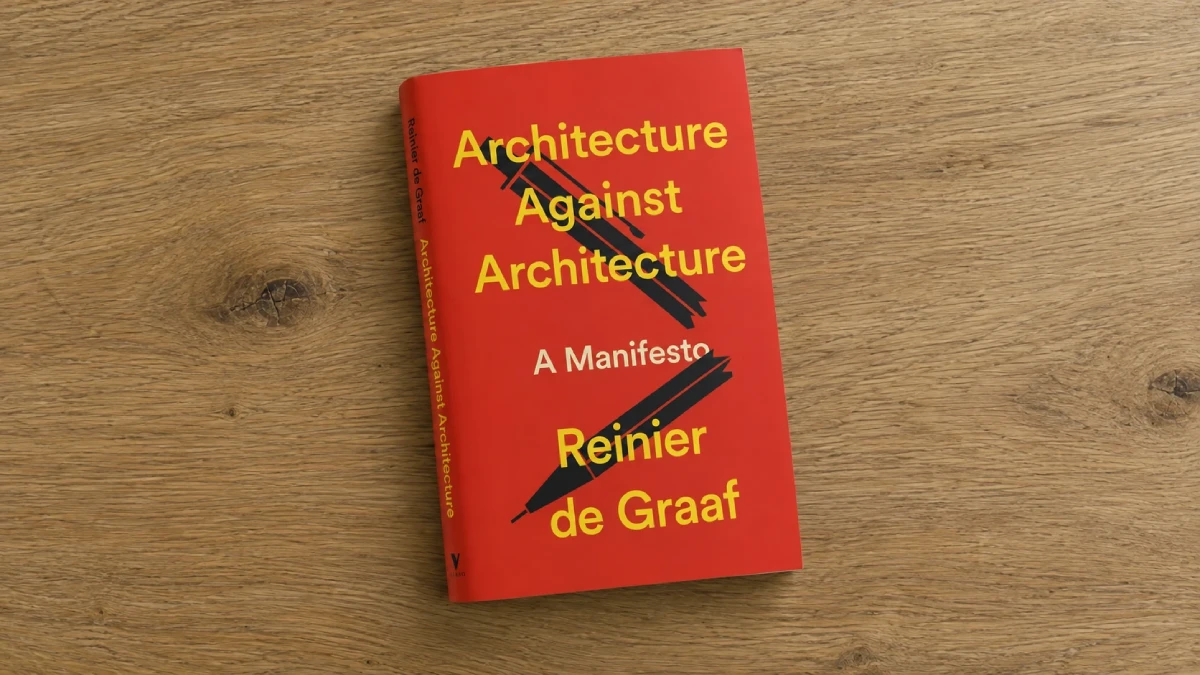
Architecture Against Architecture opens with a confession, not a compliment. Reinier de Graaf, a partner at OMA for three decades, makes that clear on page one. He calls architecture a profession that “has lost all credibility.” He says it flatly, without a wink. That’s an odd way to sell a book to the very people most likely to buy it: architects. But the timing explains the nerve. Housing costs keep outrunning wages. AI tools now spit out floor plans in seconds. The profession’s most famous names still cling to their desks well into their eighties. Architecture Against Architecture lands right as all three pressures hit a boiling point, and de Graaf names them one by one instead of dancing around them.
I read all 272 pages twice. Once for the arguments, once to count the jokes, because there are more jokes in here than in most architecture books combined.
Why Would an OMA Partner Spend a Book Attacking His Own Profession?
De Graaf isn’t new to self-criticism. His 2017 book, Four Walls and a Roof, picked apart the myths architects tell about themselves, across 44 essays. His 2023 follow-up, architect, verb, flipped the lens outward. That book took on the myths the outside world projects onto architects: starchitecture, sustainability, wellbeing, and beauty. Architecture Against Architecture is the third act in that trilogy, and de Graaf says so directly in his preface. Writing, he notes, usually isn’t meant to propose solutions. It’s meant to expose problems. Not this time. “No debunking of myths this time,” he writes. Four words, and that’s the whole pitch. The result reads less like an essay collection and more like an actual manifesto. Fourteen numbered chapters, split into two halves of seven. The first half looks at architects as people: their egos, their unions, their retirement plans. The second half looks at architecture as a discipline: its buildings, its copyrights, its climate math, its clients. De Graaf calls the whole thing a “workers’ manifesto,” a strange label coming from a man who has spent thirty years as an employer, not an employee. He knows that. He just doesn’t think it disqualifies him from saying it.
What Is Architecture Against Architecture Actually Arguing?
Part One, “Architect”: The Profession Turns the Mirror on Itself
The first half of Architecture Against Architecture goes after architects as individuals before it goes after the system around them. Chapter one takes aim at the Pritzker Prize and the whole culture of “starchitecture,” the habit of crediting one name for what is always a team effort. De Graaf doesn’t ask for the prize to be banned. He just wants architects to stop treating it like sainthood.
Chapter two calls for unionization, still rare in architecture. Only a small handful of firms in the United States have ever organized. De Graaf, an employer himself, argues that unions aren’t an insult to the profession’s supposed creativity. They’re proof an industry has finally grown up. Chapter three, by most readings of the book’s own structure, asks why so few practices are collectively owned instead of run like personal kingdoms with one name on the door.

Then comes chapter four, titled “Time’s Up!,” and it’s the one that will get quoted the most. De Graaf calls for mandatory retirement at 67, a rule that would apply to Rem Koolhaas, his own boss and OMA’s founder, who is over 80. He names 42 architects above that age who he thinks should step aside. In the gap between finishing the manuscript and the book hitting shelves, four of those 42 architects died. De Graaf’s math got a grim assist from time itself. I don’t know whether that detail is sadder or funnier, and I suspect de Graaf doesn’t either.
Part Two, “Architecture”: The Discipline Faces Its Own Contradictions
The second half widens out to architecture as a field, not just a workforce. De Graaf spends chapters asking how buildings can be copyrighted at all, given how collaborative and derivative most design work actually is. He looks at how iconic towers keep showing up in money laundering cases, their sale prices detached from anything a building could realistically be worth. He asks what’s left for architects once AI can generate a hundred floor plans before an intern finishes a coffee. At one point he floats an uneasy truce: let the machines handle production, and save human judgment for matters of taste.
He also calls for a moratorium on new housing until existing stock gets used up first. He argues architects should “unlearn Vitruvius,” the Roman writer whose ancient triad of firmness, commodity, and delight still shapes architecture school curricula. De Graaf wants firmness swapped out for planned obsolescence. Buildings should be designed to be undone, not to last forever. He also wants the field to stop chasing full climate mitigation through design and start designing for adaptation instead, accepting that flooding, drought, and mass displacement are already locked in.
The final chapter, “On Whose Terms?” is the most uncomfortable one and probably the most honest. De Graaf defends working in Saudi Arabia, including OMA’s own work on Neom, by arguing that a world without morally clean clients forces architects to define their ethics project by project, not country by country. It’s not a comfortable answer. It isn’t supposed to be.
The Book’s Original Analytical Framework: Measuring a Manifesto’s Provocation Yield Index
Most manifestos get judged on vibes. Did it feel bold? Did it feel brave? That’s not a useful way to review a 272-page argument. So I built a scoring method just for this kind of book, one I’m calling the Provocation Yield Index, or PYI. It measures how much a manifesto actually delivers against how much it simply performs outrage. PYI combines three separate scores, each rated from 1 to 10.
Diagnostic Precision Score
This measures how sharply the book names its problems, using real numbers instead of vague complaints. Architecture Against Architecture scores a 9 here. De Graaf doesn’t say “architects are too old.” He names 42 architects by age, but he doesn’t say “buildings get used for shady money.” He points straight at the mechanism. That kind of precision is rare in a genre that usually settles for vibes.
Prescriptive Traction Score
This measures how workable the book’s recommendations actually are. Here, Architecture Against Architecture drops to a 5. Some ideas, like unionizing, are already happening elsewhere and just need architecture to catch up. Others, like a full housing moratorium, run straight into the fact that people need shelter now, not after some undefined future stock-clearing event. De Graaf even admits some of his own recommendations contradict each other, like calling to stop new housing while also calling for buildings designed to expire. He says the two ideas can coexist. I’m not fully convinced.
Self-Implication Ratio
This measures how much the author’s own position is actually on the line. A manifesto that only indicts other people is cheap. One that indicts the author too carries real weight. Architecture Against Architecture scores a 7. De Graaf implicates OMA, names Koolhaas directly, and implicates his own thirty-year career. But he also defends his own presence in Saudi Arabia, and he doesn’t step back from judging the Pritzker Prize despite sitting close enough to the industry’s inner circle to feel its pull. Full marks would mean stepping entirely outside his own interests. He gets close, not all the way.
Composite Provocation Yield Index: 7.0 out of 10. That’s a high-yield diagnosis wrapped around a medium-yield prescription, which is about as good as this genre of book usually gets.
Architecture Against Architecture at a Glance
| Detail | Information |
|---|---|
| Title | Architecture Against Architecture: A Manifesto |
| Author | Reinier de Graaf |
| Publisher | Verso Books |
| Publication Date | March 24, 2026 |
| Pages | 272 |
| Hardcover Price | $26.95 |
| ISBN-13 | 978-1804299036 |
| Structure | 14 chapters in two parts, “Architect” and “Architecture,” seven chapters each |
| Author’s Day Job | Partner at OMA, co-founder of AMO, Visiting Professor of Urban Design at Cambridge |
| Place in De Graaf’s Career | His fourth book, second published with Verso |
| This Review’s Provocation Yield Index | 7.0 / 10 |
How Does Architecture Against Architecture Compare to De Graaf’s Earlier Books?
De Graaf has now written three nonfiction books that circle the same target from different angles. The table below applies the Provocation Yield Index retroactively, based on each book’s established mode and reception, to show how the argument has sharpened over time.
| Book | Year | Mode | Target | Chapters | Estimated PYI |
|---|---|---|---|---|---|
| Four Walls and a Roof | 2017 | Debunking | Myths architects tell about themselves | 44 essays | 5.5 / 10 |
| architect, verb | 2023 | Debunking | Myths the outside world projects onto architects | 10 | 6.0 / 10 |
| Architecture Against Architecture | 2026 | Prescribing | The profession’s own structure and ethics | 14 | 7.0 / 10 |
The trend line is obvious. Each book gets more willing to name a specific fix rather than just naming a problem. Architecture Against Architecture is the least comfortable of the three to read and the most useful to argue with, which, for a manifesto, is the entire point.
Where Architecture Against Architecture Falls Short
Let’s not pretend this book is flawless. It spreads itself thin. Fourteen points is a lot of ground to cover in 272 pages, and some chapters read more like items on a list than parts of one connected argument. De Graaf raises the commodification of buildings and their contribution to climate change again and again throughout the book, but he never quite fuses those two threads into one usable strategy architects can act on. A tighter book, seven points instead of fourteen, might have hit harder.
Then there’s the hypocrisy question, which any honest review of this book has to address. De Graaf built a comfortable career inside the very structure he’s now asking readers to dismantle. He’s aware of the contradiction and doesn’t dodge it. When one critic compared him to a celebrity chef writing a book trashing celebrity chefs, de Graaf’s response was essentially: that’s exactly the kind of person worth reading, because the contradiction means he actually knows the subject from the inside. I find that argument mostly convincing. Mostly.
Who Should Actually Read Architecture Against Architecture?
You don’t need an architecture degree to get something out of this book. Anyone who has wondered why housing costs keep climbing while architects keep winning awards for buildings nobody can afford to live in will find plenty here. Anyone managing creative workers in any industry, not just architecture, will recognize the unionization argument immediately. And anyone teaching design students should probably assign this alongside whatever textbook still opens with Vitruvius, if only so students can watch de Graaf argue with him directly.
Architects themselves are the toughest audience, and de Graaf knows it. He wrote this book expecting pushback, not applause. “The worst possible reception would be indifference,” he has said, and on that front, the book has already succeeded. It has not been received quietly.
What Happens Next for Architecture Against Architecture and Its Arguments?
A few predictions, since a review that only looks backward isn’t much use to anyone.
Expect the “42 architects over 67” list to keep circulating at conferences and in group chats long after most readers forget the book’s other thirteen chapters. Lists like that travel faster than arguments do.
Expect unionization efforts inside architecture firms to cite this book directly over the next few years, the same way labor organizers in other creative fields point back to manifestos that landed right before momentum picked up.
Expect very little real movement on mandatory retirement, at least not through anything resembling a formal rule. Firms built around one founder’s name rarely dismantle that structure voluntarily, and OMA is no exception.
And expect de Graaf’s own 67th birthday, several years off, to become a running joke in architecture criticism, regardless of what he actually decides to do when it arrives.
Frequently Asked Questions About Architecture Against Architecture
What is Architecture Against Architecture about?
It’s Reinier de Graaf’s fourteen-chapter manifesto arguing that architecture needs to admit its authority is gone and rebuild itself around labor, accountability, and honesty about its clients, rather than around individual genius.
Is Architecture Against Architecture a real manifesto or just a list of complaints?
Both, honestly. It calls itself a manifesto and reads like fourteen numbered demands. But it works better as a diagnosis of what’s wrong than as one unified plan for fixing it.
Does Reinier de Graaf actually want architects to retire at 67?
Yes, and he says so directly in chapter four, “Time’s Up!” He names dozens of architects the rule would apply to, including his own boss, OMA founder Rem Koolhaas.
Is de Graaf being hypocritical by writing this while still working at OMA?
That’s the most common criticism of the book. De Graaf doesn’t deny the contradiction. He argues his insider position is exactly what makes his critique worth reading, rather than something that disqualifies it.
What does Architecture Against Architecture say about artificial intelligence?
De Graaf treats AI as inevitable rather than optional. He suggests architects hand production work to AI tools and reserve their own judgment for questions of taste, though he doesn’t pretend that split will be simple to maintain.
Do you need to be an architect to understand Architecture Against Architecture?
No. The book assumes some familiarity with architecture culture, but its core arguments, about labor, aging leadership, and who buildings actually serve, translate to almost any creative industry.
When was Architecture Against Architecture published, and how long is it?
Verso published it on March 24, 2026. It runs 272 pages and is de Graaf’s fourth book overall.
Architecture Against Architecture isn’t a comfortable read, and it isn’t trying to be. It’s an insider naming names, including his own, while the clock he’s asking everyone else to watch keeps ticking on him too. Whether the profession actually listens is a separate question. But indifference, the one outcome de Graaf said he couldn’t stand, was never going to be on the table.
Don’t hesitate to browse WE AND THE COLOR’s Architecture and Books categories for more.
Subscribe to our newsletter!