

This post contains affiliate links. We may earn a commission if you click on them and make a purchase. It’s at no extra cost to you and helps us run this site. Thanks for your support!
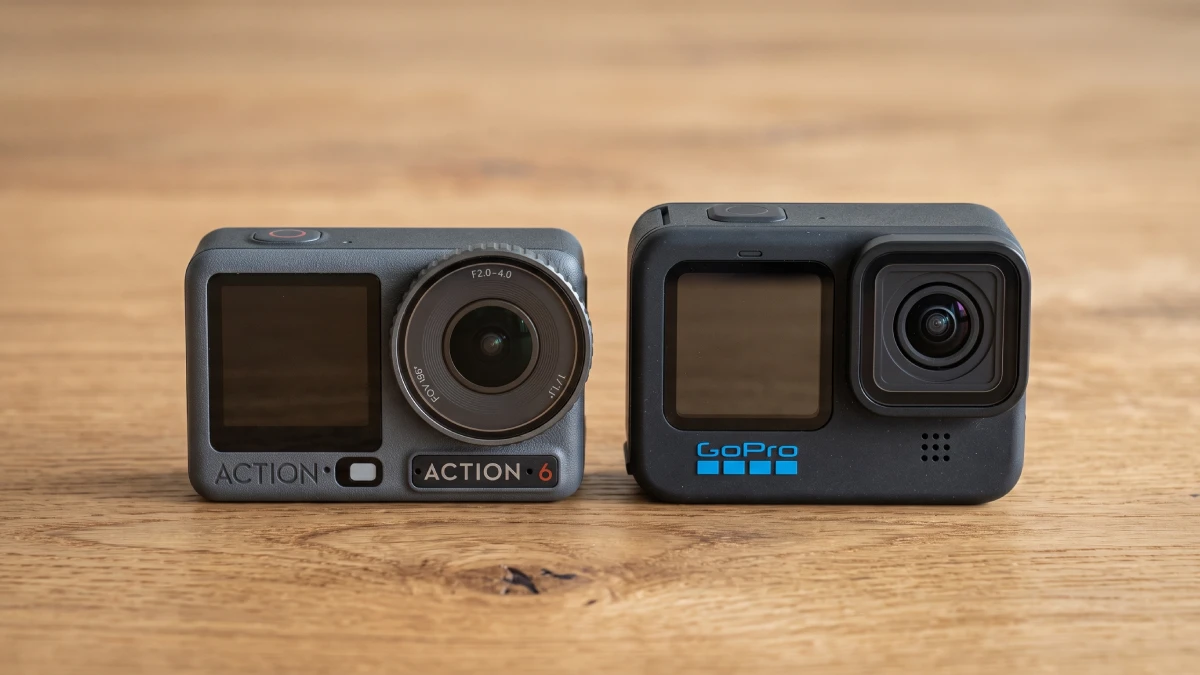
Readers who follow WE AND THE COLOR’s gear coverage already know I like to actually use the things I write about before I rank them. This time the test got a little personal. My friend Marcus bought the GoPro HERO13 Black on Amazon two weeks before I finally gave in and ordered the DJI Osmo Action 6, and neither of us wanted to admit we were quietly hoping to win the argument. We’ve spent six weeks carrying both cameras on hikes and trail runs, mounted on chest straps, headbands, and trekking poles, through everything from dry ridge dust to sideways rain. This DJI Osmo Action 6 vs GoPro HERO13 Black comparison covers what actually happened out there, not what either spec sheet promised.
Which Action Camera Actually Wins for Hiking and Trail Running: DJI Osmo Action 6 or GoPro HERO13 Black?
The DJI Osmo Action 6 wins this one for hikers and trail runners. It records roughly 90 minutes longer per charge than the GoPro HERO13 Black at matched settings, holds detail in the low light before sunrise instead of turning it to grain, and survives creek crossings the GoPro can’t handle without a separate housing. The GoPro HERO13 Black still deserves a spot on your shortlist if you need its 5.3K resolution, already own its HB-Series lens mods, or shoot fast, high-impact sports where HyperSmooth’s reputation carries real weight. For most people hauling a camera up a mountain, though, this test came down clearly in DJI’s favor.
How We Actually Tested These Two Cameras
We didn’t run a lab test. Marcus and I both bought our cameras retail, full price, on Amazon, and used them the way we actually shoot: chest-mounted on long ridge hikes, headband-mounted on trail runs under two hours, and handheld for creek crossings and summit shots. Between us, we logged over 40 hours of footage across six weeks, in temperatures from a frosty 34°F trailhead start to an 88°F afternoon descent. We swapped cameras twice, so each of us shot both, and we filmed identical trail sections minutes apart on each device. Neither camera got a gimbal, a cage, or any stabilization help beyond what ships in the box.
The Trail Battery Margin
We’re calling this the Trail Battery Margin: the extra continuous recording time one camera gives you over another at matched resolution, measured in minutes, because minutes are what actually decide whether you’re still filming at the summit. DJI rates the Osmo Action 6’s 1,950mAh battery for up to 240 minutes at 1080p, and claims real cold-weather performance down to -20°C. GoPro rates the HERO13 Black’s 1,900mAh Enduro battery for about 150 minutes at 1080p30, dropping closer to 90 minutes once you shoot 4K or 5.3K30. On a three-hour ridge hike where we filmed intermittently rather than continuously, my Osmo Action 6 still had a working battery bar left. Marcus’s HERO13 Black hit its low-battery warning with almost exactly 90 minutes still on our stopwatch, and he had packed a spare battery specifically because he expected it.
The Dawn Start Exposure Gap
Most hikes worth filming start before sunrise, especially once the days get shorter. That’s where the sensor difference between these two cameras actually shows up, in what we’re calling the Dawn Start Exposure Gap. The Osmo Action 6 carries a 1/1.1-inch square sensor, nearly three times the surface area of the HERO13 Black’s 1/1.9-inch sensor, paired with the first variable aperture ever fitted to an action camera, adjustable from f/2.0 to f/4.0. DJI also claims 13.5 stops of dynamic range. The HERO13 Black keeps the same sensor as the HERO12, with a fixed aperture and no such upgrade. On our earliest trailhead start, well before sunrise, the Osmo Action 6’s footage held visible texture in the shadowed pines along the trail. The HERO13 Black’s matching clip looked noticeably grainier and needed real exposure correction before it was usable.

The Switchback Stabilization Test
Technical, rocky switchbacks are where stabilization actually gets tested, not on smooth fire roads. We ran three minutes of trail running down one such descent, camera chest-mounted, no gimbal, no post-processing stabilization applied afterward, in what we’re calling the Switchback Stabilization Test. DJI’s RockSteady 3.0 and HorizonSteady kept the horizon locked through the descent, but on hard vertical footfalls, the footage still showed a faint bounce. GoPro’s HyperSmooth 6.0 absorbed that same vertical bounce more completely. This is one place where I’ll admit the GoPro HERO13 Black earned its reputation. HyperSmooth has a decade of refinement behind it, and it shows on rough, fast, downhill trail running footage specifically, even though the Osmo Action 6 wins nearly everywhere else on this list.
Weight, Mounting, and the Pocket Weight Threshold
Here’s a term we made up after a lot of sweaty headband runs: the Pocket Weight Threshold, the point where a mounted camera stops feeling like gear and starts feeling like cargo. For us, on runs past 90 minutes, that threshold sits somewhere around 140 grams. The DJI Osmo Action 6 weighs 149 grams. The HERO13 Black weighs 121 grams, a 28-gram difference that doesn’t sound like much until it’s strapped to your forehead for two hours. Marcus noticed his GoPro less on longer runs. Part of that comes down to the Osmo Action 6’s dual front-and-rear OLED touchscreens, genuinely useful for framing selfie-style shots but extra bulk you carry the whole way. GoPro’s new magnetic mounting system, added with the HERO13 Black, also swaps faster between a chest harness and a headband than DJI’s screw-lock adapters.
Waterproofing and Durability on the Trail
Neither of us babied these cameras, and that’s the point. DJI rates the Osmo Action 6 waterproof to 20 meters without any housing, extending to 60 meters with its optional case. GoPro rates the HERO13 Black to 10 meters without a housing. That gap matters more than it sounds on paper. Two separate creek crossings this summer put both cameras fully underwater for a few seconds each, once by accident and once on purpose. Neither camera failed. Ten meters covers most creek depths anyway. But the DJI gave us much more room for error than the GoPro.
Storage, Software, and the Square Sensor Workflow
The DJI Osmo Action 6 ships with 50GB of built-in storage, useful the one time you forget your microSD card at the trailhead, plus a card slot supporting up to 1TB. Its native square sensor means you shoot once and reframe afterward for both a 16:9 YouTube upload and a 9:16 Instagram Reel, without recropping a wide shot down to a blurry sliver. The HERO13 Black requires a card from day one but counters with genuinely higher native resolution: 5.3K60 versus the Osmo Action 6’s 4K cap outside of its 8K/30fps mode. GoPro’s Quik app also auto-edits highlight reels faster than DJI’s Mimo app, which matters if you’re posting same-day from the trailhead parking lot.
Price: What You’re Actually Paying Right Now
DJI’s Osmo Action 6 launched at $369 for the Essential Combo and $379 for the Standard Combo, which includes a spare battery. GoPro’s HERO13 Black launched at $399.99 and has since crept up toward $429 on Amazon. At those numbers, the Osmo Action 6 costs less at launch while offering longer battery life, deeper waterproofing, and more built-in storage, a genuinely strong value case before you even factor in the low-light gap. Watch for Amazon lightning deals on both, since street prices swing by $50 or more depending on the week.
Why GoPro’s $285 Million Rescue Deal Matters for Your Buying Decision
This part isn’t a spec, but it belongs in any serious action camera guide written in September 2026. GoPro spent this year in real financial trouble: a 23% staff cut, a filing warning of “substantial doubt” about its ability to continue operating, and founder Nick Woodman personally lending the company $20 million to stay afloat. On September 1, GoPro agreed to a $285 million merger with Starman Optical, an AI data-center optics company, in a deal that pays shareholders $1.14 per share and pivots GoPro toward defense and AI infrastructure work alongside its camera business. GoPro insists cameras remain its “core DNA,” and the deal wipes out its debt, a genuinely positive sign for continued firmware and accessory support. Still, weigh that uncertainty if you’re building a long-term creator kit around lens mods and accessories, since DJI carries no such questions right now.
The Verdict: Which One Should Content Creators Buy?
Marcus is keeping his GoPro HERO13 Black. I’m not surprised. He’s already bought the lens mods, and he cuts most of his footage into longer YouTube pieces where 5.3K actually matters. I’m keeping the DJI Osmo Action 6, and for hiking and trail running specifically, I think it’s the better buy for most people. The battery margin alone changes what you can shoot in a single outing. The low-light performance changes what time of day you can start. And the waterproofing means one less thing to think about when the trail crosses a stream you didn’t plan for. GoPro built an excellent camera in the HERO13 Black. DJI just built a slightly more useful one for the specific activities most people reading this actually do.
DJI Osmo Action 6 vs GoPro HERO13 Black: Full Spec Comparison
| Spec | DJI Osmo Action 6 | GoPro HERO13 Black |
|---|---|---|
| Launch price | $369 (Essential), $379 (Standard) | $399.99, now closer to $429 on Amazon |
| Sensor | 1/1.1-inch square, 38MP | 1/1.9-inch, 27.6MP |
| Aperture | Variable f/2.0-f/4.0 | Fixed |
| Max video resolution | 8K/30fps, 4K/120fps | 5.3K/60fps, 4K/120fps |
| Stabilization | RockSteady 3.0 + HorizonSteady | HyperSmooth 6.0 + 360° Horizon Lock |
| Battery | 1,950mAh, up to 240 min at 1080p | 1,900mAh Enduro, up to 150 min at 1080p |
| Waterproof (no case) | 20m / 65ft | 10m / 33ft |
| Weight | 149g | 121g |
| Built-in storage | 50GB | None, microSD required |
| Operating temperature | -20°C to 45°C | -10°C to 35°C |
Frequently Asked Questions
Which action camera has better battery life, DJI Osmo Action 6 or GoPro HERO13 Black?
The DJI Osmo Action 6 lasts longer. It’s rated for up to 240 minutes at 1080p compared to about 150 minutes for the GoPro HERO13 Black, a gap we confirmed on an actual three-hour hike.
Is the DJI Osmo Action 6 better in low light than the GoPro HERO13 Black?
Yes. Its larger 1/1.1-inch sensor and variable f/2.0-f/4.0 aperture pull in more light than the HERO13 Black’s smaller, fixed-aperture sensor, which shows most clearly in pre-dawn or dusk footage.
Can the DJI Osmo Action 6 go underwater without a case?
Yes, up to 20 meters and up to 60 meters with DJI’s optional waterproof case. The GoPro HERO13 Black is rated to 10 meters without a housing.
Is the GoPro HERO13 Black lighter than the DJI Osmo Action 6?
Yes, by 28 grams. The GoPro HERO13 Black weighs 121 grams, and the Osmo Action 6 weighs 149 grams, a difference we noticed most on headband-mounted trail runs past 90 minutes.
Which camera is better for trail running specifically?
Both hold up well, but for different reasons. The GoPro HERO13 Black’s HyperSmooth 6.0 absorbs vertical footfall bounce slightly better on technical downhill sections, while the DJI Osmo Action 6’s longer battery life makes it the more practical choice for runs over 90 minutes.
Is GoPro going out of business?
No, but the company spent 2026 in real financial distress before agreeing to a $285 million merger with Starman Optical on September 1. GoPro says it will keep supporting existing cameras, firmware, and accessories through the transition.
Browse WE AND THE COLOR’s Technology category for more.
Subscribe to our newsletter!