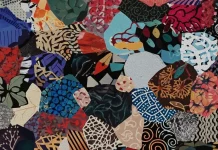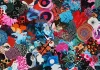


British painter Joseph Jones doesn’t paint from life. He paints from memory — not personal memory, but cultural memory, the accumulated visual residue of thousands of images pulled from the internet, newspapers, and books. That distinction matters. It’s what makes his work feel both familiar and slightly unreal, like something you almost recognize but can’t quite place. His debut solo exhibition in the Pacific Northwest opens at Adams and Ollman in Portland, Oregon, on March 14, 2026, and runs through April 11, 2026. If you care about contemporary painting and what it means to make images in an image-saturated world, this is the show to see.
Furthermore, the exhibition arrives at a moment when conversations around visual culture, AI-generated imagery, and the meaning of handmade objects are louder than ever. Joseph Jones has been quietly doing some of the most relevant work in contemporary painting before the discourse caught up with him.
What Makes Joseph Jones Different From Other Figurative Painters Working Today?
That’s the first question worth sitting with. Figurative painting is everywhere right now. Galleries from London to Los Angeles are full of painters working with the human body, with plants, with animals. So what sets Joseph Jones apart from this crowded field?
The answer lies in his method and his obsession. Jones maintains a vast personal archive — thousands of images gathered from across media, across time, across cultural registers. He doesn’t paint a specific flower or a specific animal. Instead, he constructs a composite. Each painting is a distillation of many sources, collapsed into a single intimate image. The result is something that functions simultaneously as particular and archetypal.
Think about that distinction. When you look at a Joseph Jones painting, you’re not looking at a bird. You’re looking at something closer to the cultural idea of a bird — filtered through photography, illustration, natural history books, social media, and mass print. That layering is invisible in the finished work, yet it’s entirely responsible for the painting’s emotional charge.
The Archive-to-Image Pipeline: A New Framework for Painting
To describe Jones’s process precisely, I’ll introduce a framework I call the Archive-to-Image Pipeline — a three-stage sequence that defines his practice.

First comes accumulation: the patient, an ongoing collection of source images without a predefined subject agenda. Second comes compression: the artist identifies recurring visual patterns, emotional resonances, and cultural archetypes within the archive. Third comes crystallization: the final painting emerges as a single, unified image that carries the weight of the accumulated sources without displaying any of them literally.
This pipeline isn’t merely a biographical detail. Consequently, it shapes everything about how Jones’s paintings look and feel — the hyperreal surface, the ambiguous cropping, the quiet intensity. Understanding it changes how you see his work.

Painting Plants and Animals in the Age of Infinite Scroll
The new works in the Adams and Ollman exhibition continue Jones’s ongoing series of small-scale paintings of plants and animals. At first glance, the subject matter sounds gentle, even decorative. In practice, the paintings are anything but passive.
Jones works consistently at a small scale, which immediately creates an intimacy that larger canvases simply can’t manufacture. You lean in. The painting demands your proximity. Moreover, each image is tightly cropped, stripped of the environmental context you’d expect. A flower isn’t in a vase. A bird isn’t in a tree. They exist in a kind of contextual vacuum — isolated, yet intensely present.
This is deliberate. Jones is making a point about how we encounter images today. We scroll through hundreds of photographs daily, each stripped of its original context, each competing for our attention. His paintings replicate that condition — but slow it down, make it physical, make it permanent. The digital scroll becomes a material object you can stand in front of for twenty minutes.
Hyperreality as Visual Strategy
The surface quality of a Joseph Jones painting is immediately striking. He builds it through layered paint and sanding, achieving a finish that reads as simultaneously photographic and handmade. This is what I call constructed hyperreality — an image that appears more vivid and precise than a photograph, yet carries the unmistakable warmth of the human hand.
Constructed hyperreality is not merely a technical achievement. It’s an argument. Jones is asserting that painting can do something photography cannot: it can synthesize multiple sources into a single emotional truth. Additionally, it can make that synthesis feel inevitable — as though the image could only have looked exactly this way.
Baudrillard wrote about hyperreality as a cultural condition in which simulations replace the real. Jones engages with that condition directly, but refuses its pessimism. His paintings are hyperreal and genuinely felt. That tension is where the work lives.
The Tension Between the Particular and the Archetypal in Joseph Jones’s Paintings
Jones himself has spoken about his interest in the tension between the particular and the archetypal. This tension runs through every aspect of his practice, and it’s worth unpacking for anyone trying to understand what these paintings are doing.
A particular image is specific — this bird, this moment, this photograph. An archetype is universal — the idea of a bird, stripped of specifics, reduced to its essential cultural meaning. Most paintings live firmly in one camp or the other. Documentary realism pursues the particular. Symbolism pursues the archetype. Joseph Jones wants both simultaneously.
His composite method allows that. Because each painting compresses many sources, it captures specificity without being anchored to any single one. The resulting image feels universal — like something you’ve seen before — while remaining visually precise in a way that archetypes rarely are.
Seriality as a Critical Tool
Jones works serially. He returns to the same subjects — flowers, other plants, and animals — again and again, building a body of work that accumulates meaning across individual paintings. Therefore, you need to see multiple works together to fully grasp what he’s doing.
Seriality in art has a long history, from Monet’s haystacks to Andy Warhol’s consumer goods. Jones’s seriality, however, operates differently. It’s not about capturing the same subject under changing conditions, as Monet did. Nor is it about mechanical repetition as cultural critique, as Warhol practiced. Instead, Jones’s serial approach mimics the logic of the archive itself — returning repeatedly to a category of image to understand what that category contains and what it reveals about our collective values.
Each return to the subject of flowers, for example, is also a return to the question: what do flowers mean to us now? What do we see, what do we share, what do we find beautiful, and why?
Adams and Ollman: Why This Gallery, Why Portland, Why Now?
Adams and Ollman is one of the most thoughtful galleries operating in the Pacific Northwest. Since opening in Portland, the gallery has built a reputation for showing artists who are serious about ideas — not just objects. A Joseph Jones exhibition fits that ethos precisely.
Portland, moreover, exists in a particular cultural moment. The city has a strong community of painters, printmakers, and image-makers who are actively thinking about materiality, digital culture, and the handmade. Joseph Jones’s work speaks directly into those conversations. His Pacific Northwest debut isn’t incidental geography — it’s a genuinely apt pairing of artist and context.
The opening reception takes place on Saturday, March 14, 3–5 pm. If you’re in Portland, go. These are exactly the kinds of intimate gallery openings where you can actually stand in front of the work for more than thirty seconds and think about what it’s doing to you.
Carolee Schneemann’s Infinity Kisses–The Movie: An Inspired Pairing
Concurrent with the Jones exhibition, Adams and Ollman screens Carolee Schneemann’s Infinity Kisses–The Movie (2008). © The Carolee Schneemann Foundation. Courtesy of Electronic Arts Intermix (EAI), New York.
This pairing is not accidental, and it rewards attention. Schneemann’s film is built from thousands of morning photographs she took of her cat kissing her face — each image near-identical, each image subtly different. Together, they form a meditation on repetition, intimacy, the body, and time.
Sound familiar? The structural logic of Infinity Kisses rhymes directly with Jones’s archive-based practice. Both artists accumulate vast quantities of similar images. Both then ask what that accumulation reveals — about desire, about attention, about what we choose to document and preserve. Placing these two bodies of work together creates a dialogue across media, across generations, and across very different emotional registers.
It also situates Jones within a lineage of artists who have used image accumulation as a critical and philosophical tool. That lineage matters for understanding why his work is substantive, not merely decorative.
The Cultural Stakes of Painting Plants and Animals Right Now
Some critics dismiss paintings of flowers and animals as apolitical. That reading is too quick. Consider what Jones is actually doing: he’s examining which images of the natural world we collectively produce, circulate, and value. That’s a cultural and ecological question as much as an aesthetic one.
In an era of mass extinction, climate anxiety, and algorithmically curated nature content, the question of how we image the natural world is urgent. What animals do we photograph? Which flowers appear on our feeds? Jones doesn’t answer these questions polemically. Rather, he makes them visible through the cumulative weight of his archive and the precision of his painted surfaces.
Additionally, there’s something quietly radical about choosing to paint small. In an art market that consistently rewards scale and spectacle, Joseph Jones insists on the intimate. He insists that a painting the size of a paperback book can hold something worth looking at carefully. That insistence is itself a position — a pushback against the economy of attention that governs both the art world and the digital landscape that his work examines.
Painting in the Post-Photography Moment
We live in a moment when photography is ubiquitous, and AI image generation is accelerating. In that context, what is painting for? Jones offers one compelling answer: painting is a technology of compression and transformation, not reproduction.
A camera captures a moment. An AI generates a statistical composite. A Joseph Jones painting constructs an emotional and cultural truth from a personal archive of human-gathered images. That distinction carries real weight. His process is slow, deliberate, and irreducibly human — which is precisely what makes it interesting right now.
Furthermore, his paintings engage directly with art history — gesturing toward Dutch flower painting, natural history illustration, and Photorealism — while remaining unmistakably contemporary in their logic and feel. He’s not nostalgic. He’s using the past as a tool for understanding the present.
Joseph Jones: Career Context and Critical Position
Joseph Jones (b. 1985, London, UK) lives and works in Sussex, UK. He graduated from the Royal College of Art London in 2010 and the University of the Arts London in 2008. His previous solo exhibitions include shows at Chapter NY in New York, Ehrlich Steinberg in Los Angeles, The Artists Room in London, and Roland Ross in Margate.
That’s a focused, selective exhibition history — the kind that signals an artist who is deliberate about where and how he shows his work. Jones isn’t flooding the market. He’s building a body of work with a long game in mind.
His Adams and Ollman show marks his first exhibition in the Pacific Northwest. Therefore, for Portland audiences, this is a genuine introduction — not a retrospective, not a mid-career survey, but an artist in full productive stride, bringing new work to a new context. That’s an exciting position for both the artist and the viewer.
Why Joseph Jones Deserves More Critical Attention
Honestly? The critical apparatus around contemporary painting often chases demographic novelty over conceptual rigor. Jones occupies a space where formal precision, theoretical depth, and emotional resonance coexist — and that combination is rarer than it should be.
His practice addresses photography theory, archive studies, the philosophy of the image, and the history of still life painting — all through the physical act of putting paint on a surface. That’s a genuinely ambitious intellectual project. Consequently, it deserves sustained critical engagement, not just appreciative description.
The Adams and Ollman exhibition is an opportunity for that conversation to happen on the West Coast. I hope the Portland art community takes it seriously.
What to Expect When You Visit the Joseph Jones Exhibition in Portland
If you’re planning a visit to Adams and Ollman between March 14 and April 11, 2026, here’s what to prepare yourself for. The paintings are small. Don’t expect to be overwhelmed at a distance — expect to be drawn close. Give each work time. The surface rewards sustained looking in a way that photographs of the work simply cannot communicate.
Notice the cropping. Notice what context is absent. Ask yourself whether you recognize the subject and why. That flicker of near-recognition is one of Jones’s primary tools, and paying attention to it reveals the paintings’ deeper logic.
Also, take time with the Schneemann screening. Infinity Kisses–The Movie is not background content — it’s a genuine companion to the paintings, and understanding it enriches your reading of Jones’s work considerably.
Finally, consider this: every painting in the show comes from a specific, real image that Joseph Jones collected and kept. Somewhere in his archive, the source exists. The painting is what happened when he decided that the source was worth transforming into something permanent. That’s the question his work keeps asking — and it’s one worth sitting with long after you leave the gallery.
Frequently Asked Questions About Joseph Jones and the Adams and Ollman Exhibition
Who is Joseph Jones?
Joseph Jones is a British painter born in London in 1985, currently based in Sussex, UK. He graduated from the Royal College of Art London in 2010. Jones creates small-scale, archive-based paintings of plants and animals that explore contemporary visual culture and our evolving relationship to images.
What is the Joseph Jones exhibition at Adams and Ollman about?
The exhibition presents new small-scale paintings from Jones’s ongoing series of plants and animals. The works examine how image saturation affects culture and perception, drawing from the artist’s personal archive of thousands of collected images.
When and where is the Joseph Jones exhibition?
The exhibition runs from March 14 to April 11, 2026, at Adams and Ollman in Portland, Oregon. The opening reception is Saturday, March 14, from 3–5 pm.
What is the Archive-to-Image Pipeline in Joseph Jones’s practice?
The Archive-to-Image Pipeline is a framework describing Jones’s three-stage process: accumulation of source images, compression into recurring archetypes, and crystallization into a single finished painting that carries the emotional weight of all its sources without literally depicting any of them.
Why is Carolee Schneemann’s work shown alongside Joseph Jones’?
Adams and Ollman screens Carolee Schneemann’s Infinity Kisses–The Movie (2008) concurrently with the Jones exhibition. Both artists use image accumulation as a critical and philosophical tool — making the pairing a thoughtful dialogue across media and generations.
Is Joseph Jones’s exhibition his first in the United States?
No — Jones has previously shown at Chapter NY in New York and Ehrlich Steinberg in Los Angeles. However, the Adams and Ollman exhibition marks his first solo show in the Pacific Northwest.
What does constructed hyperreality mean in relation to Joseph Jones’s paintings?
Constructed hyperreality describes the visual quality of Jones’s painted surfaces — built through layered paint and sanding to appear simultaneously more vivid than a photograph and unmistakably handmade. It’s a deliberate strategy that positions painting as a medium capable of emotional and cultural synthesis rather than mere reproduction.
Image © Joseph Jones. Feel free to browse WE AND THE COLOR’s Art category for more.